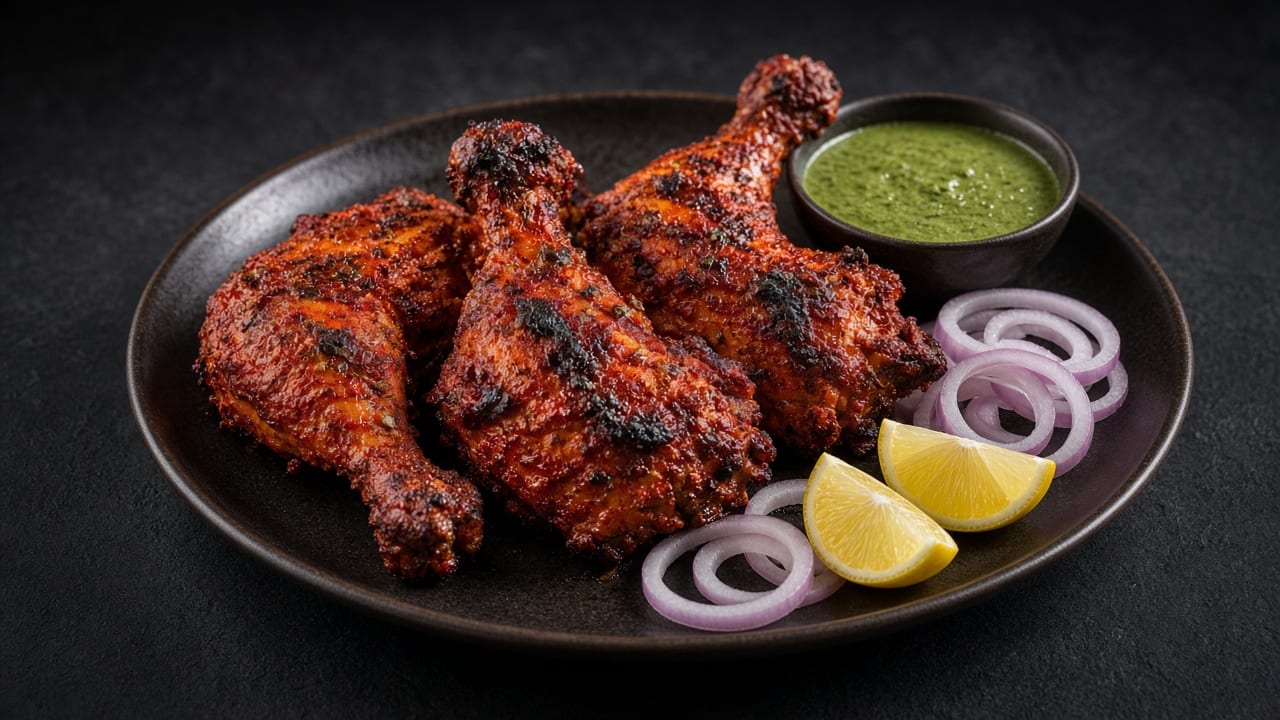
Tandoori Chicken
Inspired by techniques from NYT Cooking, America's Test Kitchen and Serious Eats.
Chicken legs double-marinated in lemon and then a spiced yoghurt mix, roasted hot and finished under the grill for char, served with a fresh mint and coriander chutney.
Always check the labels of the products you use.
Method
- 1
Slash the chicken. Cut 2-3 slashes through to the bone in each piece of chicken. This lets both marinades and the heat penetrate right through the meat rather than just seasoning the surface.
- 2
First marinade. Rub the chicken all over with the lemon juice and salt and leave for 20-30 minutes. The acid and salt begin seasoning the meat and help the thicker second marinade cling properly.
- 3
Second marinade. Mix the yoghurt with all the spices, ginger, garlic and oil, then coat the chicken thoroughly, working it into the slashes. Cover and refrigerate for 6-24 hours - the longer marinating time lets the spices and yoghurt's mild acidity tenderise the meat. About 30 minutes before cooking, heat the oven to 240°C (220°C fan) or its hottest setting, with a shelf in the top third.
- 4
Roast at high heat. Lift the chicken from the marinade, letting the excess drip off, onto the rack in the roasting tin, and roast for 25-30 minutes, turning once, until the thigh reaches 80°C and the edges are browned.
- 5
Char under the grill. Finish the chicken under a high grill (broiler) for 3-5 minutes until charred in spots, or over high direct heat on a barbecue if you have one. This brief blast of fierce heat mimics the scorch of a tandoor without drying the meat out, since it's already cooked through.
- 6
Make the chutney. Blend the mint, coriander, chilli, lemon juice, yoghurt and salt until smooth.
- 7
Serve. Serve the chicken with the onion rings, lemon wedges and chutney alongside.
Storage
Store cooked chicken in the fridge for up to 3 days. Reheat until piping hot throughout (74°C) in an oven or under the grill rather than the microwave, which won't recreate the charred edges. Cool leftovers in a shallow container and refrigerate within 2 hours (within 1 hour on a day above 32°C).
Why this label?
45.5 g protein for 365 kcal = 12.5 g per 100 kcal, so protein gives about 50% of the energy. High Protein needs at least 20% (5 g per 100 kcal), the condition in the Annex to EU Regulation (EC) No 1924/2006. How we decide
EU nutrition claims
- Low sugars: 1.8 g sugars per 100 g (limit ≤ 5 g)
Per 100 g of the finished dish, worked out from the nutrition per serving and the lowest likely cooked weight (about 202 g a serving), so the true values are, if anything, lower. Thresholds from the Annex to EU Regulation (EC) No 1924/2006. How we decide
Free sugars
0.3 g per serving
0.6 % of the 50 g daily maximum · 1.2 % of the ideal 25 g
Free sugars under 50 g a day, ideally about 25 g, based on WHO free-sugar guidance (not endorsed by WHO). The share shown is the share of one serving. WHO
Equipment
- large bowl
- roasting tin with a wire rack, lined with foil
- blender or small food processor
- instant-read thermometer
Nutrition per serving (estimated values)
| Per serving | Amount |
|---|---|
| Energy | 365 kcal |
| Protein | 45.5 g |
| Carbohydrate | 10 g |
| of which sugars | 3.6 g |
| of which free sugars | 0.3 g |
| Fat | 15.6 g |
| of which saturates | 3.3 g |
| Fibre | 2.5 g |
| Salt | 2.11 g |
Protein per 100 kcal
12.5 g meets High Protein (≥ 5 g, 20% of energy)
Calculated from USDA FoodData Central ingredient values