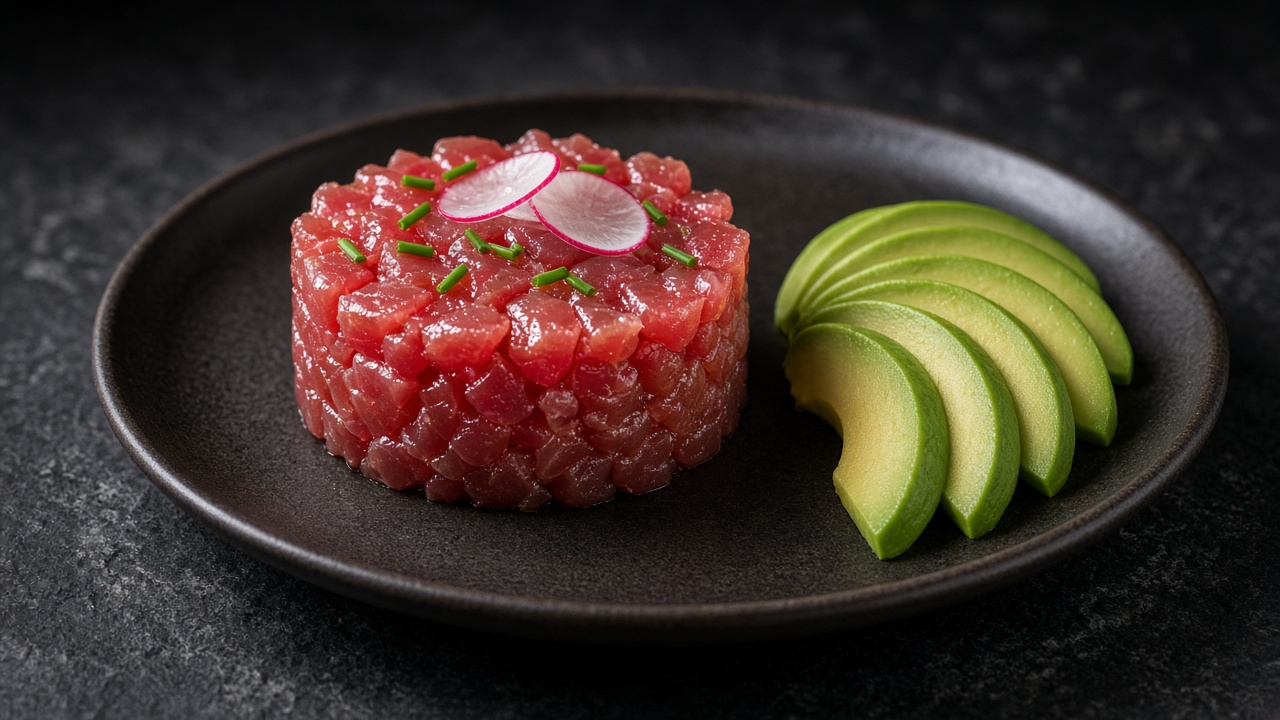
Tuna Tartare with Lime, Capers, Avocado and Radish
Inspired by techniques from NYT Cooking.
Finely diced raw tuna dressed with lime, olive oil, capers, chilli and coriander, moulded into rounds and served with fanned avocado, radish and chives.
Always check the labels of the products you use.
Method
- 1
Mellow the onion. Cover the diced onion with cold water for 5 min, then drain and pat it dry. The soak takes off its sharp edge so it does not overpower the tuna.
- 2
Dice the tuna. Cut the fish into 5 mm slices, then strips, then small, even cubes, and keep them in the bowl over ice. Even pieces give a neat look and a pleasant texture.
- 3
Whisk the dressing. Combine the lime juice, oil, garlic, chilli, capers, salt and pepper in the small bowl.
- 4
Mix at the last minute. No more than 10 min before eating, fold the dressing, onion and coriander through the tuna and leave it in the fridge for 5 min. Much longer and the lime begins to cure the fish, turning it opaque.
- 5
Mould and serve. Press a quarter of the tartare into the ring on each cold plate and lift it off. Slice the avocado, brush it with lime to stop browning, fan it beside the tartare and top with radish slices and chives.
Storage
Fish tartare must be eaten straight away; discard any leftovers.
Why this label?
25.6 g protein for 269 kcal = 9.5 g per 100 kcal, so protein gives about 38% of the energy. High Protein needs at least 20% (5 g per 100 kcal), the condition in the Annex to EU Regulation (EC) No 1924/2006. How we decide
EU nutrition claims
- Low saturated fat: 1.4 g saturated fat per 100 g, 8% of energy (limits ≤ 1.5 g and ≤ 10%)
- Low sugars: 0.7 g sugars per 100 g (limit ≤ 5 g)
Per 100 g of the finished dish, worked out from the nutrition per serving and the lowest likely cooked weight (about 170 g a serving), so the true values are, if anything, lower. Thresholds from the Annex to EU Regulation (EC) No 1924/2006. How we decide
Free sugars
0.2 g per serving
0.4 % of the 50 g daily maximum · 0.8 % of the ideal 25 g
Free sugars under 50 g a day, ideally about 25 g, based on WHO free-sugar guidance (not endorsed by WHO). The share shown is the share of one serving. WHO
Equipment
- sharp knife
- small bowl
- bowl set over ice
- 8 cm ring mould
- 4 chilled plates
Nutrition per serving (estimated values)
| Per serving | Amount |
|---|---|
| Energy | 269 kcal |
| Protein | 25.6 g |
| Carbohydrate | 6.2 g |
| of which sugars | 1.2 g |
| of which free sugars | 0.2 g |
| Fat | 16.1 g |
| of which saturates | 2.4 g |
| Fibre | 3.1 g |
| Salt | 0.99 g |
Protein per 100 kcal
9.5 g meets High Protein (≥ 5 g, 20% of energy)
Calculated from USDA FoodData Central ingredient values