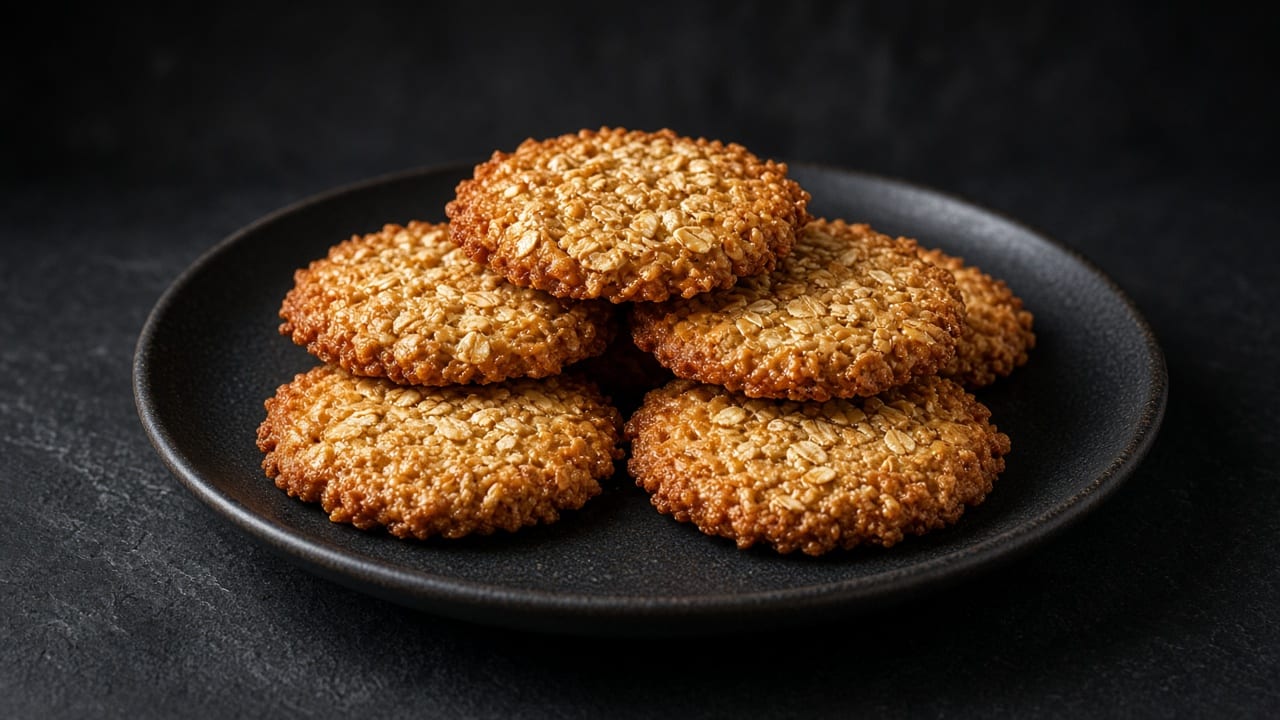
Anzac Biscuits
Inspired by techniques from King Arthur Baking and NYT Cooking.
Golden oat and coconut biscuits sweetened with golden syrup, egg-free and bakeable chewy or crunchy depending on how long you leave them in the oven.
Always check the labels of the products you use.
Method
- 1
Heat the oven. Heat the oven to 165°C (145°C fan) for at least 20 minutes, with a shelf in the middle. This lower temperature gives the oats and coconut time to toast through evenly without the edges burning before the centres cook. Line two large metal trays with baking paper while it heats.
- 2
Mix the dry ingredients. In a large bowl, mix the oats, flour, coconut, both sugars and the salt together. Combining the dry ingredients first means the butter mixture, once added, coats everything evenly rather than pooling in one spot. The brown sugar alongside the caster sugar adds a deeper, more caramel-like flavour than either would alone.
- 3
Melt butter and syrup. Melt the butter and golden syrup together in a small saucepan over low heat, stirring occasionally, until fully combined. Keeping the heat low stops the butter from browning or the syrup from scorching before it's even mixed in. There's no need to bring this to a simmer — just melted and smooth is enough.
- 4
Add the bicarbonate. Stir the bicarbonate of soda into the boiling water, where it will fizz up, then stir that straight into the warm butter mixture, which will foam considerably. Pour this foaming mixture directly into the dry ingredients and mix to a damp, clumpy dough. The fizzing reaction is what gives these biscuits their characteristic crisp, slightly open texture, since there's no egg to bind and aerate them instead.
- 5
Rest the dough. Leave the dough to rest for 5 minutes before shaping. This short rest lets the oats and coconut absorb a little of the liquid, making the dough easier to roll into balls without it feeling too wet. It also gives the fizzing reaction time to settle down.
- 6
Shape and flatten. Roll the dough into 30 g balls, spacing them 6 cm apart on the lined trays, since they spread considerably as they bake. Flatten each one slightly with your palm. Leaving enough room between them now avoids the biscuits merging into one another in the oven.
- 7
Bake to your preference. Bake one tray at a time for 14-18 minutes: around 14 minutes gives a golden, chewier biscuit, while baking closer to 18 minutes until deep amber gives a crunchier one. Baking only one tray at a time means the heat reaches every biscuit evenly, rather than one tray shielding the other from the oven's heat. Keep an eye on the colour towards the end, since the difference between chewy and crunchy is only a few minutes.
- 8
Cool on the tray. Leave the biscuits on the tray for 10 minutes before moving them, as they are soft and fragile straight from the oven and firm up considerably as they cool. Then transfer to a wire rack to finish cooling and crisp up fully. Makes about 20 biscuits.
Storage
Store in an airtight tin at room temperature for up to 2 weeks. They freeze well for up to 3 months; thaw at room temperature before serving.
Free sugars
9.8 g per serving
19.6 % of the 50 g daily maximum · 39.2 % of the ideal 25 g
Free sugars under 50 g a day, ideally about 25 g, based on WHO free-sugar guidance (not endorsed by WHO). The share shown is the share of one serving. WHO
Equipment
- 2 large metal baking trays lined with baking paper
- large bowl
- small saucepan
- wire rack
Nutrition per serving (estimated values)
| Per serving | Amount |
|---|---|
| Energy | 154 kcal |
| Protein | 1.7 g |
| Carbohydrate | 19.6 g |
| of which sugars | 10.2 g |
| of which free sugars | 9.8 g |
| Fat | 8 g |
| of which saturates | 5.6 g |
| Fibre | 1.3 g |
| Salt | 0.25 g |
Protein per 100 kcal
1.1 g High Protein needs ≥ 5 g (20% of energy)
Calculated from USDA FoodData Central ingredient values