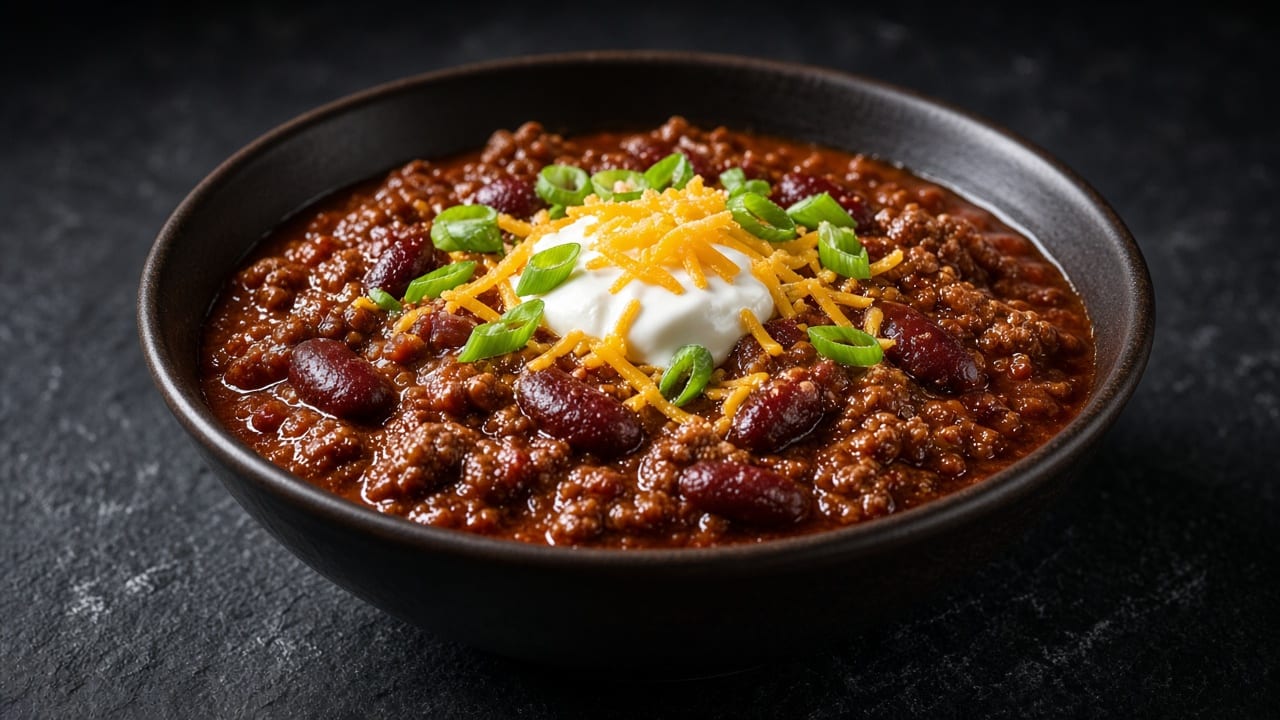
Big-Batch Beef and Bean Chili
Inspired by techniques from America's Test Kitchen and Serious Eats.
A deeply savoury, slow-simmered beef and bean chili with a rich spiced sauce built from properly browned mince and toasted spices. It's a big-batch dinner perfect for feeding a crowd or freezing in portions.
Based on the listed ingredients, none of the 14 major EU allergens. Always check product labels.
Method
- 1
Brown the beef in batches. Heat the oil in a 5-6 litre casserole over high heat, then add a third of the mince and press it into a flat layer. Leave it for 3-4 minutes until deeply browned underneath before breaking it up, turning, and cooking for a further 2 minutes; lift out with a slotted spoon and repeat with the remaining two batches. Lean mince has little fat to render, so it needs that oil and plenty of space — crowd the pan and the meat steams instead of browning, losing the rich flavour that proper browning (the Maillard reaction) gives.
- 2
Soften onion and pepper. With the beef out of the pan, add the chopped onions and red pepper to the drippings left behind and cook over medium heat for 8-10 minutes until soft, scraping up any browned bits stuck to the base as you go. Those stuck-on bits are packed with flavour from the beef, and working them back into the vegetables builds the base of the chili.
- 3
Toast the spices. Once the vegetables have softened, stir in the garlic, chili powder blend, cumin, smoked paprika, oregano, cinnamon and cocoa powder, and cook for 1 minute until fragrant, then add the tomato purée and cook for a further minute. Toasting dried spices briefly in the hot fat wakes up their oils and deepens their flavour, while the cocoa adds a savoury background note rather than any sweetness.
- 4
Simmer the base. Return the browned beef to the pan along with the chopped tomatoes, water, salt and pepper. Bring to the boil, then reduce to a gentle simmer with the lid slightly ajar and cook for 45 minutes, stirring every 10-15 minutes and scraping the bottom so the thickening sauce doesn't catch and burn.
- 5
Stir in the beans. Fifteen minutes before serving, add the drained kidney beans and simmer uncovered until thick and rich — a spoon drawn through the chili should leave a path that slowly fills back in. Loosen with a splash of water if it looks too thick; by now the beef is well beyond the 71°C needed for safety. Adding the beans this late keeps them intact rather than breaking down into mush.
- 6
Rest and serve. Taste and adjust the salt, then let the chili rest off the heat for 10 minutes so the flavours can settle and it cools enough not to scald straight from the pot. Serve with rice, tortilla chips or baked potatoes and your choice of toppings.
Storage
Cool within 2 hours, then keep in the fridge for up to 4 days or freeze in portions for up to 3 months. Thaw overnight in the fridge and reheat until piping hot throughout (74°C), stirring in a splash of water if needed.
Why this label?
33.7 g protein for 311 kcal = 10.8 g per 100 kcal, so protein gives about 43% of the energy. High Protein needs at least 20% (5 g per 100 kcal), the condition in the Annex to EU Regulation (EC) No 1924/2006. How we decide
- Total fat: 26.6 % of energy (limit ≤ 30%)
- Saturated fat: 9.3 % of energy (limit < 10%)
- Free sugars: 0 % of energy (limit < 10%)
- Salt: 1.51 g (limit ≤ 1.7 g)
- Fibre or fruit & veg: 7.6 g fibre / 158 g veg (limit ≥ 3.9 g fibre or 80 g fruit & veg)
Per serving, worked out from the nutrition table against our rule based on the WHO healthy diet guidance. Not endorsed by WHO.
EU nutrition claims
- Low sugars: 4.1 g sugars per 100 g (limit ≤ 5 g)
- Source of fibre: 2.4 g fibre per 100 kcal (needs ≥ 1.5 g)
Per 100 g of the finished dish, worked out from the nutrition per serving and the lowest likely cooked weight (about 186 g a serving), so the true values are, if anything, lower. Thresholds from the Annex to EU Regulation (EC) No 1924/2006. How we decide
Free sugars
0 g per serving
0 % of the 50 g daily maximum · 0 % of the ideal 25 g
Free sugars under 50 g a day, ideally about 25 g, based on WHO free-sugar guidance (not endorsed by WHO). The share shown is the share of one serving. WHO
Equipment
- large heavy casserole or stockpot (5-6 litres) with lid
- wooden spoon
- sieve
- instant-read thermometer (optional)
Nutrition per serving (estimated values)
| Per serving | Amount |
|---|---|
| Energy | 311 kcal |
| Protein | 33.7 g |
| Carbohydrate | 24.1 g |
| of which sugars | 7.7 g |
| of which free sugars | 0 g |
| Fat | 9.2 g |
| of which saturates | 3.2 g |
| Fibre | 7.6 g |
| Salt | 1.51 g |
Protein per 100 kcal
10.8 g meets High Protein (≥ 5 g, 20% of energy)
Calculated from USDA FoodData Central ingredient values