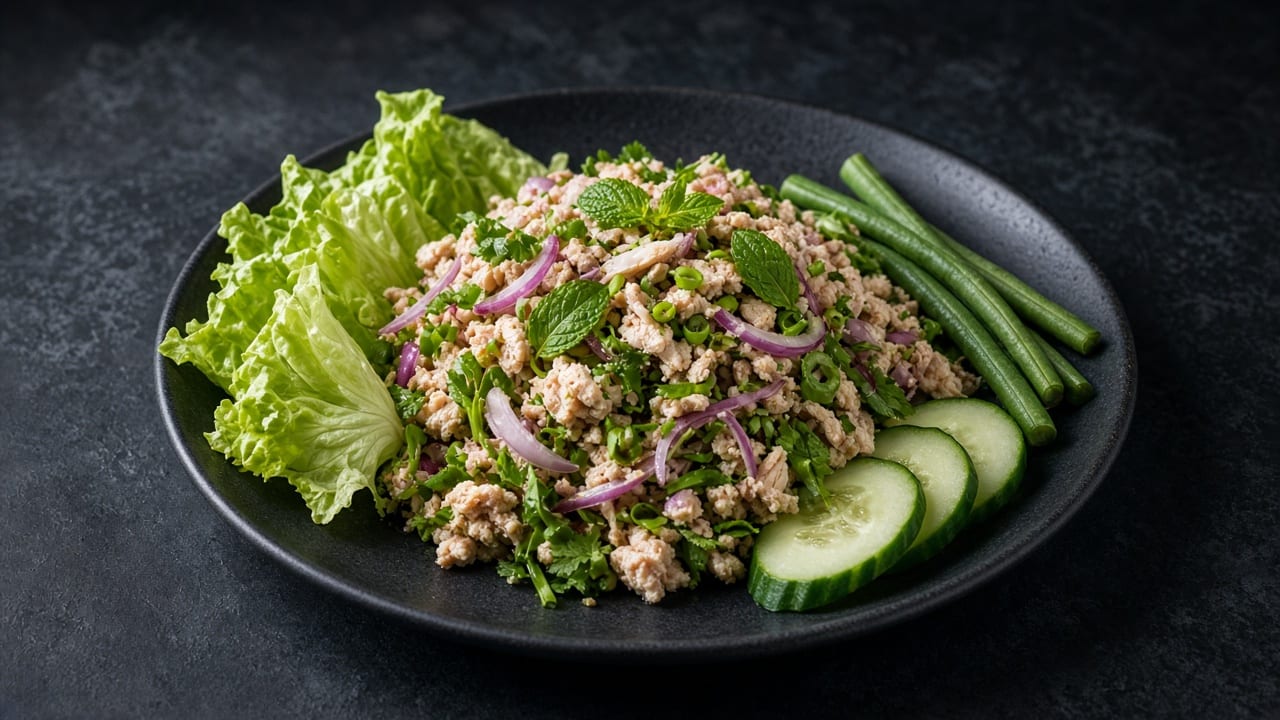
Beef Larb with Toasted Rice, Lime and Fresh Herbs
Inspired by techniques from NYT Cooking.
A warm Thai minced beef salad lifted with lime, fish sauce, fresh herbs and toasted rice powder for its signature crunch.
Always check the labels of the products you use.
Method
- 1
Toast the rice. Toast the raw rice in a dry frying pan over medium heat, stirring often, for 6-10 minutes until it turns deep golden and smells nutty. Leave it to cool, then grind it to a coarse powder with the texture of semolina. This toasted rice powder is what gives larb its characteristic crunch and faintly smoky flavour.
- 2
Mix the dressing. In a large bowl, stir together the shallots, fish sauce, lime juice, sugar and chilli flakes, using less chilli flakes if you'd prefer a milder salad. Leave this while you cook the beef. The lime juice's acidity softens the raw shallot as it sits, taking away any harsh bite.
- 3
Cook the beef. Heat the large frying pan or wok over medium heat, add the beef and water, and cook for 5-6 minutes, breaking the meat into small crumbs as it goes. Cook it through until no red remains and it reaches 71°C in the centre, but don't let it brown - larb should be tender, not crisp and caramelised. Let it cool for 3-5 minutes, then lift it into the dressing with a slotted spoon, leaving the fat behind in the pan.
- 4
Add the herbs. Stir most of the coriander, mint and spring onion into the beef along with two-thirds of the toasted rice powder. Taste and add more rice powder if you'd like extra crunch, aiming for a balance of sour, salty and hot. The rice powder also helps bind the dressing to the meat so every spoonful is seasoned evenly.
- 5
Serve. Scatter the reserved herbs over the top and serve the larb warm or at room temperature, with lettuce leaves, cucumber spears and beans alongside for scooping. For a gentler version, use fewer chilli flakes when mixing the dressing. Eat it freshly made, as the herbs wilt and lose their brightness if it sits too long.
Storage
Leftovers keep in the fridge for up to 2 days in a covered container, though the herbs will lose some crispness. Reheat gently in a pan or microwave until piping hot all the way through (74°C) before eating, or enjoy cold straight from the fridge. Cool leftovers in a shallow container and refrigerate within 2 hours (within 1 hour on a day above 32°C).
Why this label?
28 g protein for 291 kcal = 9.6 g per 100 kcal, so protein gives about 38% of the energy. High Protein needs at least 20% (5 g per 100 kcal), the condition in the Annex to EU Regulation (EC) No 1924/2006. How we decide
EU nutrition claims
- Low sugars: 2.5 g sugars per 100 g (limit ≤ 5 g)
Per 100 g of the finished dish, worked out from the nutrition per serving and the lowest likely cooked weight (about 179 g a serving), so the true values are, if anything, lower. Thresholds from the Annex to EU Regulation (EC) No 1924/2006. How we decide
Free sugars
1 g per serving
2 % of the 50 g daily maximum · 4 % of the ideal 25 g
Free sugars under 50 g a day, ideally about 25 g, based on WHO free-sugar guidance (not endorsed by WHO). The share shown is the share of one serving. WHO
Equipment
- small dry frying pan
- mortar and pestle or spice grinder
- large frying pan or wok
- instant-read thermometer
- large bowl
- slotted spoon
Nutrition per serving (estimated values)
| Per serving | Amount |
|---|---|
| Energy | 291 kcal |
| Protein | 28 g |
| Carbohydrate | 15.9 g |
| of which sugars | 4.5 g |
| of which free sugars | 1 g |
| Fat | 12.8 g |
| of which saturates | 5 g |
| Fibre | 2.9 g |
| Salt | 1.58 g |
Protein per 100 kcal
9.6 g meets High Protein (≥ 5 g, 20% of energy)
Calculated from USDA FoodData Central ingredient values