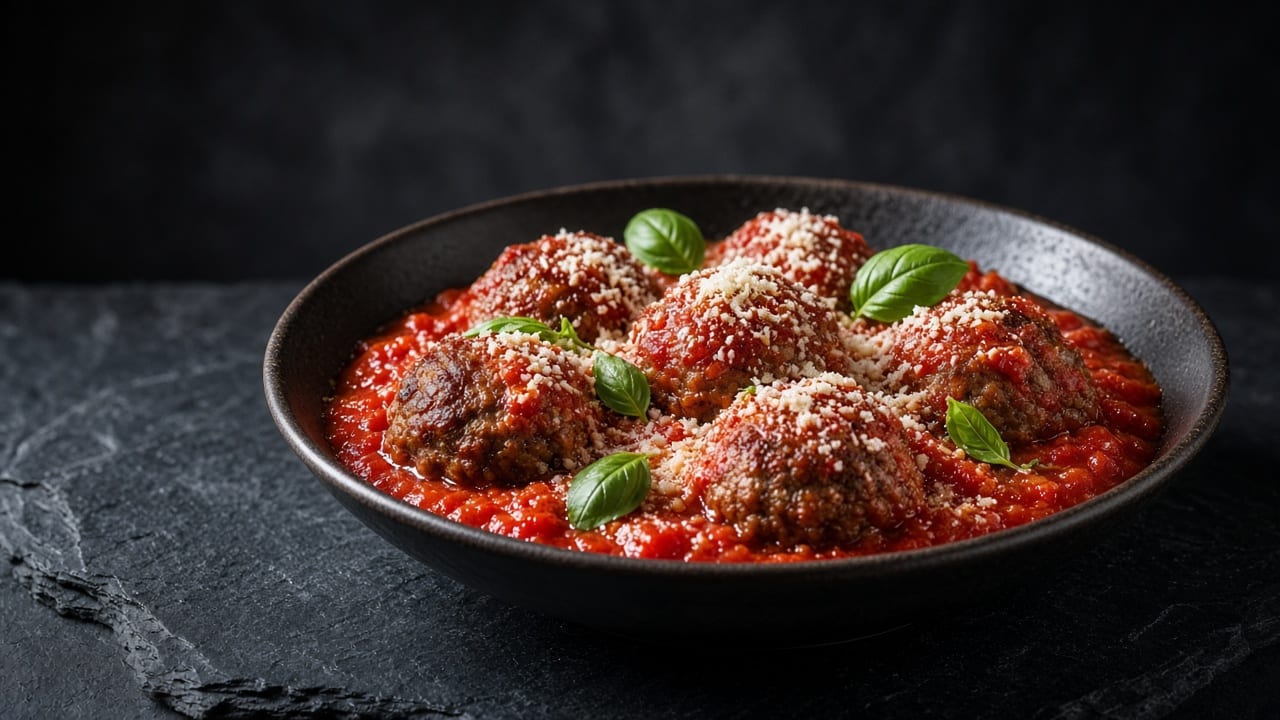
Beef Meatballs in Tomato Sauce
Inspired by techniques from NYT Cooking and America's Test Kitchen.
Tender beef meatballs, kept moist with a soaked-bread panade, are browned in the oven then finished gently in a simple garlic and chilli tomato sauce.
Always check the labels of the products you use.
Method
- 1
Make the panade. Soak the torn bread in the milk for 5 minutes, then mash it to a smooth paste with a fork. This soaked starch acts like a sponge inside the meatballs, holding onto moisture so they stay tender even once fully cooked through.
- 2
Mix and shape. Add the beef mince, egg, 25 g of the parmesan, grated garlic, parsley, and the meatball salt and pepper to the bread paste. Mix with your hands for about 1 minute, just until evenly combined and slightly tacky — overworking it at this stage makes the meatballs dense rather than light. With wet hands, roll into 20 balls of about 50g each, set on the oiled, lined tray, and chill for 15 minutes while the oven heats to 220°C (200°C fan).
- 3
Brown in the oven. Roast the meatballs for 12-14 minutes, until browned on top. Baking them this way colours them evenly on all sides without turning or splashing hot fat, and they'll finish cooking through once they go into the sauce.
- 4
Build the sauce. Meanwhile, warm the olive oil in the large pan over medium heat and cook the onion for 6-8 minutes until soft and golden. Add the sliced garlic and chilli flakes for 1 minute, then stir in the passata, sauce salt and sugar if the tomatoes taste sharp, and simmer for 10 minutes to let the flavours settle together.
- 5
Simmer and serve. Add the browned meatballs and any tray juices to the sauce, cover and simmer gently for 10-12 minutes, turning once, until a probe thermometer in the centre of a large meatball reads 71°C. Tear over the basil leaves and serve with the extra parmesan.
Storage
Keeps in a sealed container in the fridge for up to 3 days, or frozen for up to 3 months. Reheat in a covered pan over low heat, or in the microwave, stirring occasionally, until piping hot throughout (74°C). Cool leftovers in a shallow container and refrigerate within 2 hours (within 1 hour on a day above 32°C).
Why this label?
45.4 g protein for 705 kcal = 6.4 g per 100 kcal, so protein gives about 26% of the energy. High Protein needs at least 20% (5 g per 100 kcal), the condition in the Annex to EU Regulation (EC) No 1924/2006. How we decide
EU nutrition claims
- Low sugars: 4.1 g sugars per 100 g (limit ≤ 5 g)
Per 100 g of the finished dish, worked out from the nutrition per serving and the lowest likely cooked weight (about 322 g a serving), so the true values are, if anything, lower. Thresholds from the Annex to EU Regulation (EC) No 1924/2006. How we decide
Free sugars
1.8 g per serving
3.6 % of the 50 g daily maximum · 7.2 % of the ideal 25 g
Free sugars under 50 g a day, ideally about 25 g, based on WHO free-sugar guidance (not endorsed by WHO). The share shown is the share of one serving. WHO
Equipment
- large mixing bowl
- rimmed baking tray lined with baking paper
- large deep frying pan or sauté pan with a lid (28 cm)
- instant-read probe thermometer
- wooden spoon
- fine grater
Nutrition per serving (estimated values)
| Per serving | Amount |
|---|---|
| Energy | 705 kcal |
| Protein | 45.4 g |
| Carbohydrate | 32.1 g |
| of which sugars | 13.2 g |
| of which free sugars | 1.8 g |
| Fat | 44.3 g |
| of which saturates | 15.2 g |
| Fibre | 4.7 g |
| Salt | 2.66 g |
Protein per 100 kcal
6.4 g meets High Protein (≥ 5 g, 20% of energy)
Calculated from USDA FoodData Central ingredient values