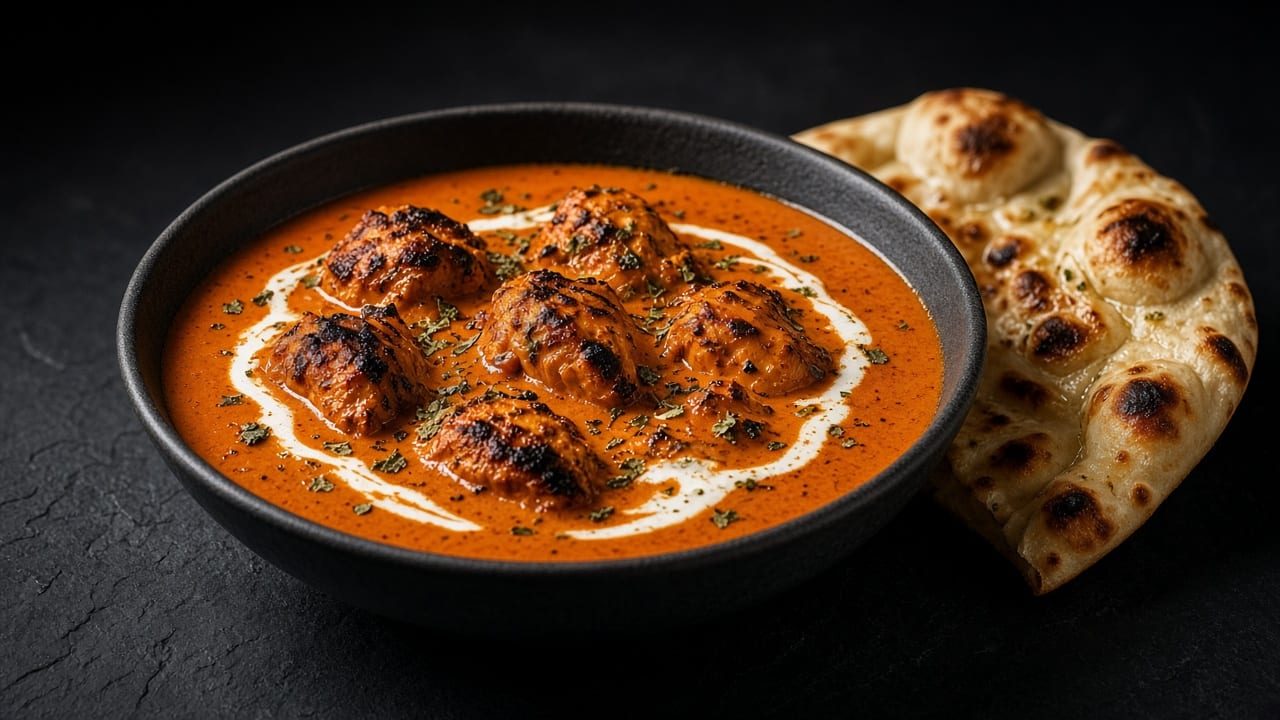
Butter Chicken
Inspired by techniques from Serious Eats and NYT Cooking.
Yoghurt-marinated chicken thighs are charred under the grill, then finished in a buttery tomato, cream and garam masala sauce.
Always check the labels of the products you use.
Method
- 1
Marinate the chicken. Mix the chicken with the yoghurt, garam masala, chilli powder and salt, then cover and refrigerate for 1-12 hours. The yoghurt's mild acidity tenderises the meat while the spices start to flavour it right through.
- 2
Char under the grill. Spread the marinated chicken on the rack and grill (broiler) on high for 8-10 minutes, turning once, until charred at the edges. It doesn't need to be fully cooked yet, since it will finish gently in the sauce.
- 3
Build the sauce base. Melt the butter with the oil in the pan over medium heat, then cook the onion with a pinch of salt for 8-10 minutes until soft and golden. Add the garlic and ginger for 1 minute, then the ground spices, apart from the sauce's garam masala, for 30 seconds until fragrant - this brief blooming in hot fat is what wakes up their flavour.
- 4
Simmer the tomato base. Stir in the tomato purée for 1 minute, then add the tinned tomatoes, water and salt. Simmer for 10-12 minutes until thickened, then blend the sauce smooth, taking care as it will be hot.
- 5
Finish and cook the chicken through. Return the sauce to the pan and add the chicken and any juices and simmer gently for 4-5 minutes, then stir in the cream, fenugreek leaves and the sauce's garam masala and simmer for 4-5 minutes more, until the chicken reaches 74°C and the sauce is thick enough to coat the back of a spoon.
- 6
Taste and serve. Taste the sauce and add the sugar only if the tomatoes taste sharp. Scatter with coriander and serve with rice or naan.
Storage
Keep in the fridge for up to 3 days or freeze for up to 2 months. Thaw in the fridge and reheat gently, stirring often, until piping hot throughout (74°C). Cool leftovers in a shallow container and refrigerate within 2 hours (within 1 hour on a day above 32°C).
Why this label?
39.3 g protein for 504 kcal = 7.8 g per 100 kcal, so protein gives about 31% of the energy. High Protein needs at least 20% (5 g per 100 kcal), the condition in the Annex to EU Regulation (EC) No 1924/2006. How we decide
EU nutrition claims
- Low sugars: 3.8 g sugars per 100 g (limit ≤ 5 g)
Per 100 g of the finished dish, worked out from the nutrition per serving and the lowest likely cooked weight (about 272 g a serving), so the true values are, if anything, lower. Thresholds from the Annex to EU Regulation (EC) No 1924/2006. How we decide
Free sugars
1 g per serving
2 % of the 50 g daily maximum · 4 % of the ideal 25 g
Free sugars under 50 g a day, ideally about 25 g, based on WHO free-sugar guidance (not endorsed by WHO). The share shown is the share of one serving. WHO
Equipment
- large bowl
- foil-lined baking tray with a rack
- large deep frying pan or sauté pan (28 cm)
- stick blender or blender
- instant-read thermometer
Nutrition per serving (estimated values)
| Per serving | Amount |
|---|---|
| Energy | 504 kcal |
| Protein | 39.3 g |
| Carbohydrate | 18.5 g |
| of which sugars | 10.3 g |
| of which free sugars | 1 g |
| Fat | 31.1 g |
| of which saturates | 14.9 g |
| Fibre | 4 g |
| Salt | 2.41 g |
Protein per 100 kcal
7.8 g meets High Protein (≥ 5 g, 20% of energy)
Calculated from USDA FoodData Central ingredient values