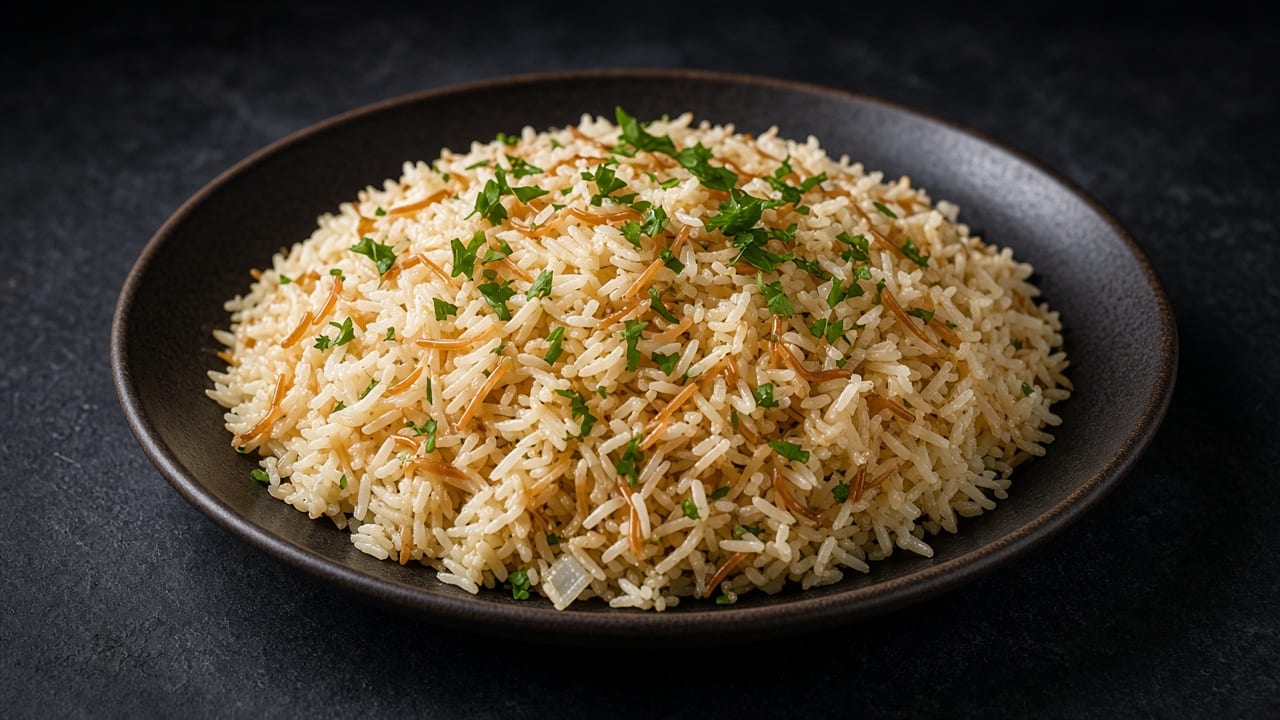
Buttery Rice Pilaf with Toasted Vermicelli and Herbs
Inspired by techniques from America's Test Kitchen, NYT Cooking and Serious Eats.
A classic buttery pilaf where broken vermicelli is toasted until golden before the rice goes in, giving every spoonful a nutty crunch alongside fresh herbs.
Always check the labels of the products you use.
Method
- 1
Rinse the Rice. Tip the rice into the sieve and rinse under cold running water, rubbing the grains gently between your fingers, until the water runs almost clear, about 1 minute. Leave it to drain for 10 minutes. This washes away loose surface starch that would otherwise make the cooked grains clump together.
- 2
Toast the Vermicelli. Melt the butter in the saucepan over medium heat, then add the vermicelli pieces and stir for 3-4 minutes until evenly golden brown. Watch closely towards the end, since the pale strands can turn from golden to burnt within seconds. The toasting builds a nutty, savoury flavour that runs through the whole pilaf.
- 3
Soften Onion, Coat Rice. Stir in the chopped onion and cook for 3-4 minutes until soft but not coloured, then add the drained rice. Stir for 2 minutes more, until every grain is glossy with butter and the edges look slightly translucent. Coating the rice in fat this way helps the grains stay separate once the liquid is added.
- 4
Simmer Until Absorbed. Pour in the hot stock, add the salt and pepper, stir once, and bring everything to a full rolling boil. Cover tightly, drop the heat to its lowest setting and cook for 15 minutes without lifting the lid, until the surface is dotted with small steam holes and the liquid has disappeared. Keeping the lid shut traps steam evenly around the grains so they cook through without turning mushy.
- 5
Rest Under a Towel. Remove the pan from the heat, lift the lid, and lay the folded tea towel over the rice before replacing the lid. Leave it for 10 minutes undisturbed. The towel soaks up condensation that would otherwise drip back in, so the grains finish drying and firm up nicely.
- 6
Fluff and Finish. Fluff the rice gently with the fork, folding through half the chopped herbs as you go. Scatter the remaining herbs over the top just before serving. A fork rather than a spoon keeps the grains whole instead of crushing them into a paste.
Storage
Cool the cooked pilaf quickly by spreading it out on a tray, then refrigerate within 1 hour and use within 24 hours. Reheat only once, until piping hot all the way through (74°C).
EU nutrition claims
- Low sugars: 1.2 g sugars per 100 g (limit ≤ 5 g)
Per 100 g of the finished dish, worked out from the nutrition per serving and the lowest likely cooked weight (about 174 g a serving), so the true values are, if anything, lower. Thresholds from the Annex to EU Regulation (EC) No 1924/2006. How we decide
Free sugars
0 g per serving
0 % of the 50 g daily maximum · 0 % of the ideal 25 g
Free sugars under 50 g a day, ideally about 25 g, based on WHO free-sugar guidance (not endorsed by WHO). The share shown is the share of one serving. WHO
Equipment
- sieve
- medium heavy saucepan (about 2.5 litres) with a tight lid
- clean tea towel
- fork
Nutrition per serving (estimated values)
| Per serving | Amount |
|---|---|
| Energy | 384 kcal |
| Protein | 8 g |
| Carbohydrate | 70.7 g |
| of which sugars | 2.1 g |
| of which free sugars | 0 g |
| Fat | 7.1 g |
| of which saturates | 4 g |
| Fibre | 1.8 g |
| Salt | 1.7 g |
Protein per 100 kcal
2.1 g High Protein needs ≥ 5 g (20% of energy)
Calculated from USDA FoodData Central ingredient values