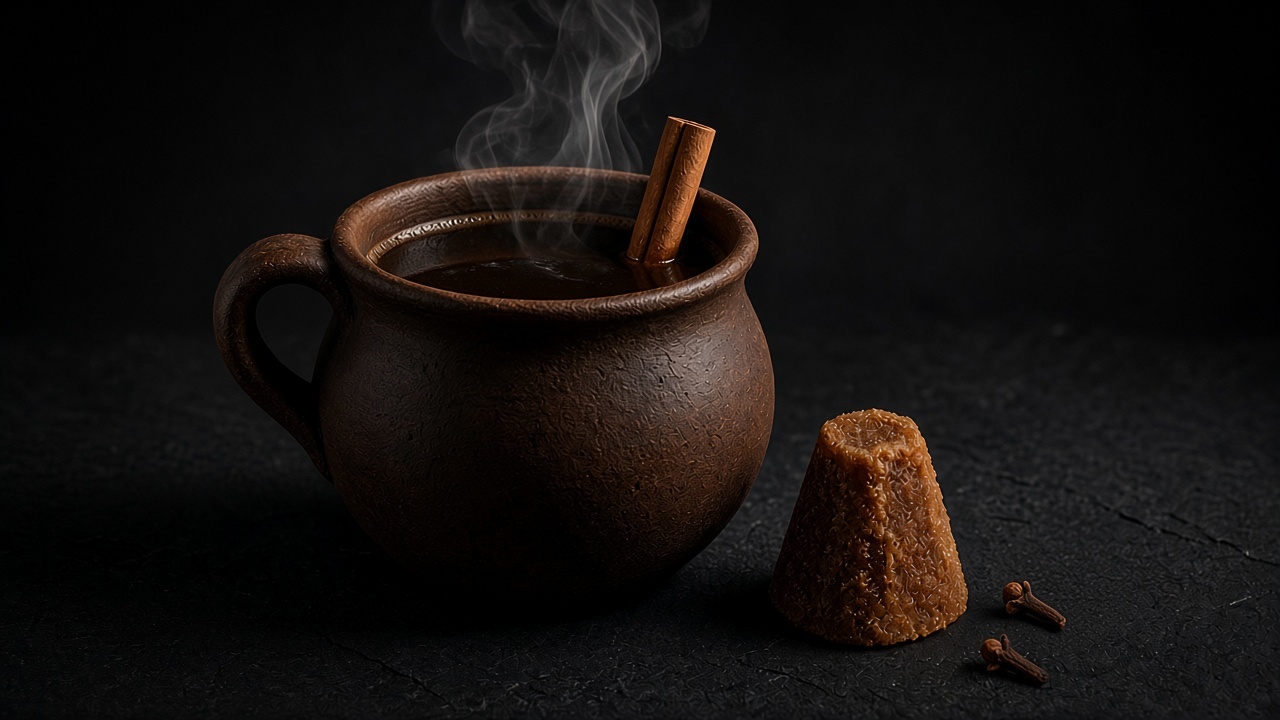
Café de Olla with Piloncillo and Cinnamon
Inspired by techniques from Bon Appétit and Rick Bayless.
Mexican spiced coffee: water gently warmed with piloncillo, cinnamon and clove, then steeped with dark-roast coffee and orange peel and strained.
Based on the listed ingredients, none of the 14 major EU allergens. Always check product labels.
Method
- 1
Dissolve. Put the water, piloncillo (or brown sugar and molasses), cinnamon and cloves in the pot and warm over medium heat, stirring often, until the sugar has melted. Keep it below a boil, at a bare tremble, for 5 minutes.
- 2
Steep. Take the pot off the heat, stir in the coffee and orange peel, cover and leave for 7 minutes. Steeping off the heat keeps the coffee from turning bitter.
- 3
Strain. Pour slowly through the lined sieve into a heatproof jug, so the grounds stay behind.
- 4
Serve. Ladle into mugs while hot. A cinnamon stick in each mug is a nice touch.
Storage
Keep covered in the fridge for up to 2 days and reheat gently without boiling. Cool leftovers in a shallow container and refrigerate within 2 hours (within 1 hour on a day above 32°C).
EU nutrition claims
- Low fat: 0 g fat per 100 ml (limit ≤ 1.5 g)
- Low saturated fat: 0 g saturated fat per 100 ml, 0% of energy (limits ≤ 0.75 g and ≤ 10%)
- Low salt: 0.01 g salt per 100 ml (limit ≤ 0.3 g)
Per 100 ml of the finished dish, worked out from the nutrition per serving and the lowest likely cooked weight (about 181 ml a serving), so the true values are, if anything, lower. Thresholds from the Annex to EU Regulation (EC) No 1924/2006. How we decide
Caffeine · Free sugars
- Per serving: about 93 mg caffeine (serving: 1 cup (about 233 ml)). Source: about 233 ml brewed per serving × USDA FDC SR Legacy #171890 (brewed coffee, 40 mg/100 g).
- Scaling: making more servings does not change the caffeine in each serving; what counts is how many servings you drink in a day. 1 serving: 93 mg · 2 servings: 186 mg · 3 servings: 279 mg (above EFSA 200 mg at once) · 4 servings: 372 mg (above EFSA 200 mg at once).
- General guideline: EFSA Scientific Opinion on the safety of caffeine (2015): for healthy adults, up to 200 mg in a single dose and up to 400 mg per day do not raise safety concerns. 1 serving = 23 % of 400 mg. EFSA
17 g per serving
34 % of the 50 g daily maximum · 68 % of the ideal 25 g
Free sugars under 50 g a day, ideally about 25 g, based on WHO free-sugar guidance (not endorsed by WHO). The share shown is the share of one serving. WHO
Equipment
- clay pot (olla) or medium saucepan
- wooden spoon
- fine-mesh sieve lined with a coffee filter or paper towel
- heatproof jug
- mugs
Nutrition per serving (estimated values)
| Per serving | Amount |
|---|---|
| Energy | 69 kcal |
| Protein | 0.3 g |
| Carbohydrate | 17.4 g |
| of which sugars | 17 g |
| of which free sugars | 17 g |
| Fat | 0 g |
| of which saturates | 0 g |
| Fibre | 0.1 g |
| Salt | 0.02 g |
Protein per 100 kcal
0.4 g High Protein needs ≥ 5 g (20% of energy)
Calculated from USDA FoodData Central ingredient values