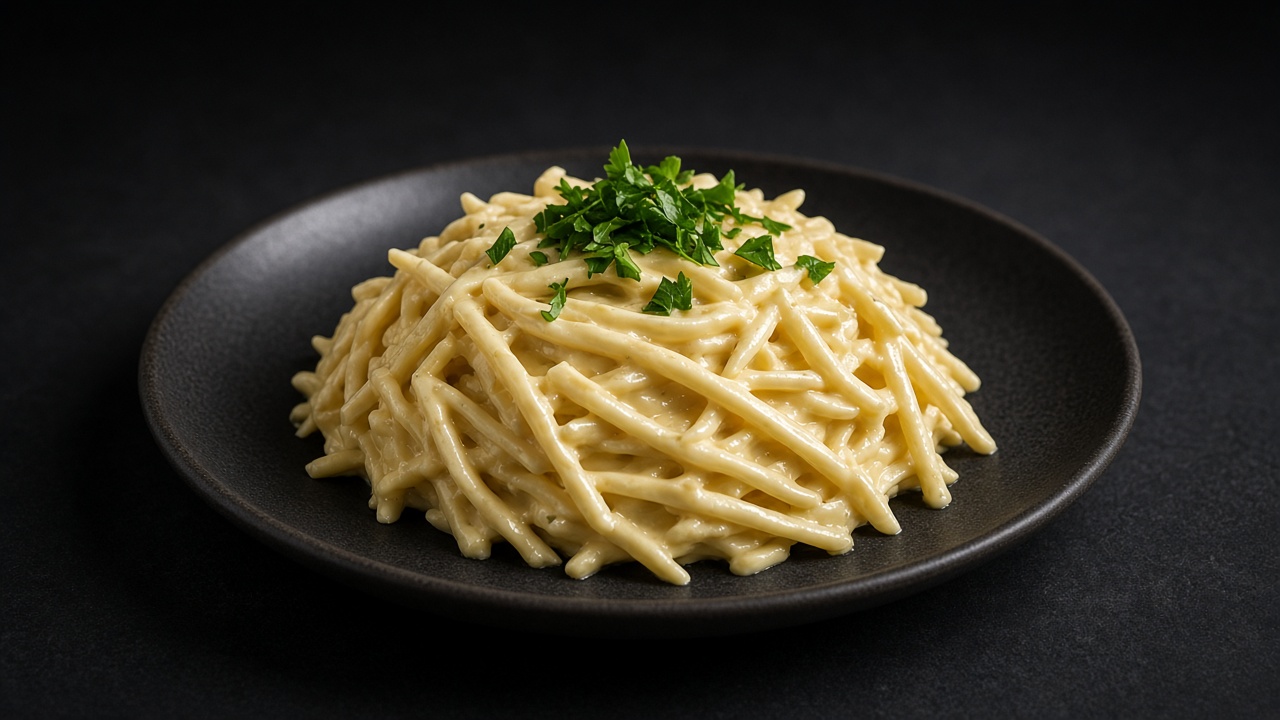
Celeriac Rémoulade with Mustard, Lemon and Parsley
Inspired by techniques from NYT Cooking and America's Test Kitchen.
A French bistro classic of finely shredded celeriac in a creamy, lemony mustard dressing, lifted with fresh parsley and chives.
Always check the labels of the products you use.
Method
- 1
Prep the celeriac. Slice the top and base off the celeriac, then cut away the knobbly skin following its curve, trimming off any stubborn brown bits with a small knife. Quarter it and shred into fine matchsticks using a food processor's grating disc or a julienne peeler. Cutting it this way, rather than grating finely, gives the rémoulade a pleasant bite instead of turning to mush.
- 2
Wilt the celeriac. Toss the shredded celeriac with the salt and 1 tbsp of lemon juice in a colander, then leave it for 20-30 minutes. The salt draws out moisture and softens the raw crunch slightly, while the lemon stops it browning. Squeeze it firmly in a clean tea towel, a handful at a time, to get rid of the excess liquid.
- 3
Make the dressing. Stir the mustard powder with the cold water in a small bowl and leave it for 10 minutes to let its heat develop fully. Mix in the mayonnaise, yoghurt, lemon juice and pepper until smooth - the dressing should be a touch looser than plain mayonnaise, so add a teaspoon more water if it feels thick. Letting the mustard powder sit in water first brings out more flavour than adding it dry.
- 4
Dress and chill. Toss the squeezed celeriac with the dressing and most of the parsley and chives, then taste and adjust the salt and lemon to your liking. Chill for 1 hour before serving, as the flavours mellow and the texture turns pleasantly tender in that time. Scatter the remaining herbs over the top just before bringing it to the table.
Storage
Keep covered in the fridge for up to 2 days; the celeriac will soften slightly but stays good to eat. This salad isn't suitable for freezing, as the mayonnaise and yoghurt will separate. Cool leftovers in a shallow container and refrigerate within 2 hours (within 1 hour on a day above 32°C).
EU nutrition claims
- Low sugars: 1.7 g sugars per 100 g (limit ≤ 5 g)
Per 100 g of the finished dish, worked out from the nutrition per serving and the lowest likely cooked weight (about 132 g a serving), so the true values are, if anything, lower. Thresholds from the Annex to EU Regulation (EC) No 1924/2006. How we decide
Free sugars
0.2 g per serving
0.4 % of the 50 g daily maximum · 0.8 % of the ideal 25 g
Free sugars under 50 g a day, ideally about 25 g, based on WHO free-sugar guidance (not endorsed by WHO). The share shown is the share of one serving. WHO
Equipment
- sharp chef's knife
- food processor with grating disc or julienne peeler
- colander
- clean tea towel
- large bowl
- small bowl
Nutrition per serving (estimated values)
| Per serving | Amount |
|---|---|
| Energy | 172 kcal |
| Protein | 2.9 g |
| Carbohydrate | 10.5 g |
| of which sugars | 2.3 g |
| of which free sugars | 0.2 g |
| Fat | 13.7 g |
| of which saturates | 2.3 g |
| Fibre | 2 g |
| Salt | 0.96 g |
Protein per 100 kcal
1.7 g High Protein needs ≥ 5 g (20% of energy)
Calculated from USDA FoodData Central ingredient values