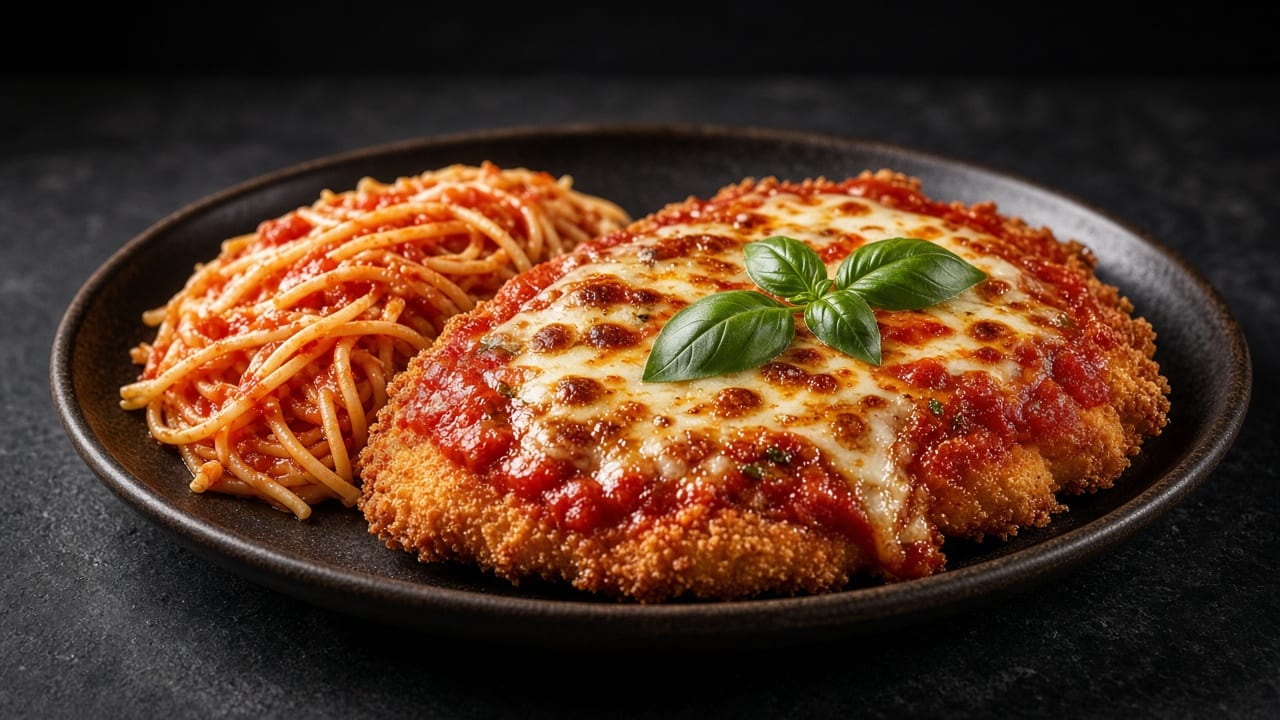
Chicken Parmigiana with Spaghetti
Inspired by techniques from America's Test Kitchen and Serious Eats.
Crumbed chicken cutlets are fried until golden, topped with tomato sauce and melted mozzarella, then served over spaghetti.
Always check the labels of the products you use.
Method
- 1
Simmer the tomato sauce. Warm the olive oil and garlic in a saucepan over medium-low heat for 1-2 minutes until pale gold, then add the no-added-salt tomatoes, oregano, the ¼ tsp salt and a few basil stems. Simmer for 15-20 minutes until thickened, then taste and adjust the seasoning.
- 2
Flatten and season the chicken. Pound the cutlets between cling film to an even 6 mm thickness, then season with the salt and pepper.
- 3
Coat the cutlets. Dip each cutlet in flour, then beaten egg, then the panko mixed with parmesan, pressing the crumb on firmly so it holds.
- 4
Fry until golden. Heat the oil to about 1 cm deep in the frying pan over medium-high until it reaches around 175°C, hot enough that a crumb sizzles instantly. Fry the cutlets 2 at a time for about 2 minutes per side until deep golden and the centre reaches 74°C, then drain on the rack.
- 5
Grill with sauce and cheese. Heat the grill (broiler) to high. Set the cutlets on the rack-lined tray, spoon 2 tbsp of sauce onto the centre of each, leaving the crisp edges bare, then top with the mozzarella and parmesan. Grill for 3-4 minutes until the cheese is melted, bubbling and browned in spots.
- 6
Cook the pasta and serve. While the cutlets grill, cook the spaghetti in 1.5 litres of boiling water salted with 7.5 g (1¼ tsp) salt - a light 0.5% because the sauce and cheese are already salty - for 1 minute less than the packet suggests, then drain and toss with most of the remaining sauce. Serve the cutlets on the spaghetti, scattered with basil.
Storage
Store sauce and cooked cutlets separately in the fridge for up to 3 days. Reheat cutlets in the oven or under the grill until piping hot (74°C) to keep the crumb crisp; a microwave will make it soggy. Cool leftovers in a shallow container and refrigerate within 2 hours (within 1 hour on a day above 32°C).
Why this label?
59.5 g protein for 883 kcal = 6.7 g per 100 kcal, so protein gives about 27% of the energy. High Protein needs at least 20% (5 g per 100 kcal), the condition in the Annex to EU Regulation (EC) No 1924/2006. How we decide
EU nutrition claims
- Low sugars: 2.6 g sugars per 100 g (limit ≤ 5 g)
Per 100 g of the finished dish, worked out from the nutrition per serving and the lowest likely cooked weight (about 323 g a serving), so the true values are, if anything, lower. Thresholds from the Annex to EU Regulation (EC) No 1924/2006. How we decide
Free sugars
1.1 g per serving
2.2 % of the 50 g daily maximum · 4.4 % of the ideal 25 g
Free sugars under 50 g a day, ideally about 25 g, based on WHO free-sugar guidance (not endorsed by WHO). The share shown is the share of one serving. WHO
Equipment
- large frying pan (28-30 cm)
- medium saucepan
- large pot for pasta
- meat mallet or rolling pin
- 3 shallow dishes
- rimmed baking tray with a rack
- instant-read thermometer
Nutrition per serving (estimated values)
| Per serving | Amount |
|---|---|
| Energy | 883 kcal |
| Protein | 59.5 g |
| Carbohydrate | 79.8 g |
| of which sugars | 8.5 g |
| of which free sugars | 1.1 g |
| Fat | 35.4 g |
| of which saturates | 9.9 g |
| Fibre | 7.2 g |
| Salt | 2.78 g |
Protein per 100 kcal
6.7 g meets High Protein (≥ 5 g, 20% of energy)
Calculated from USDA FoodData Central ingredient values