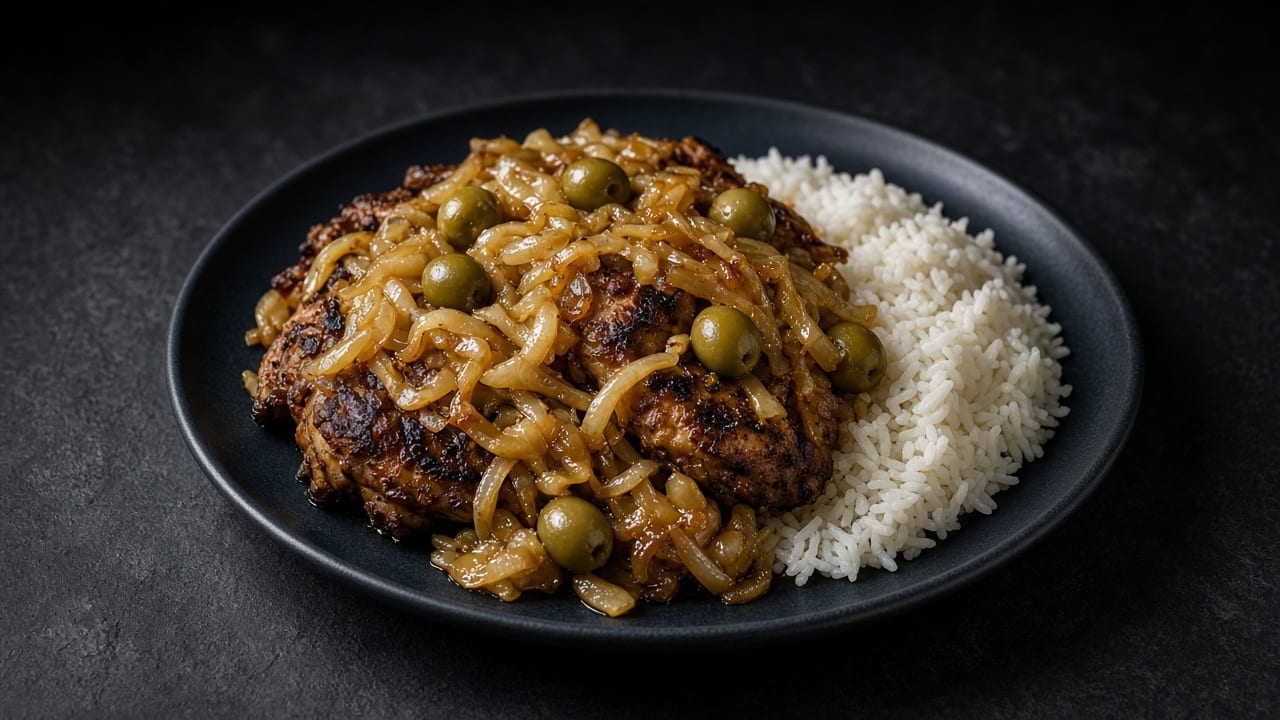
Chicken Yassa
Inspired by techniques from NYT Cooking, Serious Eats and America's Test Kitchen.
Chicken is marinated in lemon, mustard and onions, browned, then braised with the deeply softened onions until tender, finished with a scattering of olives.
Always check the labels of the products you use.
Method
- 1
Marinate the chicken. Toss the chicken and sliced onions with the lemon juice, mustard, garlic, salt and pepper in a large bowl. Cover and refrigerate for 2-12 hours, which gives the lemon time to season the meat and start softening the onions.
- 2
Brown the chicken. Lift the chicken out, scraping the onions back into the bowl of marinade, and pat the skin dry. Heat the oil in the casserole over medium-high heat and brown the chicken skin-side down for 8-10 minutes until deep golden - or grill it instead - then turn for 2 minutes before setting it aside.
- 3
Caramelise the onions. With a slotted spoon, lift the onions out of the marinade, keeping the liquid, and add them to the pan with a pinch of salt. Cook over medium heat for 20-25 minutes, stirring often, until they turn very soft and a deep golden-caramel colour - this slow sweetening is what balances out the sharp lemon in the final dish.
- 4
Simmer the chicken. Add the reserved marinade, water, the Scotch bonnet and bay leaves, and bring to a simmer. Nestle the chicken back in skin-side up, cover, and simmer gently for 25-30 minutes until the thigh meat reaches 80°C and the chicken is tender.
- 5
Add the olives. For the final 5 minutes of cooking, stir in the olives uncovered so they warm through without turning soft and losing their bite. Remove the Scotch bonnet before serving unless you want the extra heat.
- 6
Serve. Serve the chicken and onions over white rice, spooning plenty of the sauce over the top. The soft, sweet onions and sharp lemon sauce are what make this dish so distinctive.
Storage
Keep in the fridge for up to 3 days or freeze for up to 3 months. Reheat gently on the hob until piping hot and the chicken reaches 74°C throughout. Cool leftovers in a shallow container and refrigerate within 2 hours (within 1 hour on a day above 32°C).
Why this label?
35.2 g protein for 638 kcal = 5.5 g per 100 kcal, so protein gives about 22% of the energy. High Protein needs at least 20% (5 g per 100 kcal), the condition in the Annex to EU Regulation (EC) No 1924/2006. How we decide
EU nutrition claims
- Low sugars: 3.1 g sugars per 100 g (limit ≤ 5 g)
Per 100 g of the finished dish, worked out from the nutrition per serving and the lowest likely cooked weight (about 300 g a serving), so the true values are, if anything, lower. Thresholds from the Annex to EU Regulation (EC) No 1924/2006. How we decide
Free sugars
0.5 g per serving
1 % of the 50 g daily maximum · 2 % of the ideal 25 g
Free sugars under 50 g a day, ideally about 25 g, based on WHO free-sugar guidance (not endorsed by WHO). The share shown is the share of one serving. WHO
Equipment
- large bowl
- large heavy casserole with lid (28 cm)
- tongs
- instant-read thermometer
Nutrition per serving (estimated values)
| Per serving | Amount |
|---|---|
| Energy | 638 kcal |
| Protein | 35.2 g |
| Carbohydrate | 23.2 g |
| of which sugars | 9.3 g |
| of which free sugars | 0.5 g |
| Fat | 45.4 g |
| of which saturates | 10 g |
| Fibre | 4.5 g |
| Salt | 2.67 g |
Protein per 100 kcal
5.5 g meets High Protein (≥ 5 g, 20% of energy)
Calculated from USDA FoodData Central ingredient values