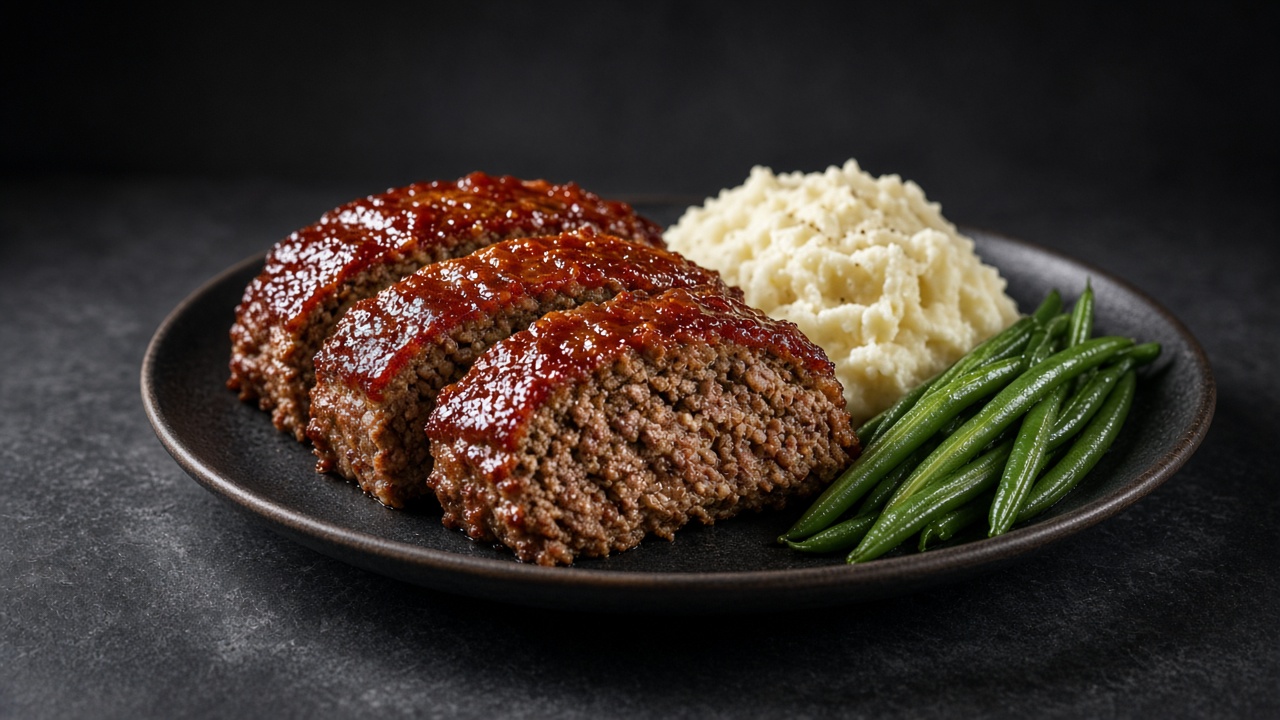
Beef Meatloaf with a Savoury Tomato Top
Inspired by techniques from America's Test Kitchen and NYT Cooking.
A classic beef meatloaf is bound with a milk-soaked bread panade for tenderness, baked on a holed foil rack so it browns on all sides, and finished with a glossy savoury tomato top.
Always check the labels of the products you use.
Method
- 1
Cook the aromatics. Heat the oil in the frying pan over medium heat and cook the onion for 6-8 minutes until soft and pale gold. Add the garlic and thyme for 1 minute, then leave to cool for 10 minutes. Cooking the onion first drives off its moisture and takes the raw edge off it, so it doesn't leak water into the loaf or stay crunchy once baked.
- 2
Mix the loaf. Heat the oven to 180°C (160°C fan). Mash the bread and milk together to a paste in the mixing bowl, beat in the eggs, then add the beef mince, cooled onions, parsley, soy sauce, salt and pepper. Mix with your hands only until evenly combined, since overmixing at this stage makes for a dense, springy loaf rather than a tender one.
- 3
Shape on a holed rack. Cover the wire rack with a sheet of foil and poke holes through it every 2cm with a skewer, then set it on the baking tray. Shape the mixture on top into a loaf about 23 x 12cm. The holes let fat drain away and hot air reach every side, so the loaf browns all over instead of stewing in its own fat.
- 4
Bake and glaze. Bake for 45 minutes, then stir together the tomato purée, soy sauce and olive oil and brush it all over the top and sides. Bake for a further 15-25 minutes, until the top looks glossy and brick-red and a probe thermometer in the centre reads 71°C. Rest for 10 minutes so the loaf firms up and holds its shape, then slice into 2cm pieces with a serrated knife.
Storage
Keeps in a sealed container in the fridge for up to 3 days, or sliced and frozen for up to 3 months. Reheat slices in a covered dish in the oven, or in the microwave, until piping hot throughout (74°C). Cool leftovers in a shallow container and refrigerate within 2 hours (within 1 hour on a day above 32°C).
Why this label?
32.6 g protein for 451 kcal = 7.2 g per 100 kcal, so protein gives about 29% of the energy. High Protein needs at least 20% (5 g per 100 kcal), the condition in the Annex to EU Regulation (EC) No 1924/2006. How we decide
EU nutrition claims
- Low sugars: 2.9 g sugars per 100 g (limit ≤ 5 g)
Per 100 g of the finished dish, worked out from the nutrition per serving and the lowest likely cooked weight (about 124 g a serving), so the true values are, if anything, lower. Thresholds from the Annex to EU Regulation (EC) No 1924/2006. How we decide
Free sugars
0.7 g per serving
1.4 % of the 50 g daily maximum · 2.8 % of the ideal 25 g
Free sugars under 50 g a day, ideally about 25 g, based on WHO free-sugar guidance (not endorsed by WHO). The share shown is the share of one serving. WHO
Equipment
- frying pan
- large mixing bowl
- rimmed baking tray
- wire rack that fits the tray
- aluminium foil
- instant-read probe thermometer
- pastry brush
- serrated or sharp knife
Nutrition per serving (estimated values)
| Per serving | Amount |
|---|---|
| Energy | 451 kcal |
| Protein | 32.6 g |
| Carbohydrate | 11.4 g |
| of which sugars | 3.6 g |
| of which free sugars | 0.7 g |
| Fat | 29.8 g |
| of which saturates | 10.3 g |
| Fibre | 1.2 g |
| Salt | 2.05 g |
Protein per 100 kcal
7.2 g meets High Protein (≥ 5 g, 20% of energy)
Calculated from USDA FoodData Central ingredient values