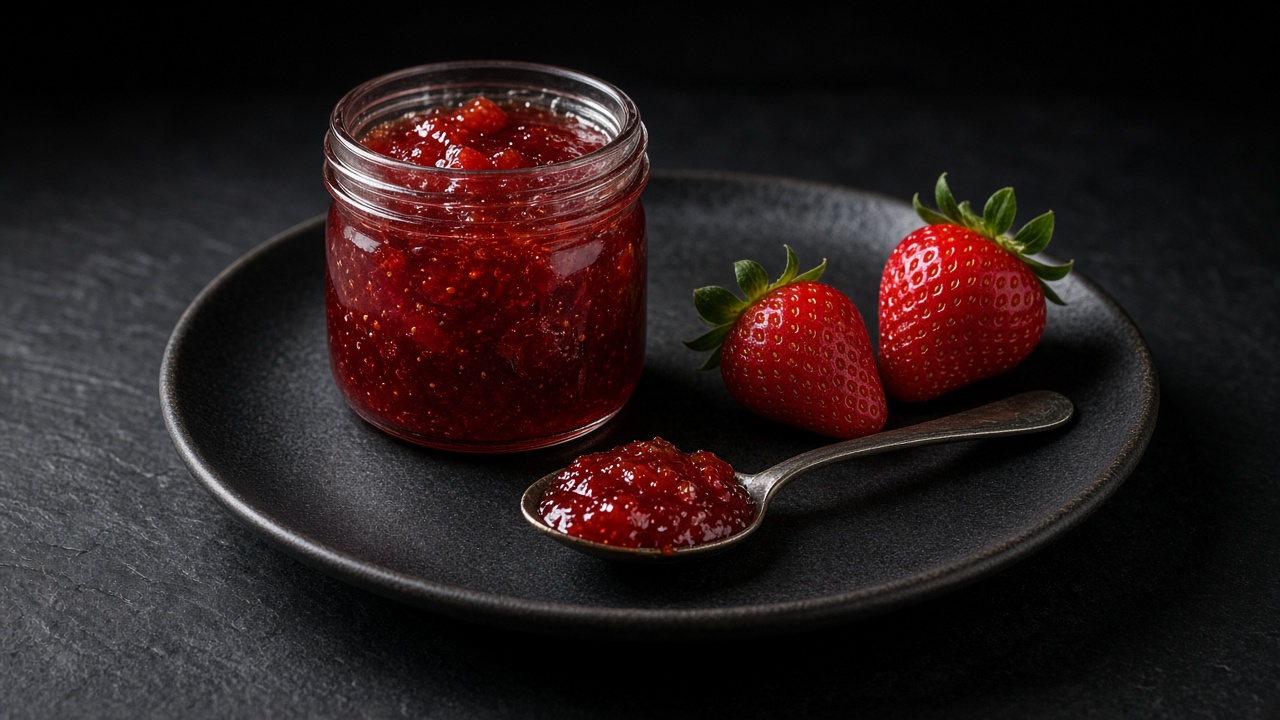
Strawberry Jam
Inspired by techniques from America's Test Kitchen and Serious Eats.
Ripe strawberries boiled with sugar, grated apple and lemon juice until glossy and set, a bright fridge jam with plenty of fruit.
Based on the listed ingredients, none of the 14 major EU allergens. Always check product labels.
Method
- 1
Get ready. Put the 2 small plates in the freezer for testing later. Mash the strawberries in the pot until mostly broken down, then stir in the sugar, grated apple and lemon juice. The apple adds natural pectin and the lemon juice adds acid, and both help the jam set.
- 2
Boil hard. Bring to the boil over medium-high heat, stirring until the sugar has dissolved. Keep it at a hard boil for 20-25 minutes, stirring often and lowering the heat if it froths up, until thick and the jam reads 104-105 °C. At this temperature enough water has boiled off for the pectin and sugar to form a gel.
- 3
Test the set. Take the pot off the heat, put 1 tsp jam on a cold plate and freeze it for 2 minutes. Drag a finger through it: if it leaves a clear trail, the jam is set. If not, boil for 1-3 minutes more and test again, then skim off any foam.
- 4
Cool and jar. Leave the jam to cool in the pot for about 2 hours, then spoon it into clean jars, cover and refrigerate. It firms up within 24 hours as the pectin finishes setting.
Storage
Keep covered in the fridge for up to 2 months. This is a fridge jam, so it is not suitable for storing at room temperature. Cool leftovers in a shallow container and refrigerate within 2 hours (within 1 hour on a day above 32°C).
EU nutrition claims
- Low fat: 0.3 g fat per 100 g (limit ≤ 3 g)
- Low saturated fat: 0 g saturated fat per 100 g, 0% of energy (limits ≤ 1.5 g and ≤ 10%)
- Low salt: 0 g salt per 100 g (limit ≤ 0.3 g)
Per 100 g of the finished dish, worked out from the nutrition per serving and the lowest likely cooked weight (about 32 g a serving), so the true values are, if anything, lower. Thresholds from the Annex to EU Regulation (EC) No 1924/2006. How we decide
Free sugars
12.5 g per serving
25 % of the 50 g daily maximum · 50 % of the ideal 25 g
Free sugars under 50 g a day, ideally about 25 g, based on WHO free-sugar guidance (not endorsed by WHO). The share shown is the share of one serving. WHO
Equipment
- 2 small plates
- large heavy pot (at least 6 litres)
- potato masher
- wooden spoon or heatproof spatula
- instant-read thermometer
- metal spoon
- clean jars with lids
Nutrition per serving (estimated values)
| Per serving | Amount |
|---|---|
| Energy | 60 kcal |
| Protein | 0.2 g |
| Carbohydrate | 15.3 g |
| of which sugars | 14.3 g |
| of which free sugars | 12.5 g |
| Fat | 0.1 g |
| of which saturates | 0 g |
| Fibre | 0.7 g |
| Salt | 0 g |
Protein per 100 kcal
0.3 g High Protein needs ≥ 5 g (20% of energy)
Calculated from USDA FoodData Central ingredient values