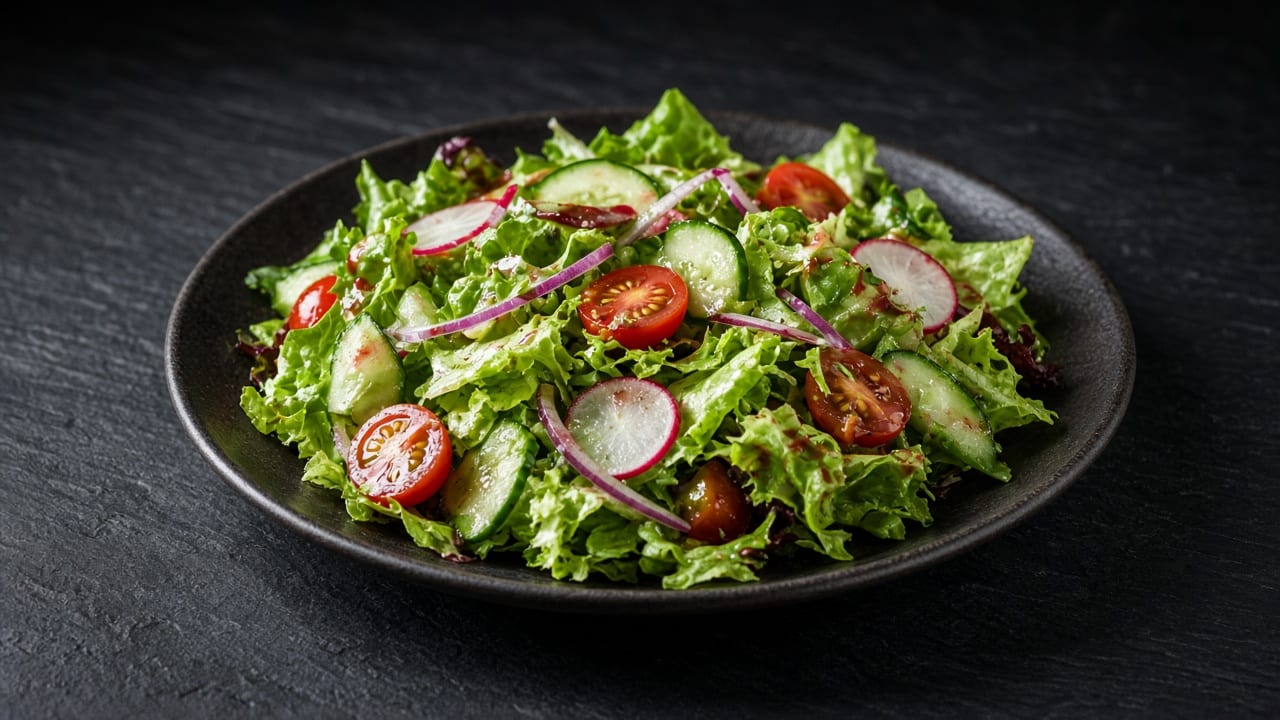
Crisp Garden Salad with Honey-Mustard Vinaigrette
Inspired by techniques from NYT Cooking and America's Test Kitchen.
A crunchy, colourful garden salad finished with a honey-mustard vinaigrette that balances sharp cider vinegar against a touch of honey.
Always check the labels of the products you use.
Method
- 1
Wash and dry leaves. Wash the lettuce thoroughly in plenty of cold water, then dry it very well in a salad spinner, working in batches, or roll it in a clean tea towel. Tear into bite-size pieces by hand and keep chilled until you're ready to serve. Any water left clinging to the leaves dilutes the vinaigrette and stops it clinging properly.
- 2
Whisk the vinaigrette. In a small bowl or jam jar, whisk together the cider vinegar, mustard powder, honey, salt, pepper and 1 tsp water. Whisking steadily (or shaking hard in the jar for about 20 seconds), add the olive oil in a thin stream until the mixture thickens slightly. The mustard powder acts as an emulsifier, helping the oil and vinegar bind instead of separating.
- 3
Dress the vegetables. In the large salad bowl, toss the halved cherry tomatoes, sliced cucumber, radishes and red onion with 2 tbsp of the vinaigrette. Dressing these firmer vegetables first lets them pick up flavour evenly without crushing the delicate lettuce underneath.
- 4
Add leaves and toss. Just before serving, add the chilled lettuce to the bowl and drizzle over the rest of the vinaigrette a little at a time. Toss gently by hand until the leaves are lightly glossed, not drenched — adding the dressing gradually stops them wilting under too much liquid. Serve at once.
Storage
Keep the undressed lettuce and vegetables separately, covered, in the fridge for up to 2 days. Once dressed the salad wilts quickly, so toss only what you'll eat and finish it the same day; the vinaigrette alone keeps in a sealed jar in the fridge for about a week. Cool leftovers in a shallow container and refrigerate within 2 hours (within 1 hour on a day above 32°C).
EU nutrition claims
- Low sugars: 2.5 g sugars per 100 g (limit ≤ 5 g)
- Low salt: 0.24 g salt per 100 g (limit ≤ 0.3 g)
Per 100 g of the finished dish, worked out from the nutrition per serving and the lowest likely cooked weight (about 182 g a serving), so the true values are, if anything, lower. Thresholds from the Annex to EU Regulation (EC) No 1924/2006. How we decide
Free sugars
1.4 g per serving
2.8 % of the 50 g daily maximum · 5.6 % of the ideal 25 g
Free sugars under 50 g a day, ideally about 25 g, based on WHO free-sugar guidance (not endorsed by WHO). The share shown is the share of one serving. WHO
Equipment
- salad spinner or clean tea towels
- small bowl or jam jar with a lid
- whisk
- large wide salad bowl
- chopping board and knife
Nutrition per serving (estimated values)
| Per serving | Amount |
|---|---|
| Energy | 159 kcal |
| Protein | 1.9 g |
| Carbohydrate | 8.3 g |
| of which sugars | 4.6 g |
| of which free sugars | 1.4 g |
| Fat | 13.9 g |
| of which saturates | 1.9 g |
| Fibre | 2.1 g |
| Salt | 0.43 g |
Protein per 100 kcal
1.2 g High Protein needs ≥ 5 g (20% of energy)
Calculated from USDA FoodData Central ingredient values