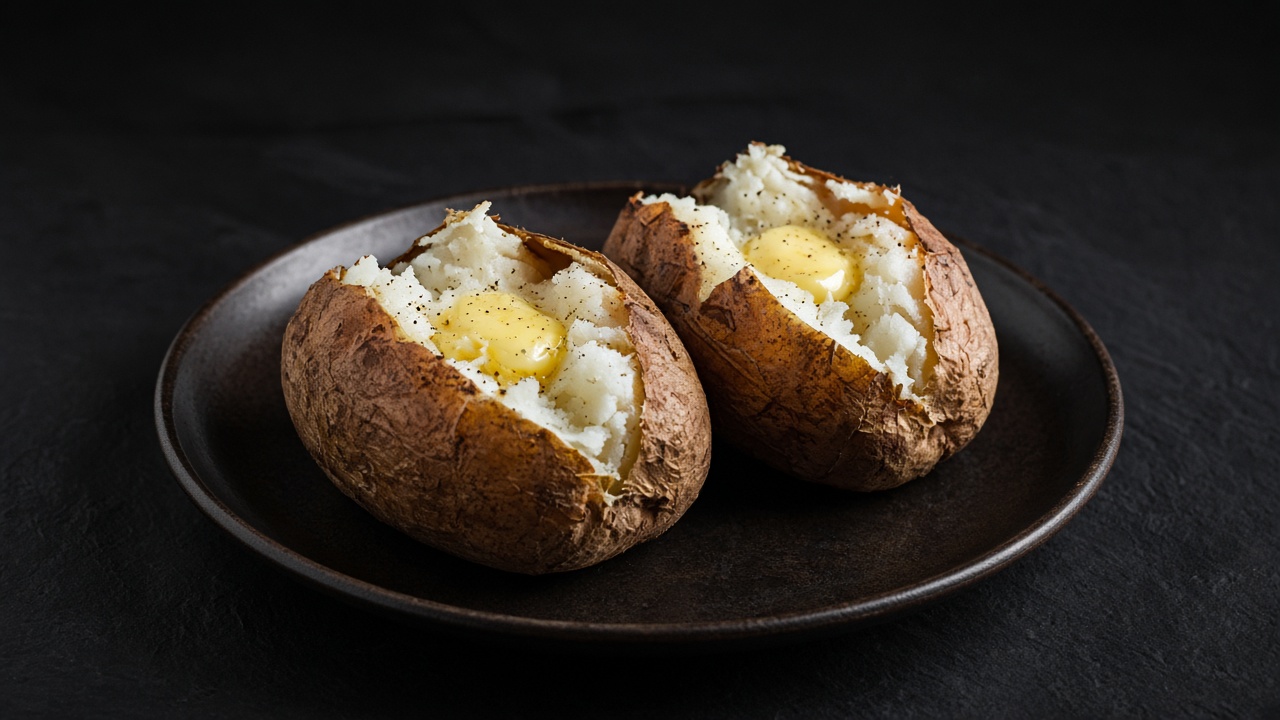
Crisp-Skinned Jacket Potatoes
Inspired by techniques from America's Test Kitchen and NYT Cooking.
Large baking potatoes baked until fluffy inside, then oiled and salted right at the end for a genuinely crisp skin, split open and loaded with butter, soured cream and chives.
Always check the labels of the products you use.
Method
- 1
Heat the Oven. Preheat to 230°C (210°C fan) at least 20 minutes ahead, so the potatoes go into a properly hot oven from the start. A hot oven from the first minute is what drives a long, even bake rather than a slow, soggy one.
- 2
Dry and Prick the Potatoes. Dry the scrubbed potatoes thoroughly, then prick each one 4-5 times with a fork. These holes let the steam that builds up inside escape gradually instead of splitting the skin.
- 3
Bake Until Fluffy. Bake directly on the oven rack, with a tray on the shelf below to catch any drips, for 50-60 minutes. A skewer should slide in with no resistance, or a probe thermometer should read 96-99°C at the centre, the point at which the starch inside has fully swollen into a fluffy texture.
- 4
Crisp the Skin. Take the potatoes out, brush the skins with oil, sprinkle with the flaky salt and return to the oven for 10 minutes. Oiling now, rather than at the start, gives a genuinely crisp skin instead of a leathery one, since it hasn't had time to steam into the surface.
- 5
Open and Fill. Holding each potato in a tea towel, cut a cross on top and squeeze the base gently to pop it open. Fill immediately with the butter, soured cream, chives and pepper, and serve right away, since leaving it to sit lets trapped steam soften the skin again.
Storage
Unfilled baked potatoes keep in the fridge for up to 2 days; reheat in a hot oven at around 200°C (180°C fan) for 15-20 minutes until piping hot (74°C) right through to the centre. It's best not to freeze once filled with soured cream and butter, as the texture suffers on thawing. Cool leftovers in a shallow container and refrigerate within 2 hours (within 1 hour on a day above 32°C).
EU nutrition claims
- Low sugars: 1.3 g sugars per 100 g (limit ≤ 5 g)
Per 100 g of the finished dish, worked out from the nutrition per serving and the lowest likely cooked weight (about 181 g a serving), so the true values are, if anything, lower. Thresholds from the Annex to EU Regulation (EC) No 1924/2006. How we decide
Free sugars
0 g per serving
0 % of the 50 g daily maximum · 0 % of the ideal 25 g
Free sugars under 50 g a day, ideally about 25 g, based on WHO free-sugar guidance (not endorsed by WHO). The share shown is the share of one serving. WHO
Equipment
- baking tray
- fork
- probe thermometer (optional)
- clean tea towel
Nutrition per serving (estimated values)
| Per serving | Amount |
|---|---|
| Energy | 361 kcal |
| Protein | 6.9 g |
| Carbohydrate | 55.1 g |
| of which sugars | 2.4 g |
| of which free sugars | 0 g |
| Fat | 13.8 g |
| of which saturates | 6.9 g |
| Fibre | 4 g |
| Salt | 0.66 g |
Protein per 100 kcal
1.9 g High Protein needs ≥ 5 g (20% of energy)
Calculated from USDA FoodData Central ingredient values