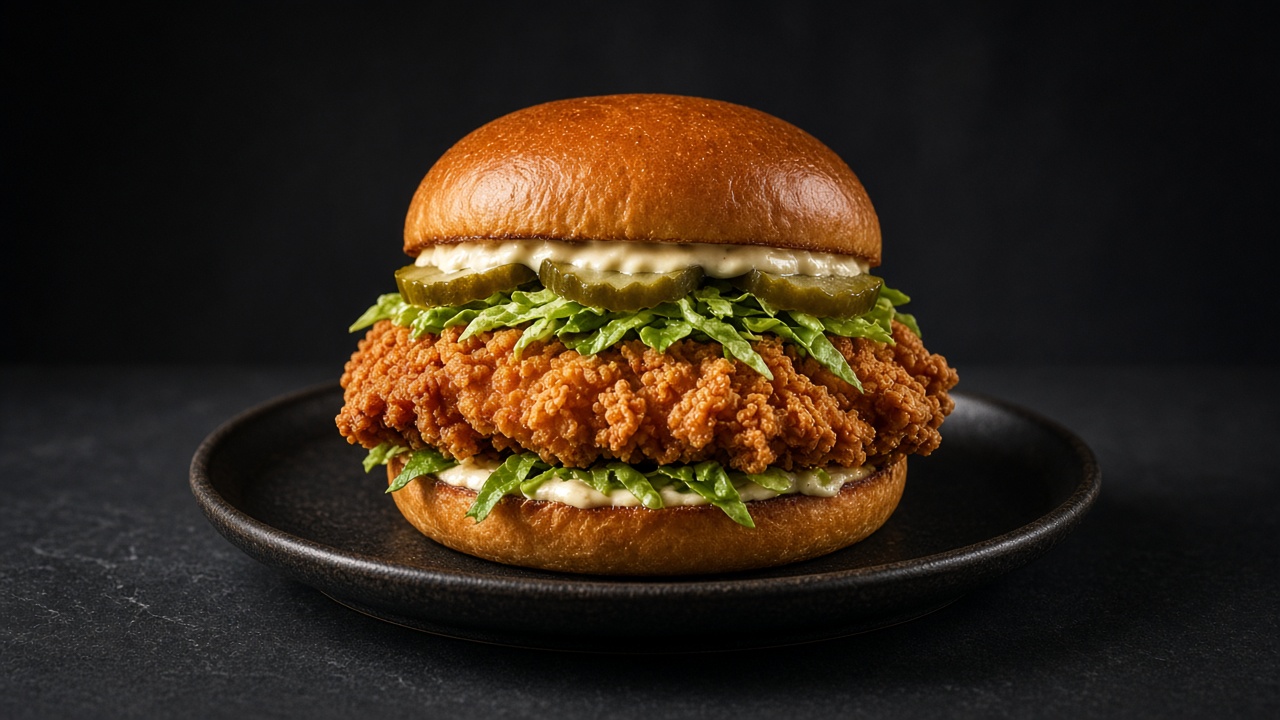
Crispy Buttermilk Chicken Sandwich
Inspired by techniques from Serious Eats and America's Test Kitchen.
Buttermilk-marinated chicken thighs get a double-textured, deeply crunchy crust and a quick fry, then stack into a sandwich with spicy mayo, crisp lettuce and pickles.
Always check the labels of the products you use.
Method
- 1
Marinate the chicken. Whisk the buttermilk with the salt, garlic powder, paprika and cayenne, then add the chicken and turn to coat. Covered and refrigerated for at least 1 hour, or up to 24 hours, the chicken has time to brine: salt helps the meat hold onto its moisture, while the mild acid in the buttermilk softens the surface so the coating has something to grip.
- 2
Build the dredge. Whisk the flour, cornflour, baking powder, salt, paprika and pepper together in a shallow dish. Drizzle in 2 tbsp of the marinade and rub it through with your fingertips until small shaggy clumps form — these turn into extra-crunchy bits once fried. The cornflour gives a crisper, less greasy crust, and the baking powder adds tiny bubbles that lighten it.
- 3
Heat the oil. Pour oil into the heavy pot to a depth of about 5 cm, keeping it no more than half full so there is room for bubbling. Heat over medium-high until the thermometer reads 175°C; this usually takes 10-15 minutes. Set a wire rack over a tray ready for draining.
- 4
Coat the chicken. Lift each thigh from the marinade, letting the excess drip off, then press it firmly into the flour mixture on both sides, packing the coating on well. Rest the coated pieces on a rack for 10 minutes so the coating hydrates slightly — this short rest stops it falling off the moment the chicken hits the oil.
- 5
Fry in batches. Two pieces at a time go into the oil, lowered away from you. The temperature will dip to around 150-160°C; adjust the heat to hold it between 150-165°C. Fry for 6-8 minutes, turning once halfway, until deep golden brown and the thickest part reads 74°C — thighs stay juicy even a little above this.
- 6
Drain and rest. The wire rack, not kitchen paper, is where the chicken should land, since kitchen paper traps steam underneath and softens the crust. Sprinkle with a pinch of salt if you like, and let the oil climb back to 175°C before frying the next batch.
- 7
Build the sandwich. Stir the mayonnaise with the lemon juice and cayenne to make the spicy mayo. Spread it over the toasted buns, then layer on the lettuce, the fried chicken and the pickle slices, and serve immediately while the crust is at its crispest.
Storage
This sandwich is best enjoyed fresh and crisp. Cooked chicken keeps in the fridge for 2 days; reheat on a rack in the oven at 200°C (180°C fan) for 10-12 minutes until piping hot (74°C) and crisp again. Don't freeze the raw chicken while it's still in its buttermilk marinade. Cool leftovers in a shallow container and refrigerate within 2 hours (within 1 hour on a day above 32°C).
Why this label?
38.9 g protein for 687 kcal = 5.7 g per 100 kcal, so protein gives about 23% of the energy. High Protein needs at least 20% (5 g per 100 kcal), the condition in the Annex to EU Regulation (EC) No 1924/2006. How we decide
EU nutrition claims
- Low sugars: 2.6 g sugars per 100 g (limit ≤ 5 g)
Per 100 g of the finished dish, worked out from the nutrition per serving and the lowest likely cooked weight (about 252 g a serving), so the true values are, if anything, lower. Thresholds from the Annex to EU Regulation (EC) No 1924/2006. How we decide
Free sugars
4.5 g per serving
9 % of the 50 g daily maximum · 18 % of the ideal 25 g
Free sugars under 50 g a day, ideally about 25 g, based on WHO free-sugar guidance (not endorsed by WHO). The share shown is the share of one serving. WHO
Equipment
- large bowl and a shallow dish
- heavy, deep pot or casserole (about 24 cm, at least 10 cm deep)
- digital probe thermometer (for oil and chicken)
- wire rack set over a baking tray
- slotted spoon or tongs
Nutrition per serving (estimated values)
| Per serving | Amount |
|---|---|
| Energy | 687 kcal |
| Protein | 38.9 g |
| Carbohydrate | 51.3 g |
| of which sugars | 6.6 g |
| of which free sugars | 4.5 g |
| Fat | 35.4 g |
| of which saturates | 5.3 g |
| Fibre | 2.3 g |
| Salt | 2.75 g |
Protein per 100 kcal
5.7 g meets High Protein (≥ 5 g, 20% of energy)
Calculated from USDA FoodData Central ingredient values