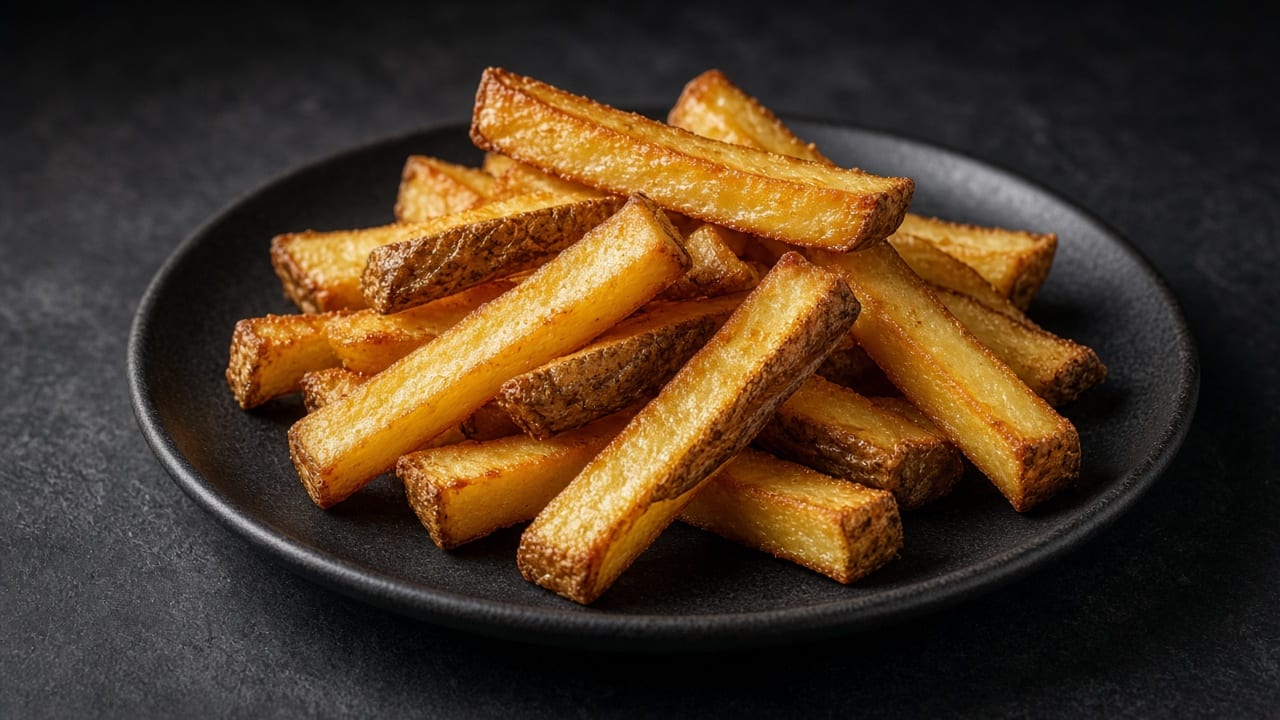
Crispy Thick-Cut Steak Fries
Inspired by techniques from America's Test Kitchen, Serious Eats and NYT Cooking.
Thick potato wedges are parboiled until tender, coated in cornflour, then fried twice - first at a lower temperature to cook through, then hotter to crisp - for a fluffy centre and deeply golden crust.
Based on the listed ingredients, none of the 14 major EU allergens. Always check product labels.
Method
- 1
Parboil the wedges. Cover the potato wedges with cold water in a large pan, add the 20 g salt and bring to a gentle simmer; cook for 6-8 minutes until tender but not falling apart. Since these are thick cuts, cooking them through before frying stops the outside from burning long before the centre is done.
- 2
Dry and coat. Drain the wedges on kitchen paper and leave to cool for 10 minutes, then pat them dry. Toss with the cornflour until lightly and evenly coated; the starch forms a crisp crust on a cut this thick once it hits the hot oil.
- 3
First fry at 160°C. Heat the frying oil to 160°C and fry the wedges in 2-3 batches for 4-5 minutes, until a pale crust just forms. Drain each batch on a wire rack; this gentler first fry sets the crust without colouring it too far, leaving room for the second fry to finish the job.
- 4
Second fry at 190°C. Raise the oil temperature to 190°C and fry the wedges again in batches for 3-4 minutes, until deep golden and crisp all over. The higher heat this time drives off surface moisture fast, giving the deep, crunchy crust steak fries are known for.
- 5
Season and serve. Drain the finished wedges, season with the salt and pepper, and serve immediately while the crust is at its crispest. Never leave hot oil unattended at any stage of frying.
Storage
Best eaten straight away; leftovers keep in the fridge for up to 2 days but lose their crispness. Reheat in a hot oven until piping hot (74°C) rather than the microwave; freezing isn't recommended as the texture suffers on thawing. Cool leftovers in a shallow container and refrigerate within 2 hours (within 1 hour on a day above 32°C).
EU nutrition claims
- Low saturated fat: 0.7 g saturated fat per 100 g, 3.4% of energy (limits ≤ 1.5 g and ≤ 10%)
- Low sugars: 1.2 g sugars per 100 g (limit ≤ 5 g)
- Source of fibre: 1.6 g fibre per 100 kcal (needs ≥ 1.5 g)
Per 100 g of the finished dish, worked out from the nutrition per serving and the lowest likely cooked weight (about 195 g a serving), so the true values are, if anything, lower. Thresholds from the Annex to EU Regulation (EC) No 1924/2006. How we decide
Free sugars
0 g per serving
0 % of the 50 g daily maximum · 0 % of the ideal 25 g
Free sugars under 50 g a day, ideally about 25 g, based on WHO free-sugar guidance (not endorsed by WHO). The share shown is the share of one serving. WHO
Equipment
- large heavy pot or Dutch oven (at least 5 litres) or a deep fryer
- deep-frying or probe thermometer
- spider strainer or slotted spoon
- 2 rimmed baking trays, one lined with kitchen paper, one with a wire rack
- large pan for simmering
- large bowl
Nutrition per serving (estimated values)
| Per serving | Amount |
|---|---|
| Energy | 374 kcal |
| Protein | 5.7 g |
| Carbohydrate | 50 g |
| of which sugars | 2.3 g |
| of which free sugars | 0 g |
| Fat | 17.8 g |
| of which saturates | 1.4 g |
| Fibre | 5.8 g |
| Salt | 1.5 g |
Protein per 100 kcal
1.5 g High Protein needs ≥ 5 g (20% of energy)
Calculated from USDA FoodData Central ingredient values