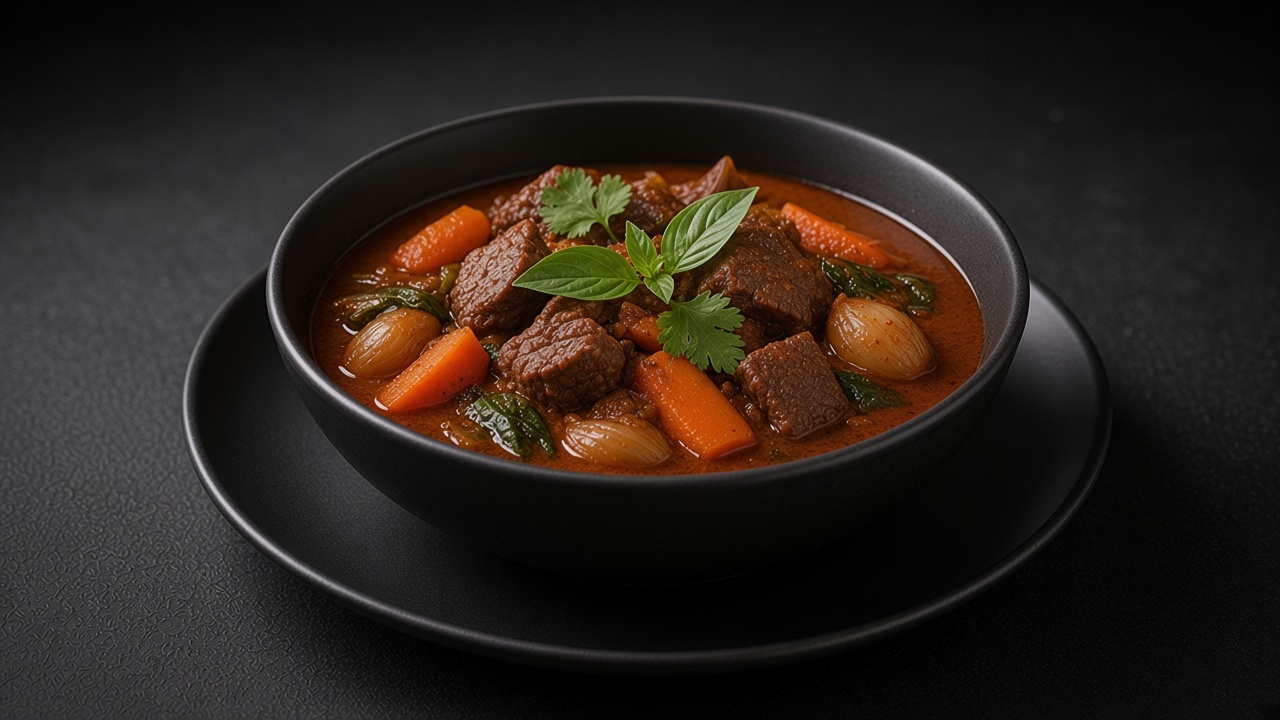
Curried Beef Stew
Inspired by techniques from Bon Appétit.
Beef chuck cubes simmer for hours in a hand-pounded curry paste of chillies, lemongrass, galangal, turmeric and shrimp paste until they are fork-tender in a deeply savoury broth. Shallots, carrots and makrut lime leaves go in at the end so they stay bright, and a scatter of coriander and Thai basil keeps the finished bowl fresh.
Always check the labels of the products you use.
Method
- 1
Pound the curry paste. In a mortar, pound the chillies and fine salt with a pestle until pulverized, about 5 minutes. Add the lemongrass, galangal, turmeric, shallots, garlic and shrimp paste one at a time, in that order, fully crushing each addition before the next, about 15 minutes more, until you have a fairly smooth, fragrant paste.
- 2
Coat the beef. Combine the curry paste, beef cubes, soy sauce and ground dried chillies in a large pot and stir until the beef is evenly coated. Cook over medium heat, stirring occasionally, for 5 minutes.
- 3
Simmer until tender. Pour in the beef broth and bring to a boil. Cover, reduce the heat to medium-low, and simmer, stirring occasionally, until the beef is tender but not falling apart, 2-2 1/2 hours.
- 4
Add the vegetables. Stir in the halved shallots, carrots and lime leaves. Simmer until the vegetables are just tender, about 10 minutes. If the broth tastes too salty, loosen it with a few tablespoons of water at a time.
- 5
Garnish and serve. Ladle the stew into bowls and scatter with the coriander and Thai basil.
Storage
Cool leftovers in a shallow container and refrigerate within 2 hours (within 1 hour on a day above 32°C). Keeps refrigerated for 3-4 days, or freeze for up to 3 months; reheat until steaming hot throughout.
Why this label?
60.9 g protein for 442 kcal = 13.8 g per 100 kcal, so protein gives about 55% of the energy. High Protein needs at least 20% (5 g per 100 kcal), the condition in the Annex to EU Regulation (EC) No 1924/2006. How we decide
EU nutrition claims
- Low saturated fat: 1.2 g saturated fat per 100 g, 9.4% of energy (limits ≤ 1.5 g and ≤ 10%)
- Low sugars: 2.1 g sugars per 100 g (limit ≤ 5 g)
Per 100 g of the finished dish, worked out from the nutrition per serving and the lowest likely cooked weight (about 370 g a serving), so the true values are, if anything, lower. Thresholds from the Annex to EU Regulation (EC) No 1924/2006. How we decide
Free sugars
0 g per serving
0 % of the 50 g daily maximum · 0 % of the ideal 25 g
Free sugars under 50 g a day, ideally about 25 g, based on WHO free-sugar guidance (not endorsed by WHO). The share shown is the share of one serving. WHO
Equipment
- mortar and pestle (or food processor)
- chef's knife
- chopping board
- large heavy pot or Dutch oven
- wooden spoon
- ladle
- measuring spoons
Nutrition per serving (estimated values)
| Per serving | Amount |
|---|---|
| Energy | 442 kcal |
| Protein | 60.9 g |
| Carbohydrate | 26.3 g |
| of which sugars | 7.9 g |
| of which free sugars | 0 g |
| Fat | 11.7 g |
| of which saturates | 4.6 g |
| Fibre | 6 g |
| Salt | 6.83 g |
Protein per 100 kcal
13.8 g meets High Protein (≥ 5 g, 20% of energy)
Calculated from USDA FoodData Central and Open Food Facts ingredient values