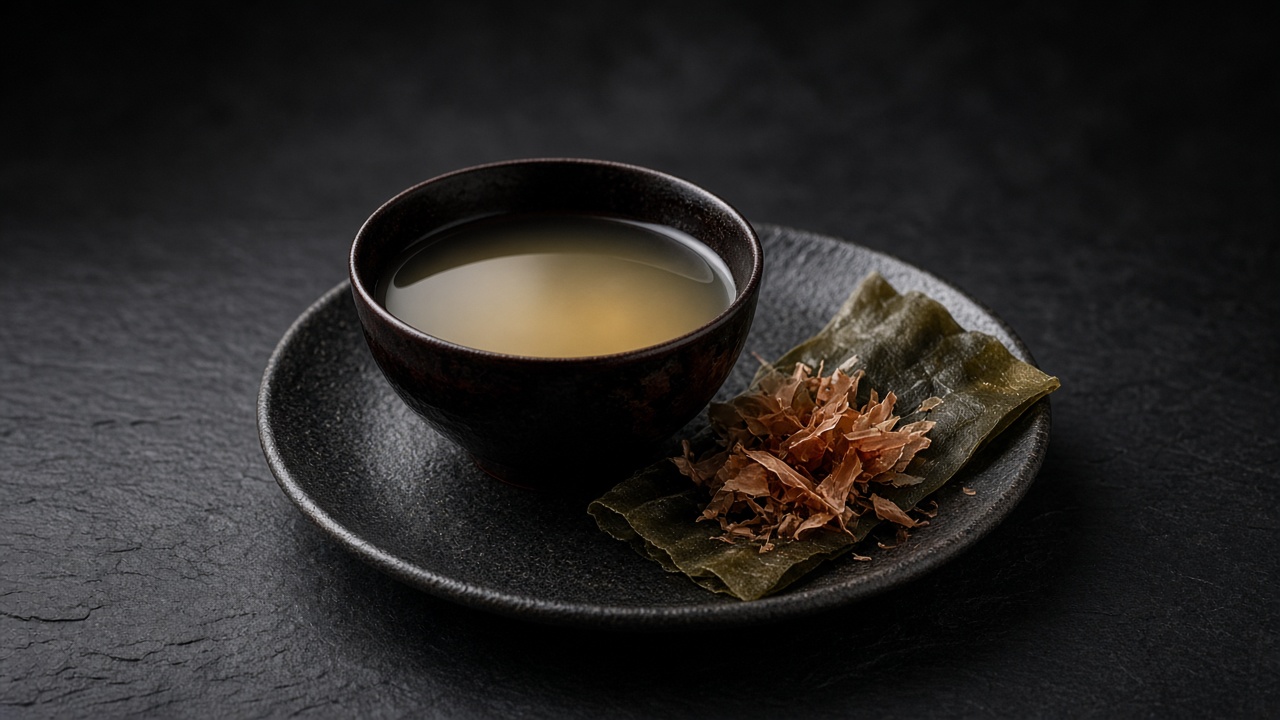
Dashi: Japanese Kombu and Bonito Stock
Inspired by techniques from America's Test Kitchen and Serious Eats.
Kombu is soaked and gently heated to draw out its savoury flavour, then bonito flakes steep briefly off the heat. Strained without pressing, it gives a pale golden, crystal-clear stock.
Always check the labels of the products you use.
Method
- 1
Soak the kombu. Put the water and kombu in the saucepan and leave for 30 minutes, or overnight in the fridge. Soaking softens the seaweed so it releases its flavour easily. Wiping, not washing, the kombu keeps the white powder on its surface, which is full of flavour.
- 2
Heat gently. Set the pan over medium-low heat and bring it slowly to about 65 °C, when small bubbles cling to the kombu; this takes about 10 minutes. Hold it at 60-65 °C for 30 minutes, checking with the thermometer. Boiling would make the stock slimy and bitter.
- 3
Lift out the kombu. Remove the kombu with the tongs. Keep it for another use, such as slicing into a stir-fry. Its flavour has now passed into the water.
- 4
Steep the bonito. Raise the heat until the liquid reaches a bare simmer, about 90 °C, then add the katsuobushi and turn off the heat. Leave for 5 minutes, until the flakes sink to the bottom. Short steeping off the heat keeps the smoky fish flavour clean.
- 5
Strain without pressing. Pour through the lined sieve into the bowl and let it drip through on its own. Do not press or squeeze the flakes, which would make the dashi cloudy and fishy. You should have about 1.7 litres.
- 6
Use or store. Use straight away for miso soup, noodle broths or simmered dishes. Otherwise cool it, pour into airtight containers and refrigerate for up to 3 days.
Storage
Refrigerate in airtight containers up to 3 days or freeze up to 3 months. Bring to a simmer before using in a hot dish. Cool leftovers in a shallow container and refrigerate within 2 hours (within 1 hour on a day above 32°C).
Why this label?
0.8 g protein for 6 kcal = 13.3 g per 100 kcal, so protein gives about 53% of the energy. High Protein needs at least 20% (5 g per 100 kcal), the condition in the Annex to EU Regulation (EC) No 1924/2006. How we decide
EU nutrition claims
- Low energy: 3 kcal per 100 ml (limit ≤ 20 kcal)
- Low fat: 0 g fat per 100 ml (limit ≤ 1.5 g)
- Low saturated fat: 0 g saturated fat per 100 ml, 0% of energy (limits ≤ 0.75 g and ≤ 10%)
- Sugar-free: 0 g sugars per 100 ml (limit ≤ 0.5 g)
- Low salt: 0.12 g salt per 100 ml (limit ≤ 0.3 g)
Per 100 ml of the finished dish, worked out from the nutrition per serving and the lowest likely cooked weight (about 197 ml a serving), so the true values are, if anything, lower. Thresholds from the Annex to EU Regulation (EC) No 1924/2006. How we decide
Free sugars
0 g per serving
0 % of the 50 g daily maximum · 0 % of the ideal 25 g
Free sugars under 50 g a day, ideally about 25 g, based on WHO free-sugar guidance (not endorsed by WHO). The share shown is the share of one serving. WHO
Equipment
- large saucepan (about 4 litres)
- instant-read thermometer
- fine sieve lined with kitchen paper or muslin
- large heatproof bowl
- tongs
- airtight containers
Nutrition per serving (estimated values)
| Per serving | Amount |
|---|---|
| Energy | 6 kcal |
| Protein | 0.8 g |
| Carbohydrate | 0.8 g |
| of which sugars | 0 g |
| of which free sugars | 0 g |
| Fat | 0 g |
| of which saturates | 0 g |
| Fibre | 0 g |
| Salt | 0.24 g |
Protein per 100 kcal
13.3 g meets High Protein (≥ 5 g, 20% of energy)
Calculated from USDA FoodData Central ingredient values