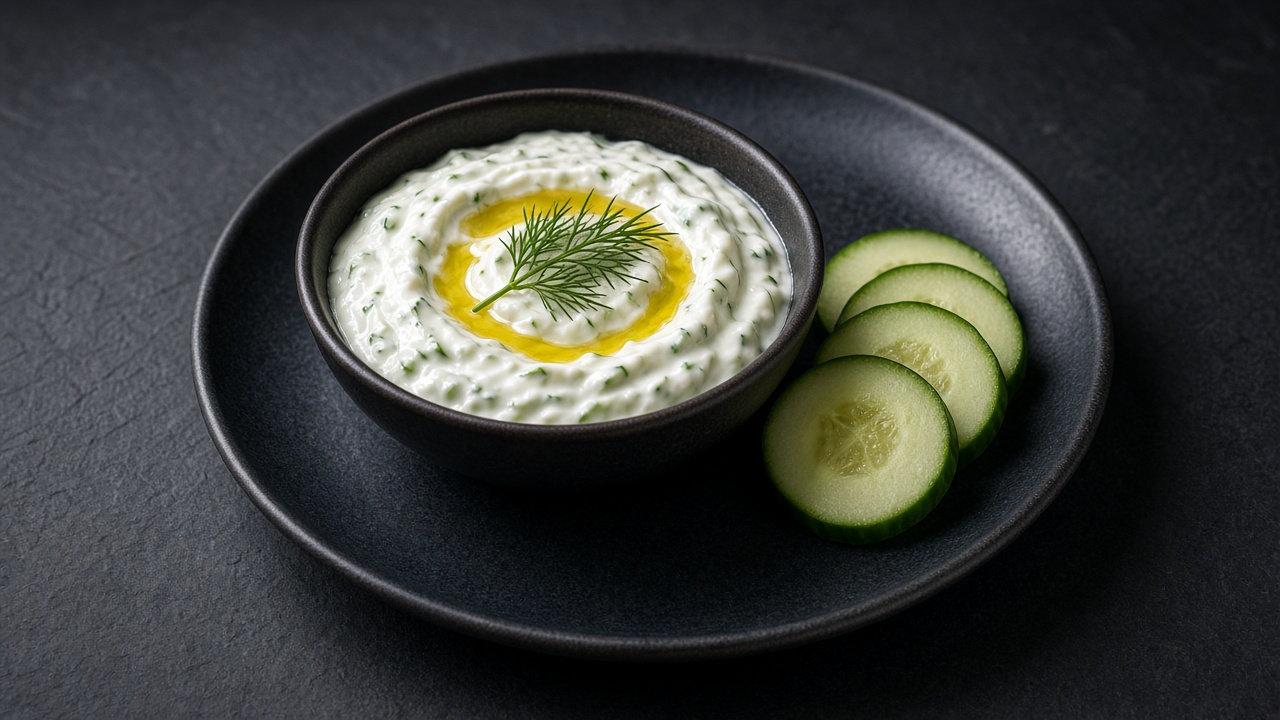
Dill and Cucumber Tzatziki
Inspired by techniques from America's Test Kitchen and NYT Cooking.
Thick Greek yoghurt with salted, squeezed cucumber, plenty of dill, lemon and a thread of olive oil, chilled until the garlic softens.
Always check the labels of the products you use.
Method
- 1
Grate and salt. Coarsely grate the unpeeled cucumber, toss it with 0.25 tsp salt in the sieve and let it sit for 10 min. Salt draws water out of the cucumber cells, so the dip stays thick instead of turning runny in the fridge.
- 2
Wring it dry. Pile the cucumber into the clean tea towel, twist the ends and squeeze hard over the sink. You should end up with a compact, barely damp handful.
- 3
Build the sauce. In the mixing bowl, stir together the yoghurt, garlic paste, chopped dill, lemon juice, 2 tbsp olive oil, the remaining salt and the pepper. Fold the cucumber through last so it keeps a little crunch.
- 4
Let it chill. Cover the bowl and refrigerate for at least 30 min. Resting lets the sharp garlic spread out and soften, and the yoghurt firms up again once cold.
- 5
Swirl and serve. Spoon the tzatziki into a serving bowl and drag the back of the spoon round to make a shallow swirl. Pool a little olive oil in the hollow and finish with a sprig of dill.
Storage
Keep covered in the fridge for up to 3 days; stir before serving, as a little liquid may collect on top. Do not freeze, as the yoghurt separates. Cool leftovers in a shallow container and refrigerate within 2 hours (within 1 hour on a day above 32°C).
Why this label?
5.3 g protein for 94 kcal = 5.6 g per 100 kcal, so protein gives about 23% of the energy. High Protein needs at least 20% (5 g per 100 kcal), the condition in the Annex to EU Regulation (EC) No 1924/2006. How we decide
EU nutrition claims
- Low sugars: 3.1 g sugars per 100 g (limit ≤ 5 g)
Per 100 g of the finished dish, worked out from the nutrition per serving and the lowest likely cooked weight (about 89 g a serving), so the true values are, if anything, lower. Thresholds from the Annex to EU Regulation (EC) No 1924/2006. How we decide
Free sugars
0 g per serving
0 % of the 50 g daily maximum · 0 % of the ideal 25 g
Free sugars under 50 g a day, ideally about 25 g, based on WHO free-sugar guidance (not endorsed by WHO). The share shown is the share of one serving. WHO
Equipment
- box grater
- sieve
- clean tea towel
- mixing bowl
- spoon
Nutrition per serving (estimated values)
| Per serving | Amount |
|---|---|
| Energy | 94 kcal |
| Protein | 5.3 g |
| Carbohydrate | 3.8 g |
| of which sugars | 2.8 g |
| of which free sugars | 0 g |
| Fat | 6.6 g |
| of which saturates | 1.9 g |
| Fibre | 0.2 g |
| Salt | 0.42 g |
Protein per 100 kcal
5.6 g meets High Protein (≥ 5 g, 20% of energy)
Calculated from USDA FoodData Central ingredient values