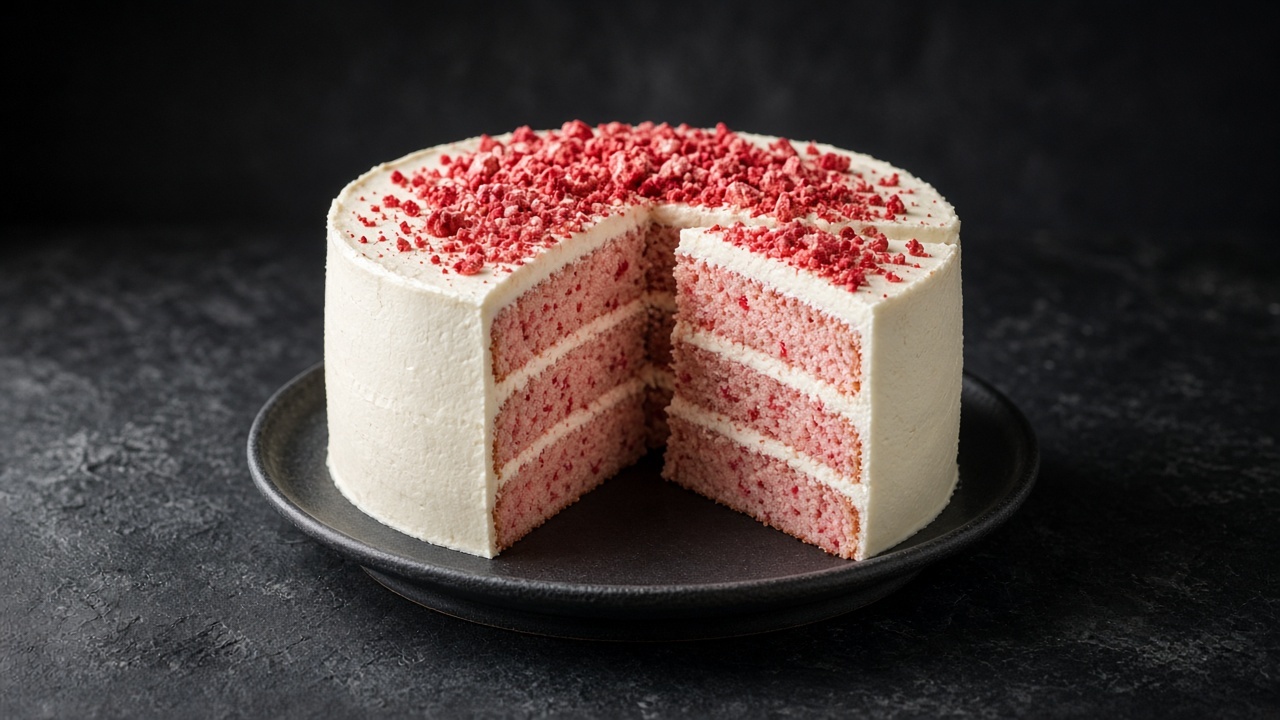
Double-Strawberry Cake
Inspired by techniques from Serious Eats.
This three-layer cake gets its colour and flavour from strawberries twice over: ground freeze-dried fruit folded right into the flour, and fresh fruit puréed into the batter. A Swiss meringue buttercream coats the layers in something light and silky rather than overly sweet.
Always check the labels of the products you use.
Method
- 1
Make the strawberry flour and purée. Grind the cake flour and freeze-dried strawberries together in a food processor until you have a fine, pale pink powder with no visible pieces of fruit. Separately, purée the fresh strawberries until completely smooth; bring both to about 21°C before using.
- 2
Prep the pans. Preheat the oven to 180°C (160°C fan). Grease three 20 cm round cake tins and line the bases with baking paper.
- 3
Cream the base. In a stand mixer fitted with the paddle, combine the butter, sugar, baking powder, bicarbonate of soda, salt and five-spice. Mix on low to bring together, then beat on medium until pale and fluffy, about 5 minutes, scraping down the bowl halfway through.
- 4
Add the egg whites. With the mixer running, add the egg whites a little at a time, letting each addition disappear into the batter before adding more. Scrape the bowl and beater well.
- 5
Fold in the strawberries. On low speed, mix in the strawberry flour and purée in three alternating additions, scraping the bowl between each. Finish with a brief turn on medium until the batter looks uniformly pale pink and creamy; it should sit at about 18-20°C.
- 6
Bake. Divide the batter evenly between the three pans, about 655 g each. Bake until puffed and firm, about 30 minutes, or until a probe inserted in the centre reads 93°C.
- 7
Cool. Cool the cakes in their pans for 1 hour, then run a knife around the edges, invert onto a wire rack, peel off the baking paper and turn the layers right side up to finish cooling.
- 8
Make the Swiss meringue buttercream. Set the stand-mixer bowl over a wide pan of gently simmering water without letting it touch the water. Add the egg whites, sugar, salt and cream of tartar and stir constantly, scraping the sides with a flexible spatula, until the mixture holds steady at 85 °C, 10-12 minutes. Move the bowl to the mixer with the whisk and whip on high until glossy, stiff and cool to the touch, about 32 °C, around 10 minutes. With the mixer running, add the butter 1-2 tablespoons at a time; it may look soupy partway through but thickens as the butter goes in. It is ready when thick, creamy and soft, about 22 °C. Mix in the vanilla on low.
- 9
Crumb coat and chill. Level the cakes with a serrated knife. Set one layer on a serving plate or turntable and spread about 240 ml of buttercream evenly to the edge. Repeat with the second and third layers, then cover the sides with another 240 ml, smoothing as you go. Refrigerate until the frosting is firm, about 30 minutes.
- 10
Decorate and serve. Decorate the chilled cake with the remaining buttercream, then let it stand at room temperature until it reaches about 21 °C. Scatter the crushed freeze-dried strawberries over the top just before slicing into wedges. Spread a little extra buttercream over any cut sides to keep leftovers moist.
Storage
Keep the cake covered at room temperature for about 24 hours, or wrapped in the fridge for up to 5 days; bring it back to room temperature before serving. The buttercream alone keeps in a sealed bag in the fridge for up to 2 weeks; re-whip at about 22 °C before using.
Free sugars
47.1 g per serving
94.2 % of the 50 g daily maximum · 188.4 % of the ideal 25 g
Free sugars under 50 g a day, ideally about 25 g, based on WHO free-sugar guidance (not endorsed by WHO). The share shown is the share of one serving. WHO
Equipment
- food processor or blender
- immersion blender (optional)
- stand mixer with paddle and whisk attachments
- three 20 cm round cake tins
- baking paper
- flexible spatula
- digital thermometer
- heatproof bowl and saucepan (for a double boiler)
- offset spatula
- wire rack
- serrated knife
- chef's knife
Nutrition per serving (estimated values)
| Per serving | Amount |
|---|---|
| Energy | 732 kcal |
| Protein | 5.7 g |
| Carbohydrate | 76.7 g |
| of which sugars | 51.3 g |
| of which free sugars | 47.1 g |
| Fat | 46.4 g |
| of which saturates | 28.6 g |
| Fibre | 2.1 g |
| Salt | 0.88 g |
Protein per 100 kcal
0.8 g High Protein needs ≥ 5 g (20% of energy)
Calculated from USDA FoodData Central ingredient values