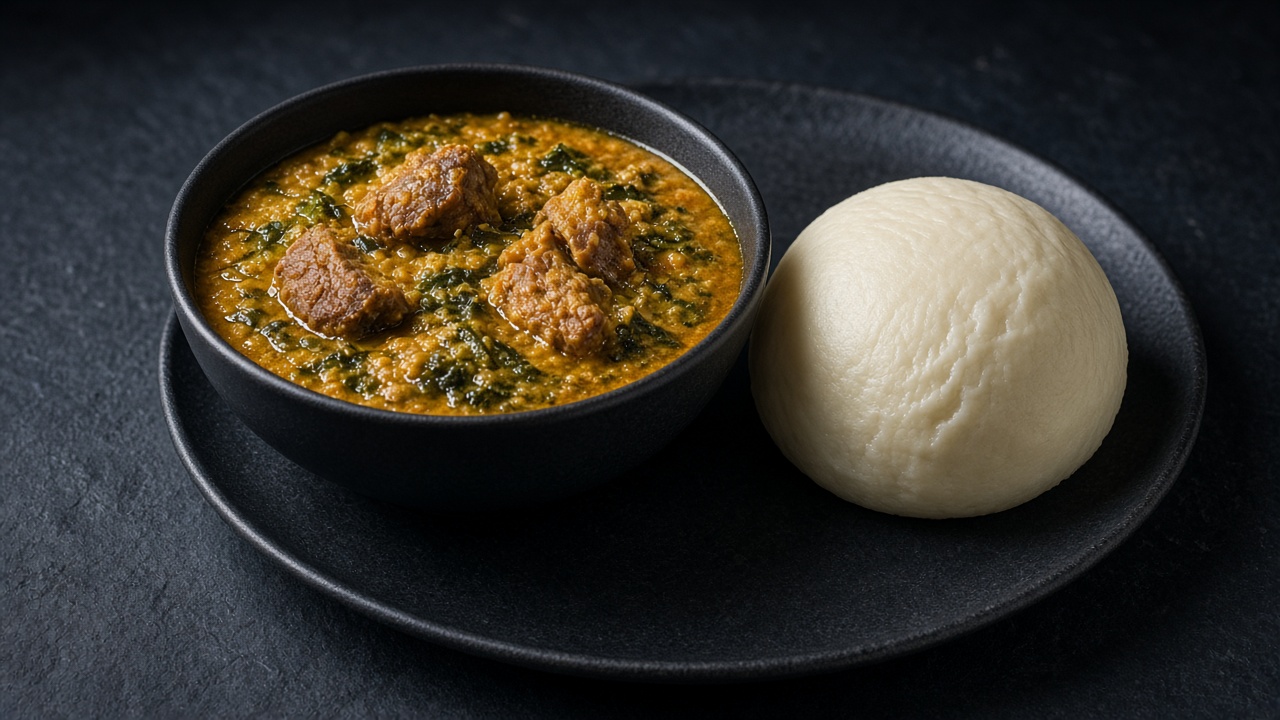
Egusi Soup with Beef and Greens
Inspired by techniques from Serious Eats.
Beef simmers with onion and cayenne to make a savoury stock, then a paste of egusi, onion and Scotch bonnet is fried in palm oil and simmered into rich curds. Kale and spinach go in at the end for colour and freshness.
Based on the listed ingredients, none of the 14 major EU allergens. Always check product labels.
Method
- 1
Simmer the beef. Put the beef, sliced onion, 1 tsp salt, cayenne and water in the saucepan, bring to the boil and skim. Cover and simmer gently for 60 minutes, until the beef is nearly tender. Lift out the beef with the slotted spoon and measure the stock: you need about 1.2 litres, so top up with water if needed.
- 2
Make the egusi paste. Blend the chopped onion and Scotch bonnet until smooth. Tip into the mixing bowl with the egusi and the 120 ml water and stir to a thick, spoonable paste. The onion's moisture helps bind the ground seeds into clumps.
- 3
Fry the clumps. Heat the palm oil in the wide pot over medium heat until it melts and shimmers, but do not let it smoke. Drop in heaped tablespoons of the paste in a single layer and cook, without stirring, for 5 minutes, until the bottoms set and brown lightly. Leaving them alone lets a crust form so they hold together.
- 4
Form the curds. Pour about 500 ml of the stock around the clumps, cover and simmer for 5 minutes. Then turn them gently with the spoon so they break into rough curds rather than a smooth paste. Those soft, cheesy-looking curds are the hallmark of a good egusi.
- 5
Simmer together. Add the beef, the rest of the stock and the 0.5 tsp salt, cover and simmer gently for 25-30 minutes, stirring now and then so nothing catches. The beef should be tender and red oil should pool on the surface. That pooled oil is the sign the egusi is fully cooked.
- 6
Add the greens. Stir in the kale and cook for 5 minutes, then add the spinach for 2 minutes until wilted. Taste and add more chilli if you like. Adding the greens last keeps them bright and fresh-tasting.
- 7
Serve. Serve hot in bowls with pounded yam, fufu, eba or plain rice. Pinch off a piece of swallow and use it to scoop up the soup.
Storage
Refrigerate up to 3 days or freeze up to 3 months. Reheat gently with a splash of water, stirring, until piping hot (74 °C). Cool leftovers in a shallow container and refrigerate within 2 hours (within 1 hour on a day above 32°C).
Why this label?
41.7 g protein for 642 kcal = 6.5 g per 100 kcal, so protein gives about 26% of the energy. High Protein needs at least 20% (5 g per 100 kcal), the condition in the Annex to EU Regulation (EC) No 1924/2006. How we decide
EU nutrition claims
- Low sugars: 1.1 g sugars per 100 ml (limit ≤ 2.5 g)
Per 100 ml of the finished dish, worked out from the nutrition per serving and the lowest likely cooked weight (about 251 ml a serving), so the true values are, if anything, lower. Thresholds from the Annex to EU Regulation (EC) No 1924/2006. How we decide
Free sugars
0 g per serving
0 % of the 50 g daily maximum · 0 % of the ideal 25 g
Free sugars under 50 g a day, ideally about 25 g, based on WHO free-sugar guidance (not endorsed by WHO). The share shown is the share of one serving. WHO
Equipment
- large saucepan (about 4 litres) with a lid
- blender
- large mixing bowl
- wide heavy pot or casserole (about 5 litres) with a lid
- wooden spoon
- slotted spoon
- measuring jug
Nutrition per serving (estimated values)
| Per serving | Amount |
|---|---|
| Energy | 642 kcal |
| Protein | 41.7 g |
| Carbohydrate | 15.4 g |
| of which sugars | 2.8 g |
| of which free sugars | 0 g |
| Fat | 49.4 g |
| of which saturates | 17 g |
| Fibre | 2.5 g |
| Salt | 1.93 g |
Protein per 100 kcal
6.5 g meets High Protein (≥ 5 g, 20% of energy)
Calculated from USDA FoodData Central ingredient values