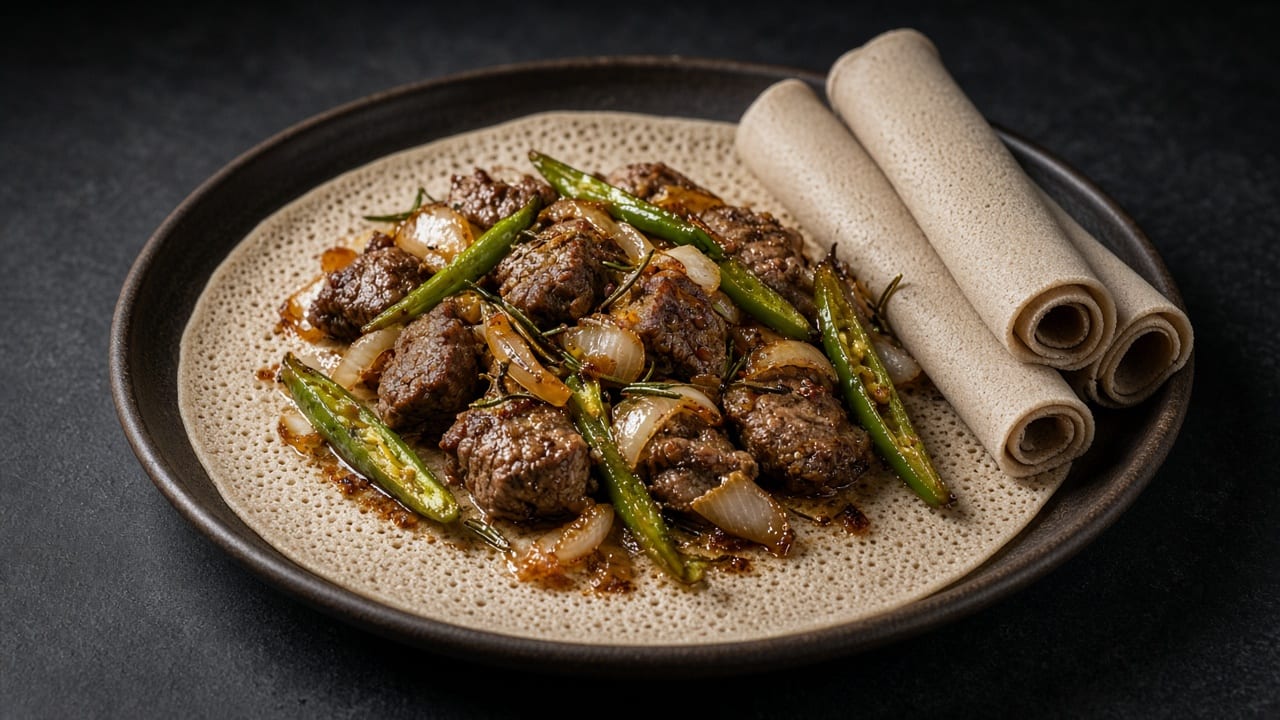
Ethiopian Berbere Beef with Onions and Green Chillies
Inspired by techniques from Serious Eats and NYT Cooking.
Cubes of beef are seared hard and fast, then tossed through onions, garlic, ginger and green chillies with a warm berbere spice blend for a quick, deeply savoury sauté.
Always check the labels of the products you use.
Method
- 1
Season the beef. Mix the paprika, cayenne, ginger, fenugreek, coriander, cardamom, allspice and cloves together to make the berbere blend. Toss the beef cubes with the salt and half of this spice mix so the flavour begins working into the meat straight away.
- 2
Sear in batches. Heat the oil in a large frying pan over high heat until lightly smoking, then add half the beef in a single layer with space between the pieces. Leave it for 2-3 minutes until well seared underneath, turn, and sear for 1-2 minutes more before lifting it into a bowl and repeating with the second batch. The beef won't be cooked through at this stage; searing in batches keeps the pan hot enough to brown the meat properly instead of letting it stew in its own juices.
- 3
Soften the onions. Lower the heat to medium, add the ghee, onion wedges and rosemary sprigs, and cook for 5-6 minutes, stirring occasionally, until the onions have softened and browned at the edges.
- 4
Bloom the spices. Stir in the garlic, ginger, chillies and the remaining berbere and cook for 1 minute until fragrant. Letting the spice mix sizzle briefly in the hot ghee draws out far more aroma than adding it straight to a liquid would.
- 5
Finish the beef. Return the seared beef and its juices to the pan and toss for 2-3 minutes until everything is coated, sizzling, and a thermometer in the centre of the thickest cube reads 63°C. Take the pan off the heat and rest for 3 minutes, then stir in the lemon juice and lift out the rosemary sprigs. Resting lets the juices settle back into the meat before serving.
- 6
Serve with injera. Serve the tibs on injera, or with rice if you prefer, tearing off pieces of the flatbread to scoop up the spiced beef and onions. The slightly sour, spongy injera is traditionally used instead of cutlery.
Storage
Cool leftovers within 2 hours, refrigerate for up to 3 days, and reheat in a hot pan until piping hot (74°C) throughout before serving.
Why this label?
44.6 g protein for 507 kcal = 8.8 g per 100 kcal, so protein gives about 35% of the energy. High Protein needs at least 20% (5 g per 100 kcal), the condition in the Annex to EU Regulation (EC) No 1924/2006. How we decide
EU nutrition claims
- Low sugars: 2.3 g sugars per 100 g (limit ≤ 5 g)
Per 100 g of the finished dish, worked out from the nutrition per serving and the lowest likely cooked weight (about 204 g a serving), so the true values are, if anything, lower. Thresholds from the Annex to EU Regulation (EC) No 1924/2006. How we decide
Free sugars
0.1 g per serving
0.2 % of the 50 g daily maximum · 0.4 % of the ideal 25 g
Free sugars under 50 g a day, ideally about 25 g, based on WHO free-sugar guidance (not endorsed by WHO). The share shown is the share of one serving. WHO
Equipment
- large heavy frying pan or cast-iron skillet (30 cm)
- tongs
- wooden spoon
- bowl
- instant-read probe thermometer
Nutrition per serving (estimated values)
| Per serving | Amount |
|---|---|
| Energy | 507 kcal |
| Protein | 44.6 g |
| Carbohydrate | 33 g |
| of which sugars | 4.7 g |
| of which free sugars | 0.1 g |
| Fat | 22 g |
| of which saturates | 9.3 g |
| Fibre | 6.6 g |
| Salt | 1.74 g |
Protein per 100 kcal
8.8 g meets High Protein (≥ 5 g, 20% of energy)
Calculated from USDA FoodData Central ingredient values