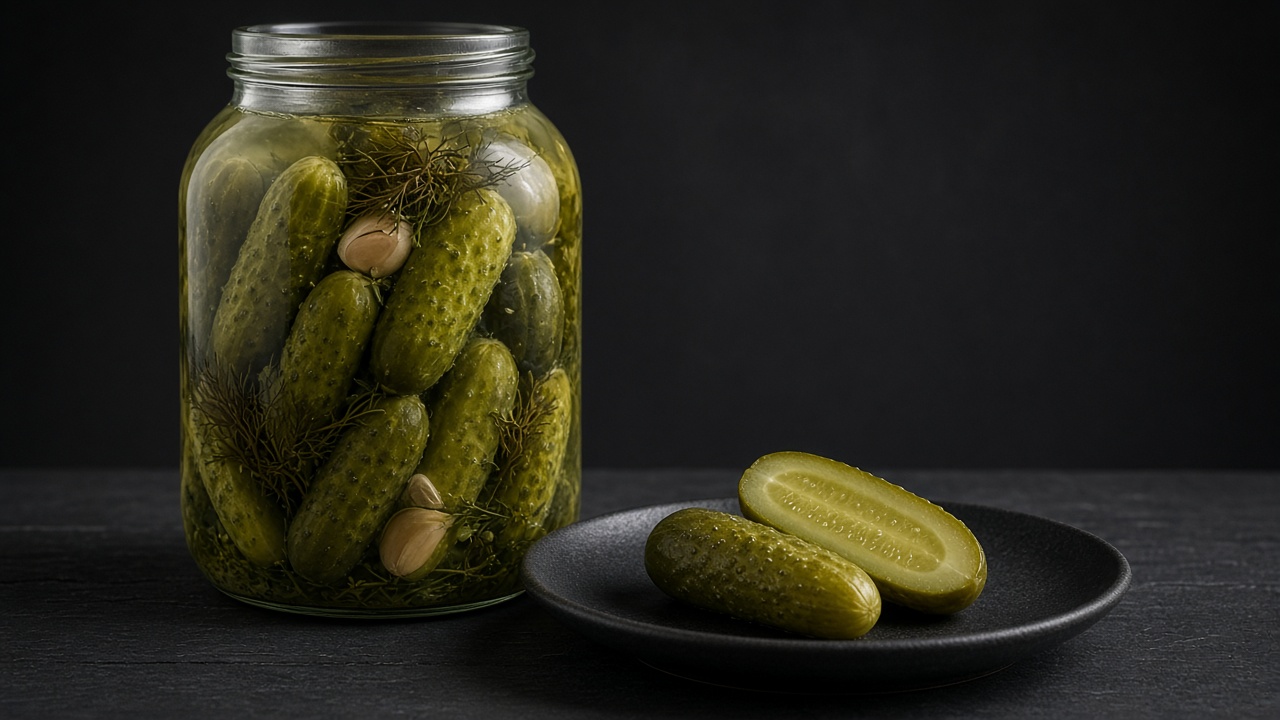
Fermented Sour Dill Pickles
Inspired by techniques from America's Test Kitchen and Serious Eats.
Small cucumbers fermented in a garlicky dill brine until olive-green, crunchy and pleasantly sour.
Based on the listed ingredients, none of the 14 major EU allergens. Always check product labels.
Method
- 1
Make the brine. Bring 500 ml of the water to the boil with the salt and stir until it dissolves. Add the remaining 1 litre cold water and leave the brine to cool completely to room temperature. Hot brine would cook the cucumbers and soften them, so patience here keeps them crisp.
- 2
Prepare the cucumbers. Scrub the cucumbers and trim a thin slice from both ends. Soak them in iced water for 30 minutes to firm them up. The blossom end holds enzymes that soften pickles, so removing it is worth the extra minute.
- 3
Pack the jar. Put half the dill, garlic, dill seeds and peppercorns in the jar. Pack in the cucumbers upright and as tightly as you can, then tuck the rest of the flavourings on top. A snug pack stops the cucumbers floating up out of the brine.
- 4
Cover and weigh. Pour in brine to cover the cucumbers by 2-3 cm, leaving 5 cm of headspace. Press a round of baking paper onto the surface, then half-fill the bag with leftover brine, seal it and set it on top as a weight. Cover with the tea towel, secure with the rubber band and stand the jar on the tray.
- 5
Ferment slowly. Leave at 16-21 °C, out of the sun, for 7-14 days, checking daily to skim any film and keep the cucumbers submerged. As fermentation takes hold, the brine turns cloudy and the pickles change from bright to olive-green. Start tasting on day 7.
- 6
Chill when ready. Once they are as sour as you like, remove the weight and paper, close the jar and refrigerate. Cold almost stops the fermentation, locking in the flavour.
Storage
Keep the pickles in their brine in a closed jar in the fridge for up to 1 month. They continue to sour slowly as they sit. Cool leftovers in a shallow container and refrigerate within 2 hours (within 1 hour on a day above 32°C).
EU nutrition claims
- Source of protein: 4.4 g protein per 100 kcal, about 18% of energy (needs ≥ 12%)
- Low energy: 24 kcal per 100 g (limit ≤ 40 kcal)
- Low fat: 0.3 g fat per 100 g (limit ≤ 3 g)
- Low saturated fat: 0 g saturated fat per 100 g, 0% of energy (limits ≤ 1.5 g and ≤ 10%)
- Low sugars: 1.8 g sugars per 100 g (limit ≤ 5 g)
- High fibre: 3.9 g fibre per 100 kcal (needs ≥ 3 g)
Per 100 g of the finished dish, worked out from the nutrition per serving and the lowest likely cooked weight (about 76 g a serving), so the true values are, if anything, lower. Thresholds from the Annex to EU Regulation (EC) No 1924/2006. How we decide
Free sugars
0 g per serving
0 % of the 50 g daily maximum · 0 % of the ideal 25 g
Free sugars under 50 g a day, ideally about 25 g, based on WHO free-sugar guidance (not endorsed by WHO). The share shown is the share of one serving. WHO
Equipment
- medium saucepan
- 2000 ml wide-mouth glass jar, washed in hot soapy water
- baking paper
- 1 litre zip-lock bag
- clean tea towel
- rubber band
- shallow tray
Nutrition per serving (estimated values)
| Per serving | Amount |
|---|---|
| Energy | 18 kcal |
| Protein | 0.8 g |
| Carbohydrate | 4.3 g |
| of which sugars | 1.4 g |
| of which free sugars | 0 g |
| Fat | 0.2 g |
| of which saturates | 0 g |
| Fibre | 0.7 g |
| Salt | 1.78 g |
Protein per 100 kcal
4.4 g High Protein needs ≥ 5 g (20% of energy)
Calculated from USDA FoodData Central ingredient values