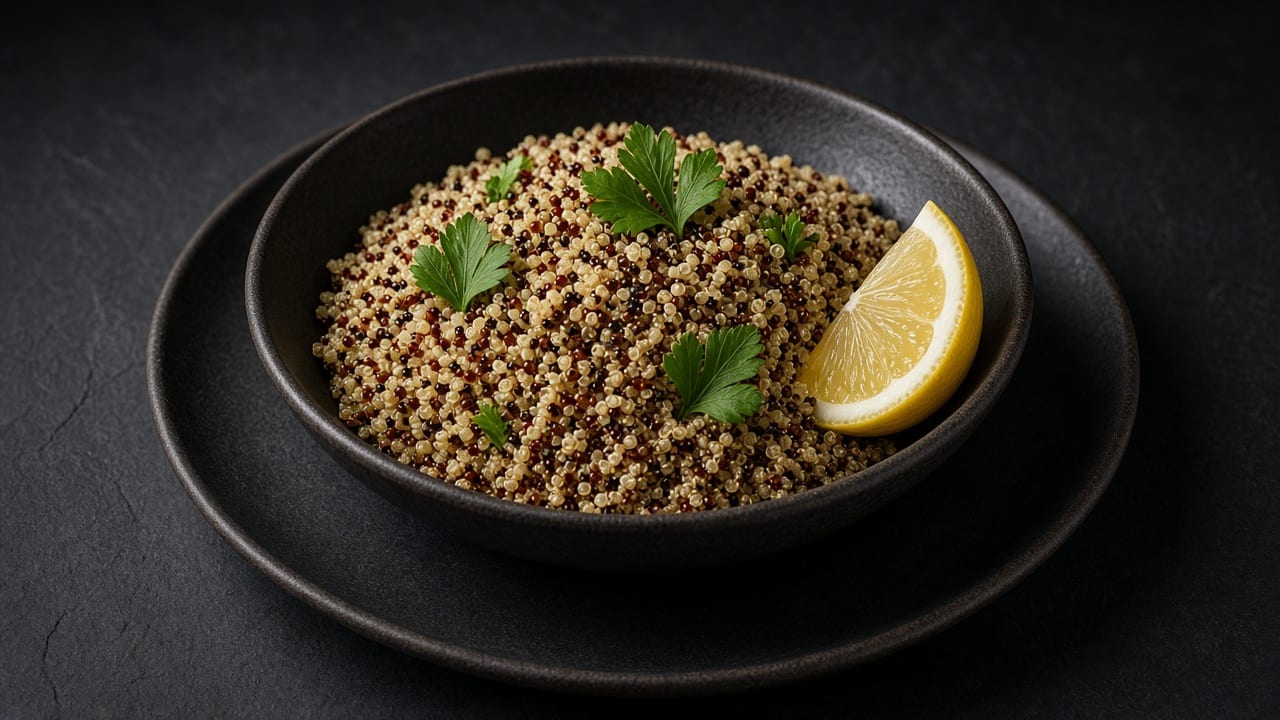
Fluffy Tricolour Quinoa with Parsley and Lemon
Inspired by techniques from America's Test Kitchen and Food Network Kitchen.
Rinsed tricolour quinoa toasted in a little oil, simmered with a bay leaf and rested under a towel so the grains stay separate and fluffy.
Based on the listed ingredients, none of the 14 major EU allergens. Always check product labels.
Method
- 1
Rinse well. Put the quinoa in the sieve and run cold water through it for 30 seconds, rubbing the seeds between your fingers. Rinsing removes the bitter natural coating, called saponin. Shake the sieve hard to get it as dry as possible.
- 2
Toast in oil. Heat 1 tbsp oil in the saucepan over medium heat and stir the quinoa for 4-5 min. It is ready when it is dry, smells toasty and starts to crackle; this step deepens the flavour.
- 3
Simmer covered. Add the 480 ml water, bay leaf and salt and bring to the boil. Cover, lower the heat and simmer 15 min, until the water has gone and the little curly tails have come away from the seeds.
- 4
Rest under a towel. Take the pan off the heat, lay a folded clean tea towel over it and put the lid back on. After 10 min the towel will have absorbed the excess steam, so the quinoa finishes fluffy rather than wet.
- 5
Fluff and finish. Remove the bay leaf and fluff the quinoa with a fork. Fold in the remaining oil, the parsley and pepper, and serve with lemon wedges.
Storage
Refrigerate in a covered container up to 4 days, or freeze flat in a bag up to 2 months. Reheat with a splash of water, covered, until piping hot (74 °C). Cool leftovers in a shallow container and refrigerate within 2 hours (within 1 hour on a day above 32°C).
EU nutrition claims
- Source of protein: 3.1 g protein per 100 kcal, about 12% of energy (needs ≥ 12%)
- Sugar-free: 0.2 g sugars per 100 g (limit ≤ 0.5 g)
- Source of fibre: 1.6 g fibre per 100 kcal (needs ≥ 1.5 g)
Per 100 g of the finished dish, worked out from the nutrition per serving and the lowest likely cooked weight (about 62 g a serving), so the true values are, if anything, lower. Thresholds from the Annex to EU Regulation (EC) No 1924/2006. How we decide
Free sugars
0.1 g per serving
0.2 % of the 50 g daily maximum · 0.4 % of the ideal 25 g
Free sugars under 50 g a day, ideally about 25 g, based on WHO free-sugar guidance (not endorsed by WHO). The share shown is the share of one serving. WHO
Equipment
- fine-mesh sieve
- medium saucepan with lid
- wooden spoon
- clean tea towel
- fork
Nutrition per serving (estimated values)
| Per serving | Amount |
|---|---|
| Energy | 310 kcal |
| Protein | 9.6 g |
| Carbohydrate | 43.8 g |
| of which sugars | 0.1 g |
| of which free sugars | 0.1 g |
| Fat | 10.9 g |
| of which saturates | 1.4 g |
| Fibre | 4.9 g |
| Salt | 1.11 g |
Protein per 100 kcal
3.1 g High Protein needs ≥ 5 g (20% of energy)
Calculated from USDA FoodData Central ingredient values