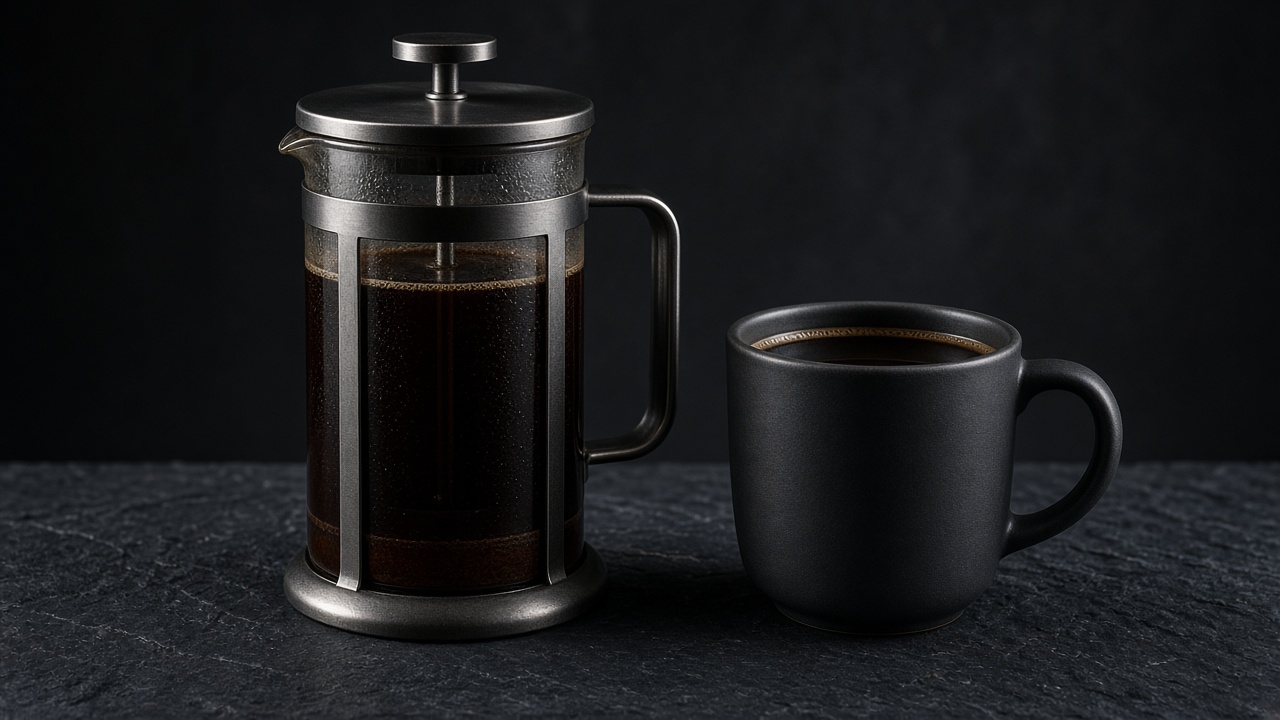
French Press Coffee with a Short Bloom and Long Steep
Inspired by techniques from Serious Eats.
Coarsely ground coffee steeped in hot water for 4–6 minutes, then pressed to separate the grounds, creating a rich and full-bodied brew.
Based on the listed ingredients, none of the 14 major EU allergens. Always check product labels.
Method
- 1
Boil. Boil the water and let it sit 30 s, reaching about 95 °C.
- 2
Warm. Warm the 1000 ml press with hot water and empty it.
- 3
Grind. Grind the 56 g beans to a coarse consistency, between filter and very coarse.
- 4
Bloom. Tip the grounds into the press, pour in just enough water to wet them all and let bloom 30 s.
- 5
Steep. Add the rest of the 900 ml water, stir briefly, and set the lid on with the plunger raised so it does not touch the coffee; steep for 4–6 min, depending on how light or full-bodied you like it.
- 6
Press. Press the plunger down slowly and steadily, holding the jug; if it resists, lift slightly and press again, but do not force it.
- 7
Pour. Pour all the coffee out at once into mugs or a carafe so it does not keep brewing; for a cleaner brew, pour through a paper filter.
Storage
Brew and serve fresh. Cool leftovers in a shallow container and refrigerate within 2 hours (within 1 hour on a day above 32°C).
Why this label?
0.3 g protein for 2 kcal = 15 g per 100 kcal, so protein gives about 60% of the energy. High Protein needs at least 20% (5 g per 100 kcal), the condition in the Annex to EU Regulation (EC) No 1924/2006. How we decide
- Total fat: 0 % of energy (limit ≤ 30%)
- Saturated fat: 0 % of energy (limit < 10%)
- Free sugars: 0 % of energy (limit < 10%)
- Salt: 0.01 g (limit ≤ 0.01 g)
- Fibre or fruit & veg: 0 g fibre / 0 g veg (limit ≥ 0 g fibre or 80 g fruit & veg)
Per serving, worked out from the nutrition table against our rule based on the WHO healthy diet guidance. Not endorsed by WHO.
EU nutrition claims
- Low energy: 1 kcal per 100 ml (limit ≤ 20 kcal)
- Low fat: 0 g fat per 100 ml (limit ≤ 1.5 g)
- Low saturated fat: 0 g saturated fat per 100 ml, 0% of energy (limits ≤ 0.75 g and ≤ 10%)
- Sugar-free: 0 g sugars per 100 ml (limit ≤ 0.5 g)
- Low salt: 0.01 g salt per 100 ml (limit ≤ 0.3 g)
Per 100 ml of the finished dish, worked out from the nutrition per serving and the lowest likely cooked weight (about 167 ml a serving), so the true values are, if anything, lower. Thresholds from the Annex to EU Regulation (EC) No 1924/2006. How we decide
Caffeine · Free sugars
- Per serving: about 90 mg caffeine (serving: 1 mug (about 225 ml)). Source: about 225 ml brewed per serving × USDA FDC SR Legacy #171890 (brewed coffee, 40 mg/100 g).
- Scaling: making more servings does not change the caffeine in each serving; what counts is how many servings you drink in a day. 1 serving: 90 mg · 2 servings: 180 mg · 3 servings: 270 mg (above EFSA 200 mg at once) · 4 servings: 360 mg (above EFSA 200 mg at once).
- General guideline: EFSA Scientific Opinion on the safety of caffeine (2015): for healthy adults, up to 200 mg in a single dose and up to 400 mg per day do not raise safety concerns. 1 serving = 23 % of 400 mg. EFSA
0 g per serving
0 % of the 50 g daily maximum · 0 % of the ideal 25 g
Free sugars under 50 g a day, ideally about 25 g, based on WHO free-sugar guidance (not endorsed by WHO). The share shown is the share of one serving. WHO
Equipment
- 1000 ml French press (cafetière)
- kettle
- burr grinder
- digital scale
- long spoon
- timer
Nutrition per serving (estimated values)
| Per serving | Amount |
|---|---|
| Energy | 2 kcal |
| Protein | 0.3 g |
| Carbohydrate | 0 g |
| of which sugars | 0 g |
| of which free sugars | 0 g |
| Fat | 0 g |
| of which saturates | 0 g |
| Fibre | 0 g |
| Salt | 0.01 g |
Protein per 100 kcal
15 g meets High Protein (≥ 5 g, 20% of energy)
Calculated from USDA FoodData Central ingredient values