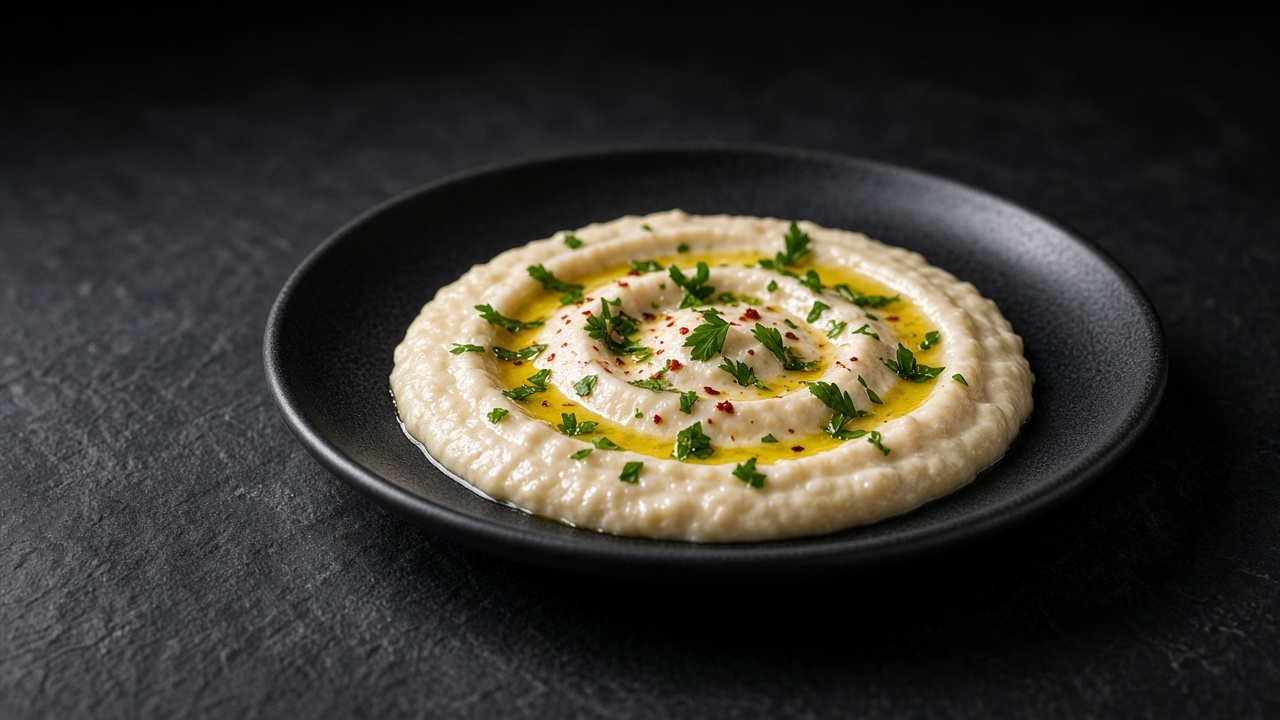
Garlicky White Bean Dip with Sage
Inspired by techniques from America's Test Kitchen.
Home-cooked cannellini beans are warmed through with garlic, sage and chilli flakes, then pureed smooth with lemon juice and oil into a creamy dip. A generous drizzle of olive oil and a scatter of parsley finish it at the table.
Based on the listed ingredients, none of the 14 major EU allergens. Always check product labels.
Method
- 1
Brine the beans. Dissolve the brining salt in the cold water in a large container. Add the beans and let them soak at room temperature for at least 8 hours, or up to 24 hours.
- 2
Simmer. Drain the beans in a colander and rinse well. Combine the beans, the fresh water and the 3 tsp salt in a large casserole (Dutch oven) and bring to the boil over high heat. Reduce the heat to medium and cook at a gentle simmer until the beans are barely tender, 40-50 min.
- 3
Steep and set aside. Turn off the heat, cover the pot, and let the beans steep until fully tender, 20-30 min more. Drain. You'll need about half the beans for the dip; refrigerate or freeze the rest for another use.
- 4
Cook the garlic. Combine 60 ml of the olive oil and the garlic in a non-stick frying pan and cook over medium heat until the garlic is just lightly golden at the edges, about 3 min.
- 5
Bloom the sage and chilli. Add the sage and chilli flakes and cook until fragrant, about 30 sec. Add about half the cooked beans and the remaining 1/4 tsp salt and cook until just heated through, about 2 min.
- 6
Puree. Transfer the bean mixture to a food processor with 75 ml water, the lemon juice and the remaining 30 ml olive oil. Process until smooth, about 2 min, scraping down the sides as needed.
- 7
Finish and serve. Spread the dip in a shallow serving dish, drizzle liberally with extra olive oil, and sprinkle with the parsley.
Storage
Refrigerate the dip in an airtight container for up to 3-4 days. The extra cooked beans keep refrigerated up to 3 days or frozen up to 1 month.
EU nutrition claims
- Source of protein: 3.4 g protein per 100 kcal, about 13% of energy (needs ≥ 12%)
- Low sugars: 0.7 g sugars per 100 g (limit ≤ 5 g)
- Source of fibre: 2.2 g fibre per 100 kcal (needs ≥ 1.5 g)
Per 100 g of the finished dish, worked out from the nutrition per serving and the lowest likely cooked weight (about 82 g a serving), so the true values are, if anything, lower. Thresholds from the Annex to EU Regulation (EC) No 1924/2006. How we decide
Free sugars
0.1 g per serving
0.2 % of the 50 g daily maximum · 0.4 % of the ideal 25 g
Free sugars under 50 g a day, ideally about 25 g, based on WHO free-sugar guidance (not endorsed by WHO). The share shown is the share of one serving. WHO
Equipment
- large container for soaking
- colander
- large casserole (Dutch oven) or large saucepan
- 30 cm non-stick frying pan
- food processor
- shallow serving dish
- chef's knife
- chopping board
Nutrition per serving Calculated from USDA FoodData Central
| Per serving | Amount |
|---|---|
| Energy | 419 kcal |
| Protein | 14.1 g |
| Carbohydrate | 37.2 g |
| of which sugars | 0.6 g |
| of which free sugars | 0.1 g |
| Fat | 24.9 g |
| of which saturates | 3.5 g |
| Fibre | 9.3 g |
| Salt | 1.12 g |
Protein per 100 kcal
3.4 g High Protein needs ≥ 5 g (20% of energy)
Calculated from USDA FoodData Central ingredient values