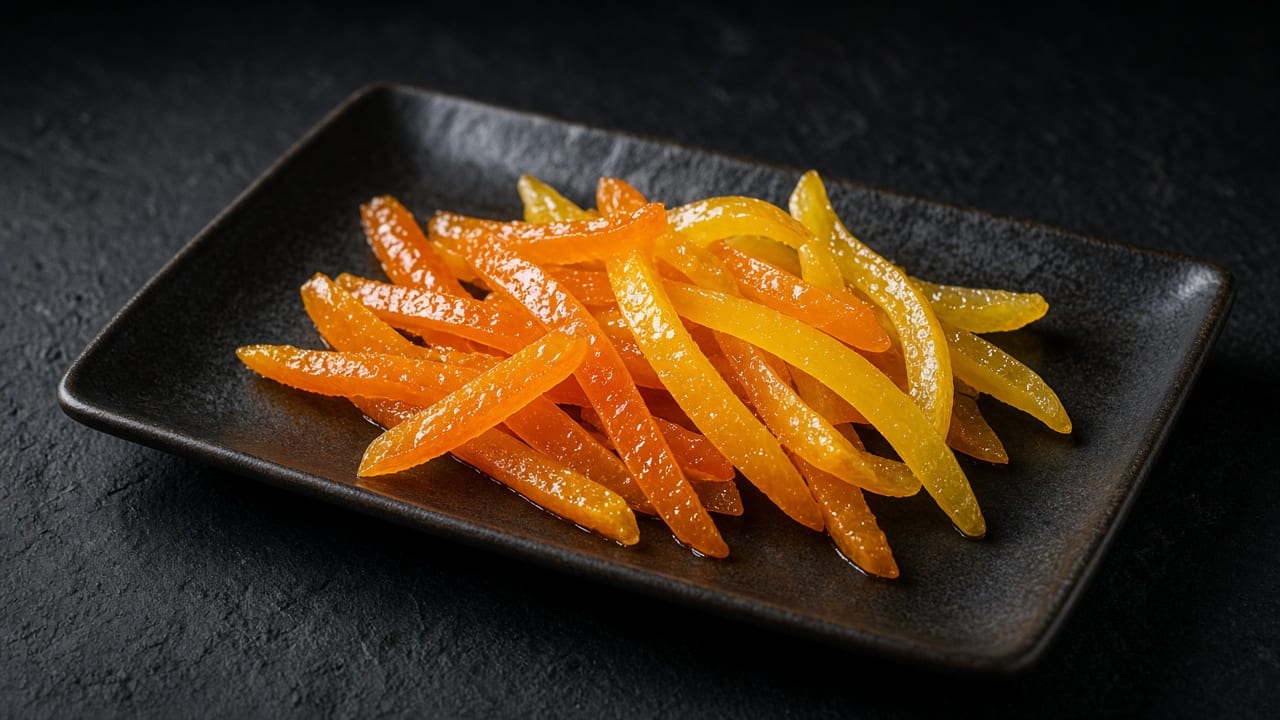
Glossy Candied Orange and Lemon Peel
Inspired by techniques from King Arthur Baking, Serious Eats and America's Test Kitchen.
Strips of orange and lemon peel blanched three times to tame their bitterness, then simmered slowly in syrup until soft, glossy and translucent.
Based on the listed ingredients, none of the 14 major EU allergens. Always check product labels.
Method
- 1
Cut the peel. Score each orange and lemon from top to bottom into quarters and pull the peel away from the fruit. Slice it into strips about 6 mm wide and trim off any thick white pith or bits of flesh.
- 2
Blanch three times. Put the strips in the saucepan and cover them with cold water. Bring to the boil, boil for 5 min and drain. Do this twice more, with fresh cold water each time; each round takes away more bitterness.
- 3
Make the syrup. Put the sugar, the 400 ml water and the corn syrup in the empty pan over medium heat and stir until the sugar has completely dissolved.
- 4
Simmer until translucent. Add the blanched peel and bring back to the boil, then turn the heat down so the syrup barely bubbles. Simmer for 40-60 min, stirring now and then, until the strips are soft and look translucent, especially at the edges.
- 5
Drain. Lift the strips out with a fork, letting the excess syrup drip back into the pan, and lay them in a single layer on the paper-lined rack.
- 6
Dry. Leave uncovered at room temperature for 8-12 h, until the peel is glossy but no longer wet or sticky to touch.
Storage
Keep in an airtight jar at room temperature for up to 1 month, or in the fridge for up to 3 months.
EU nutrition claims
- Low fat: 0.3 g fat per 100 g (limit ≤ 3 g)
- Low saturated fat: 0 g saturated fat per 100 g, 0% of energy (limits ≤ 1.5 g and ≤ 10%)
- Low salt: 0.03 g salt per 100 g (limit ≤ 0.3 g)
- High fibre: 3.2 g fibre per 100 kcal (needs ≥ 3 g)
Per 100 g of the finished dish, worked out from the nutrition per serving and the lowest likely cooked weight (about 35 g a serving), so the true values are, if anything, lower. Thresholds from the Annex to EU Regulation (EC) No 1924/2006. How we decide
Free sugars
17.9 g per serving
35.8 % of the 50 g daily maximum · 71.6 % of the ideal 25 g
Free sugars under 50 g a day, ideally about 25 g, based on WHO free-sugar guidance (not endorsed by WHO). The share shown is the share of one serving. WHO
Equipment
- sharp paring knife
- chopping board
- medium saucepan
- colander
- wire rack set over a tray
- baking paper
Nutrition per serving (estimated values)
| Per serving | Amount |
|---|---|
| Energy | 93 kcal |
| Protein | 0.4 g |
| Carbohydrate | 24.3 g |
| of which sugars | 18.3 g |
| of which free sugars | 17.9 g |
| Fat | 0.1 g |
| of which saturates | 0 g |
| Fibre | 3 g |
| Salt | 0.01 g |
Protein per 100 kcal
0.4 g High Protein needs ≥ 5 g (20% of energy)
Calculated from USDA FoodData Central ingredient values