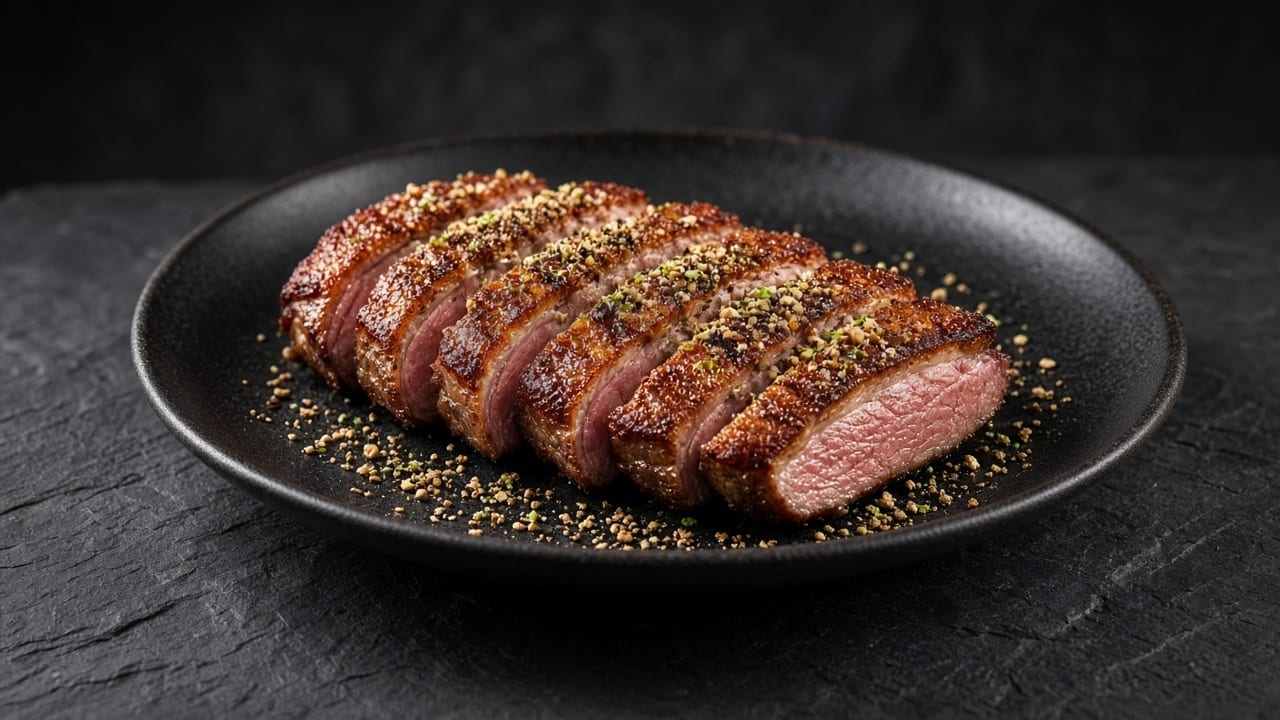
Grains of Paradise Duck Breast
Inspired by techniques from Serious Eats.
Duck breasts scored and rubbed both over and under the skin with toasted grains of paradise, coriander and lime zest, then seared skin side down under a second pan until deep brown and crisp. Keeping most of the spice beneath the skin lets it season the meat directly without scorching on the surface.
Based on the listed ingredients, none of the 14 major EU allergens. Always check product labels.
Method
- 1
Mix the rub. Combine the ground grains of paradise, ground coriander, fine salt, demerara sugar and lime zest in a small bowl and set aside.
- 2
Score and season the skin. Gently slice through just the skin of each duck breast three or four times, deep enough to expose a little fat but not into the meat. Press a couple of small pinches of the rub onto each side, along with a touch more salt; a light coating on the outside is enough, since too much will burn.
- 3
Open the breast under the skin. With a sharp paring knife, slice between the fat and the meat of each breast, leaving one long edge attached like a hinge. Open the flap and work the rub generously into the meat underneath, with a little more salt, so it's fully coated; keeping most of the rub under the skin stops it scorching while still seasoning the meat directly.
- 4
Rest, then sear skin side down. Let the breasts sit for about 30 minutes. Heat a cast-iron frying pan over medium-high heat. Pat the duck dry with kitchen paper, then lay the breasts skin side down in the hot but not smoking pan. Set a second heavy frying pan on top to press them flat and stop the skin curling.
- 5
Brown, flip and finish. After 2-5 minutes, lift a corner to check the skin; if it isn't a deep brown yet, give it another minute or two. Once it is, flip the breasts and cook for a few minutes more, again pressed under the second pan.
- 6
Rest and slice. Move the duck to a plate and lift the skin to check the meat: it should be rare but not raw, a dull red rather than shiny (about 54-57 °C). Let it rest a few minutes, then slice on the diagonal and scatter over a little more of the spice rub.
Storage
Best eaten right away while the skin is crisp. Refrigerate leftovers in an airtight container for up to 3 days and reheat gently so the meat doesn't dry out. Cool leftovers in a shallow container and refrigerate within 2 hours (within 1 hour on a day above 32°C).
EU nutrition claims
- Low sugars: 3 g sugars per 100 g (limit ≤ 5 g)
Per 100 g of the finished dish, worked out from the nutrition per serving and the lowest likely cooked weight (about 133 g a serving), so the true values are, if anything, lower. Thresholds from the Annex to EU Regulation (EC) No 1924/2006. How we decide
Free sugars
4 g per serving
8 % of the 50 g daily maximum · 16 % of the ideal 25 g
Free sugars under 50 g a day, ideally about 25 g, based on WHO free-sugar guidance (not endorsed by WHO). The share shown is the share of one serving. WHO
Equipment
- paring knife
- chopping board
- small mixing bowl
- fine grater
- spice grinder or pestle and mortar
- cast-iron frying pan
- second heavy frying pan or heavy lid, to press the breasts flat
- tongs
- instant-read thermometer
Nutrition per serving Calculated from USDA FoodData Central
| Per serving | Amount |
|---|---|
| Energy | 633 kcal |
| Protein | 17.7 g |
| Carbohydrate | 6.4 g |
| of which sugars | 4 g |
| of which free sugars | 4 g |
| Fat | 59.4 g |
| of which saturates | 19.9 g |
| Fibre | 1.4 g |
| Salt | 3.15 g |
Protein per 100 kcal
2.8 g High Protein needs ≥ 5 g (20% of energy)
Calculated from USDA FoodData Central ingredient values