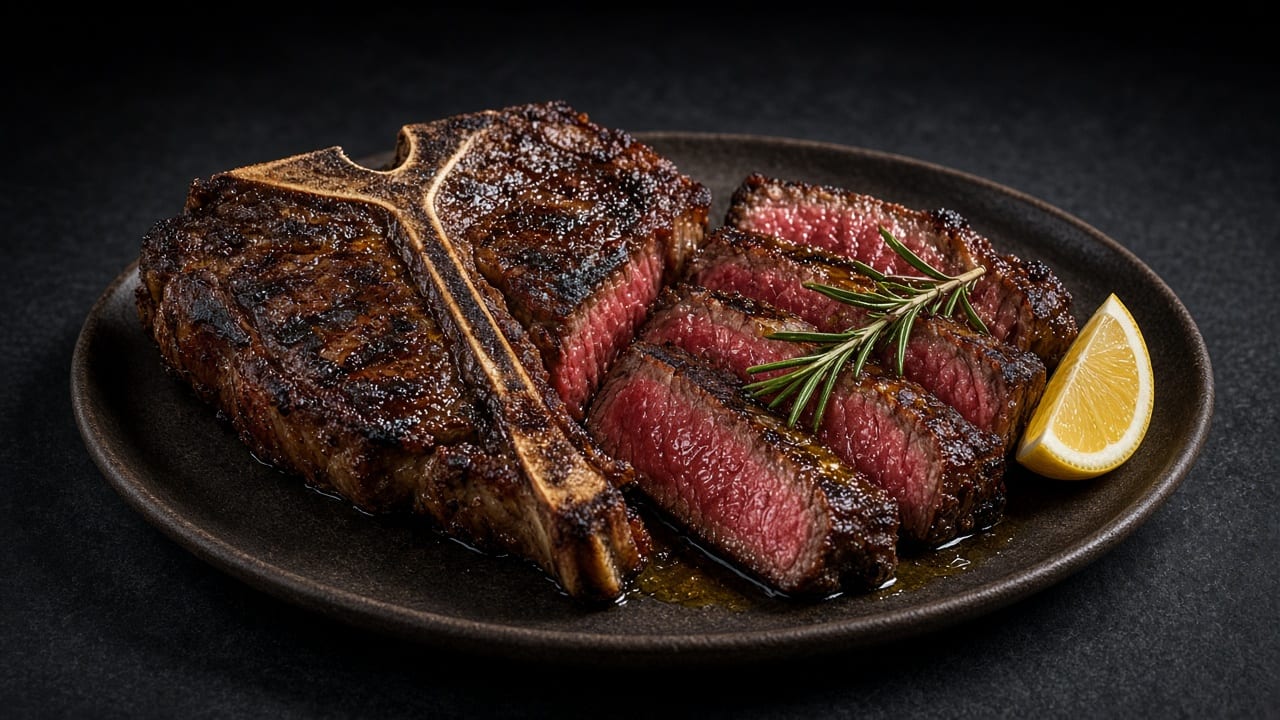
Grilled Thick-Cut Porterhouse Steak with Rosemary, Olive Oil and Lemon
Inspired by techniques from America's Test Kitchen.
Thick porterhouse steaks are charred over a hot fire and finished gently on the cooler side of the barbecue, then sliced and dressed with rosemary-infused olive oil, flaky salt and lemon.
Based on the listed ingredients, none of the 14 major EU allergens. Always check product labels.
Method
- 1
Salt ahead. Pat the steaks dry, sprinkle them all over with the steak salt and refrigerate uncovered on the rack for 1-24 h. Salt draws out moisture that is then reabsorbed, seasoning the meat more deeply and drying the surface for a better char.
- 2
Build a two-zone fire. Light a full chimney of charcoal and, once the coals are covered in grey ash, pour them over half the barbecue. On a gas barbecue, heat on high for 15 min, then turn off one side. Clean and oil the grate so the steaks release easily.
- 3
Char over high heat. Pat the steaks dry again, rub with 1 tbsp of the olive oil and season with the pepper. Place them over the hot side with the fillet sections facing the cooler side, since the smaller fillet cooks faster. Grill for 6-8 min per side, until well charred.
- 4
Finish gently. Move the steaks to the cooler side with the bone facing the fire, cover and cook for 10-20 min, turning once. They are done when a thermometer pushed in sideways reads at least 63°C in both the strip and the fillet. The bone shields the meat from direct heat while the thick centre catches up gently.
- 5
Rest the steaks. Rest on the rack, loosely covered with foil, for 10 min (at least 3 min). This gives the juices time to settle so less runs out when you carve.
- 6
Carve and dress. Cut the strip and fillet away from the bone, slice each across the grain 1.5 cm thick and reassemble around the bones on the board. Warm the remaining olive oil with the rosemary for 2 min, spoon it over the meat and sprinkle with the flaky salt. Serve with lemon wedges and rocket.
Storage
Cool leftovers within 2 hours and refrigerate, covered, for up to 3 days. Reheat gently until piping hot (74°C), or serve cold, thinly sliced, over rocket.
Why this label?
60.7 g protein for 631 kcal = 9.6 g per 100 kcal, so protein gives about 38% of the energy. High Protein needs at least 20% (5 g per 100 kcal), the condition in the Annex to EU Regulation (EC) No 1924/2006. How we decide
EU nutrition claims
- Sugar-free: 0.2 g sugars per 100 g (limit ≤ 0.5 g)
Per 100 g of the finished dish, worked out from the nutrition per serving and the lowest likely cooked weight (about 296 g a serving), so the true values are, if anything, lower. Thresholds from the Annex to EU Regulation (EC) No 1924/2006. How we decide
Free sugars
0.2 g per serving
0.4 % of the 50 g daily maximum · 0.8 % of the ideal 25 g
Free sugars under 50 g a day, ideally about 25 g, based on WHO free-sugar guidance (not endorsed by WHO). The share shown is the share of one serving. WHO
Equipment
- charcoal or gas barbecue set up for two-zone cooking
- chimney starter (charcoal)
- long tongs
- wire rack set in a rimmed baking tray
- foil
- carving board
- sharp knife
- instant-read probe thermometer
Nutrition per serving (estimated values)
| Per serving | Amount |
|---|---|
| Energy | 631 kcal |
| Protein | 60.7 g |
| Carbohydrate | 1.4 g |
| of which sugars | 0.5 g |
| of which free sugars | 0.2 g |
| Fat | 41 g |
| of which saturates | 14.4 g |
| Fibre | 0.5 g |
| Salt | 1.77 g |
Protein per 100 kcal
9.6 g meets High Protein (≥ 5 g, 20% of energy)
Calculated from USDA FoodData Central ingredient values