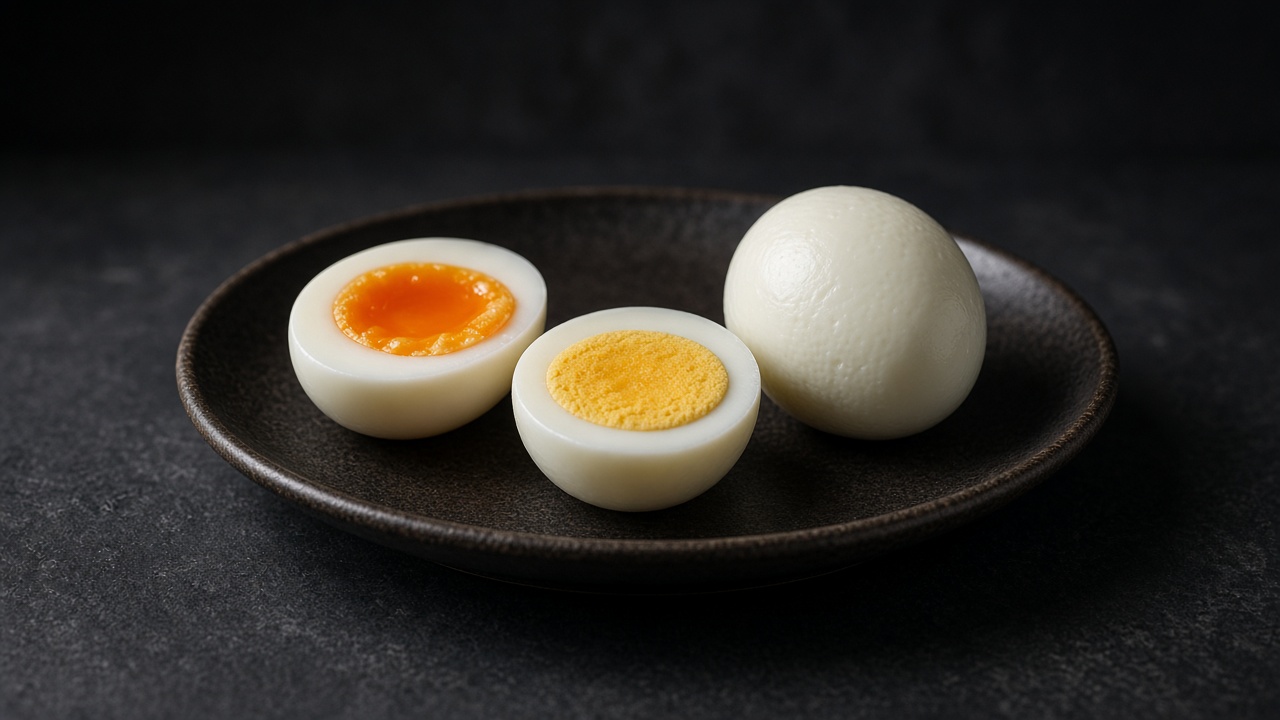
Hard-Boiled Eggs with an Ice Bath for Easy Peeling
Inspired by techniques from Serious Eats and America's Test Kitchen.
Reliable hard-boiled eggs with firm whites and fully set yolks, cooked gently and plunged into iced water so the shells slip off easily. Perfect for snacks, salads and lunchboxes.
Always check the labels of the products you use.
Method
- 1
Prepare the water. Bring at least 2 litres of water to a rolling boil in the large saucepan, and meanwhile fill the bowl with the ice cubes and cold water. Having the ice bath ready before the eggs go in means you can cool them the moment they are done.
- 2
Cook the eggs. Using the slotted spoon, lower the eggs gently into the boiling water and boil for 30 seconds. Then cover, turn the heat to low so the water barely simmers and cook for 12 minutes, until the whites and yolks are completely firm (well above 71°C). That brief hard boil sets the outer white quickly so it pulls away from the shell, while the gentle simmer that follows cooks the yolk through without turning the white rubbery.
- 3
Chill in iced water. Lift the eggs straight into the iced water and leave for 5-10 minutes until cold right through. Rapid cooling stops the cooking, which prevents a grey-green ring forming around the yolk, and makes the egg contract slightly from its shell for easier peeling.
- 4
Peel and season. Tap each egg all over on the worktop to crack the shell into small pieces. Starting at the wider end, where there is a small air pocket, peel under a trickle of water, getting your thumb under the thin membrane so the shell lifts away in large pieces. Halve the eggs and season with the salt and pepper to serve.
Storage
Refrigerate within 1 hour of cooking. Unpeeled eggs keep in the fridge for up to 7 days and peeled eggs for up to 2 days in a covered container.
Why this label?
12.6 g protein for 143 kcal = 8.8 g per 100 kcal, so protein gives about 35% of the energy. High Protein needs at least 20% (5 g per 100 kcal), the condition in the Annex to EU Regulation (EC) No 1924/2006. How we decide
EU nutrition claims
- Low sugars: 0.6 g sugars per 100 g (limit ≤ 5 g)
Per 100 g of the finished dish, worked out from the nutrition per serving and the lowest likely cooked weight (about 72 g a serving), so the true values are, if anything, lower. Thresholds from the Annex to EU Regulation (EC) No 1924/2006. How we decide
Free sugars
0 g per serving
0 % of the 50 g daily maximum · 0 % of the ideal 25 g
Free sugars under 50 g a day, ideally about 25 g, based on WHO free-sugar guidance (not endorsed by WHO). The share shown is the share of one serving. WHO
Equipment
- large saucepan with a lid
- slotted spoon or spider
- large bowl
- timer
Nutrition per serving (estimated values)
| Per serving | Amount |
|---|---|
| Energy | 143 kcal |
| Protein | 12.6 g |
| Carbohydrate | 0.8 g |
| of which sugars | 0.4 g |
| of which free sugars | 0 g |
| Fat | 9.5 g |
| of which saturates | 3.1 g |
| Fibre | 0 g |
| Salt | 0.72 g |
Protein per 100 kcal
8.8 g meets High Protein (≥ 5 g, 20% of energy)
Calculated from USDA FoodData Central ingredient values