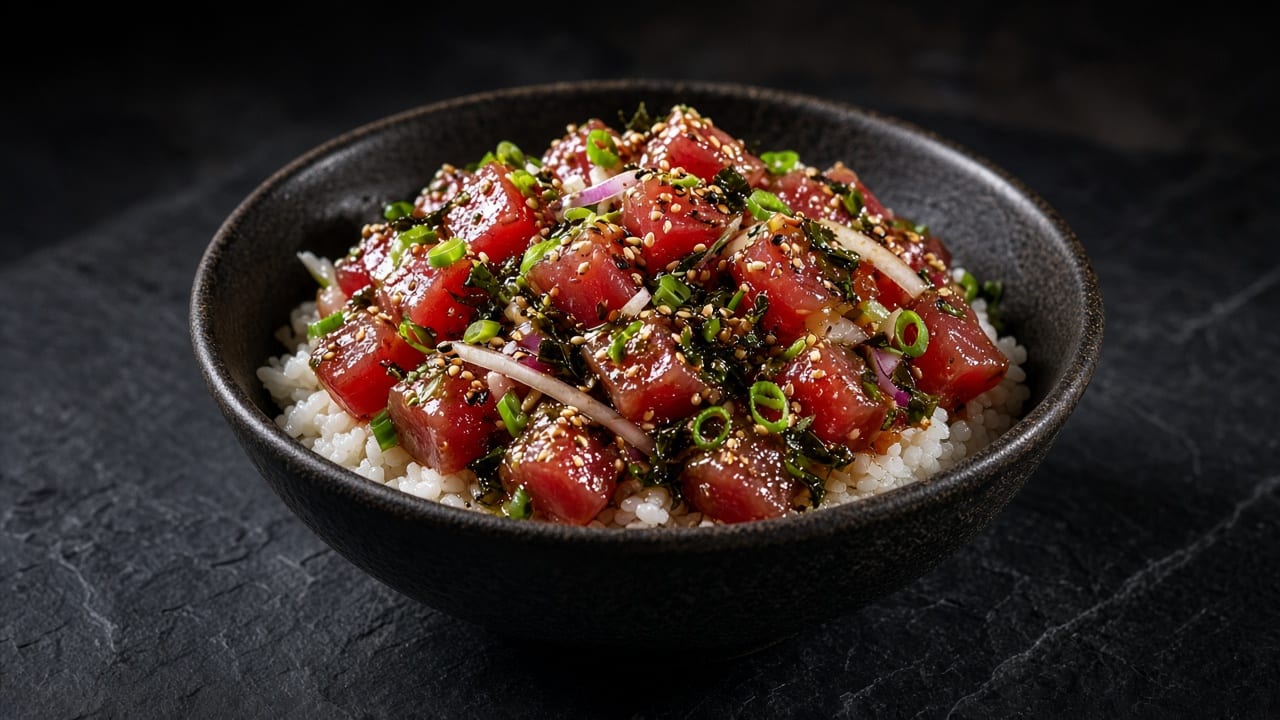
Hawaiian Ahi Tuna Poke with Sesame, Macadamia and Rice
Inspired by techniques from America's Test Kitchen.
Cubes of raw yellowfin tuna in a soy, sesame and ginger dressing with onion, spring onion and toasted macadamias, piled over short-grain rice with sesame and nori.
Always check the labels of the products you use.
Method
- 1
Cook the rice. Rinse the rice until the water runs nearly clear, then boil it with 360 ml water, cover and cook on the lowest heat for 12 min. Rest it off the heat for 10 min, fluff and let it cool until just warm, so it does not cook the fish.
- 2
Mix the dressing. Whisk together the soy sauce, neutral oil, sesame oil, ginger, garlic and chilli flakes in a small bowl. Taste it on its own; it should be salty, nutty and gently hot.
- 3
Toast the nuts. Shake the macadamias in a dry frying pan over medium heat for 3-4 min until golden in patches and fragrant. Cool, then chop roughly; toasting brings out their buttery taste and keeps them crunchy.
- 4
Dress the tuna. No more than 15 min before eating, fold the tuna cubes through the dressing with the onion, spring onion whites and half the nuts. Chill for 5-10 min; any longer and the salt starts to firm the fish and draw out its juices.
- 5
Build the bowls. Spoon the rice into four bowls and top with the poke and its dressing. Scatter over the spring onion greens, the rest of the nuts, the sesame seeds and strips of nori, and eat at once.
Storage
Poke is best eaten straight away. Leftover dressed tuna should be discarded; plain rice keeps 1 day in the fridge (cool it quickly).
Why this label?
34.8 g protein for 556 kcal = 6.3 g per 100 kcal, so protein gives about 25% of the energy. High Protein needs at least 20% (5 g per 100 kcal), the condition in the Annex to EU Regulation (EC) No 1924/2006. How we decide
- Total fat: 27.5 % of energy (limit ≤ 30%)
- Saturated fat: 3.9 % of energy (limit < 10%)
- Free sugars: 0 % of energy (limit < 10%)
- Salt: 1.51 g (limit ≤ 1.7 g)
- Fibre or fruit & veg: 1.8 g fibre / 123 g veg (limit ≥ 7 g fibre or 80 g fruit & veg)
Per serving, worked out from the nutrition table against our rule based on the WHO healthy diet guidance. Not endorsed by WHO.
EU nutrition claims
- Low saturated fat: 1.3 g saturated fat per 100 g, 3.9% of energy (limits ≤ 1.5 g and ≤ 10%)
- Low sugars: 0.7 g sugars per 100 g (limit ≤ 5 g)
Per 100 g of the finished dish, worked out from the nutrition per serving and the lowest likely cooked weight (about 191 g a serving), so the true values are, if anything, lower. Thresholds from the Annex to EU Regulation (EC) No 1924/2006. How we decide
Free sugars
0 g per serving
0 % of the 50 g daily maximum · 0 % of the ideal 25 g
Free sugars under 50 g a day, ideally about 25 g, based on WHO free-sugar guidance (not endorsed by WHO). The share shown is the share of one serving. WHO
Equipment
- sieve
- heavy saucepan with tight lid
- large bowl
- small bowl
- sharp knife
- kitchen scissors
- 4 bowls
Nutrition per serving (estimated values)
| Per serving | Amount |
|---|---|
| Energy | 556 kcal |
| Protein | 34.8 g |
| Carbohydrate | 64.3 g |
| of which sugars | 1.3 g |
| of which free sugars | 0 g |
| Fat | 17 g |
| of which saturates | 2.4 g |
| Fibre | 1.8 g |
| Salt | 1.51 g |
Protein per 100 kcal
6.3 g meets High Protein (≥ 5 g, 20% of energy)
Calculated from USDA FoodData Central ingredient values