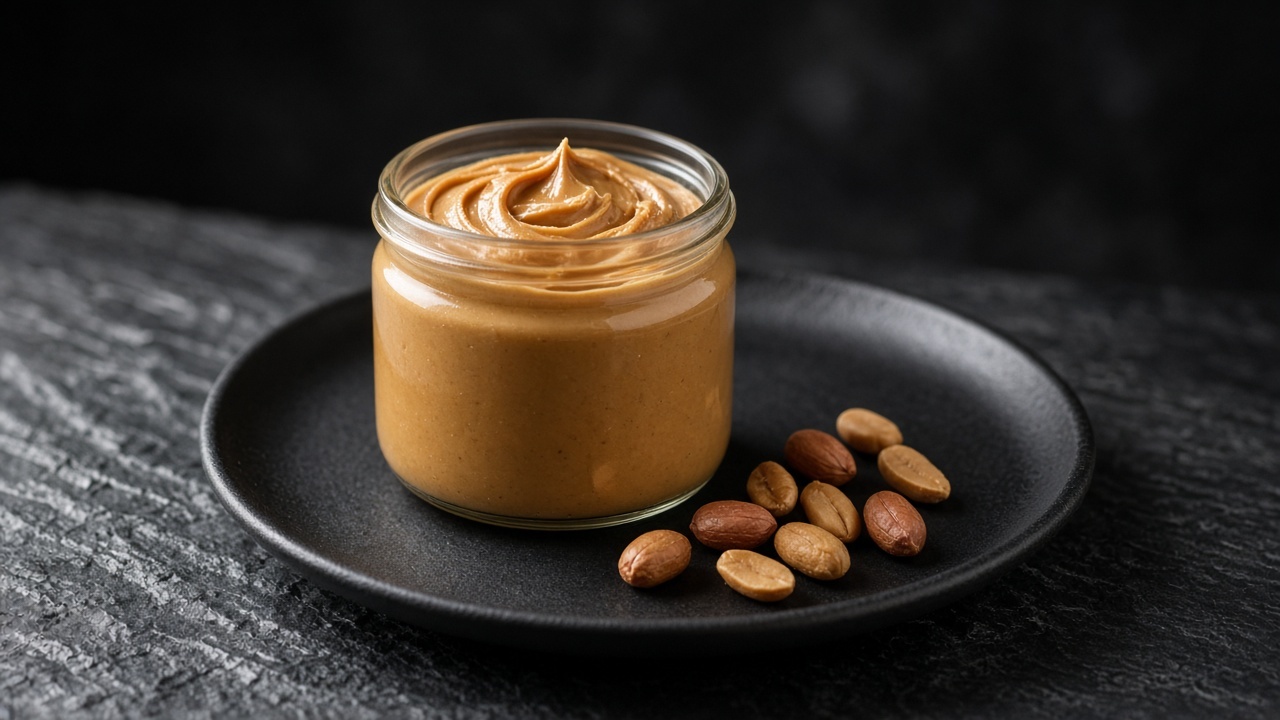
Homemade Peanut Butter
Inspired by techniques from America's Test Kitchen.
Raw peanuts are roasted until fragrant, then ground in a food processor until their own oil turns them into a smooth, spreadable paste lightly sweetened with honey and salt. Making it yourself means no added stabilisers or sugar, and a splash of oil or water tunes the final texture to however thick or thin you like it.
Always check the labels of the products you use.
Method
- 1
Roast the peanuts. Set an oven rack in the middle position and heat the oven to 190 °C (170 °C fan). Spread the peanuts in a single layer on a rimmed baking tray and roast until fragrant and slightly darkened, 10-12 min, rotating the tray halfway through. (If starting from preroasted peanuts, just warm them in the oven for 5 min.) Move the tray to a wire rack and let the peanuts cool slightly, about 10 min.
- 2
Grind to a paste. Process the peanuts in a food processor, scraping down the sides often, until the oil releases and a paste begins to form.
- 3
Sweeten and season. Add the honey and salt and keep processing to the smoothness you want, 3-4 min longer. Taste and work in more honey or salt if needed.
- 4
Adjust the texture. If the butter is thicker than you'd like, thin it by adding vegetable oil 1 tsp at a time, pulsing three times after each addition, until it loosens. If it's thinner than you'd like, thicken it the same way with water, 1 tsp at a time. Transfer to a jar with a tight-fitting lid.
Storage
Keep in a sealed jar at room temperature, or refrigerate, for up to 2 months.
EU nutrition claims
- Source of protein: 4.5 g protein per 100 kcal, about 18% of energy (needs ≥ 12%)
Per serving, from the nutrition table. Condition from the Annex to EU Regulation (EC) No 1924/2006. How we decide
Free sugars
0.4 g per serving
0.8 % of the 50 g daily maximum · 1.6 % of the ideal 25 g
Free sugars under 50 g a day, ideally about 25 g, based on WHO free-sugar guidance (not endorsed by WHO). The share shown is the share of one serving. WHO
Equipment
- rimmed baking tray
- wire cooling rack
- food processor
- jar with a tight-fitting lid
Nutrition per serving Calculated from USDA FoodData Central
| Per serving | Amount |
|---|---|
| Energy | 202 kcal |
| Protein | 9.1 g |
| Carbohydrate | 6.1 g |
| of which sugars | 2 g |
| of which free sugars | 0.4 g |
| Fat | 17.4 g |
| of which saturates | 2.2 g |
| Fibre | 3 g |
| Salt | 0.14 g |
Protein per 100 kcal
4.5 g High Protein needs ≥ 5 g (20% of energy)
Calculated from USDA FoodData Central ingredient values