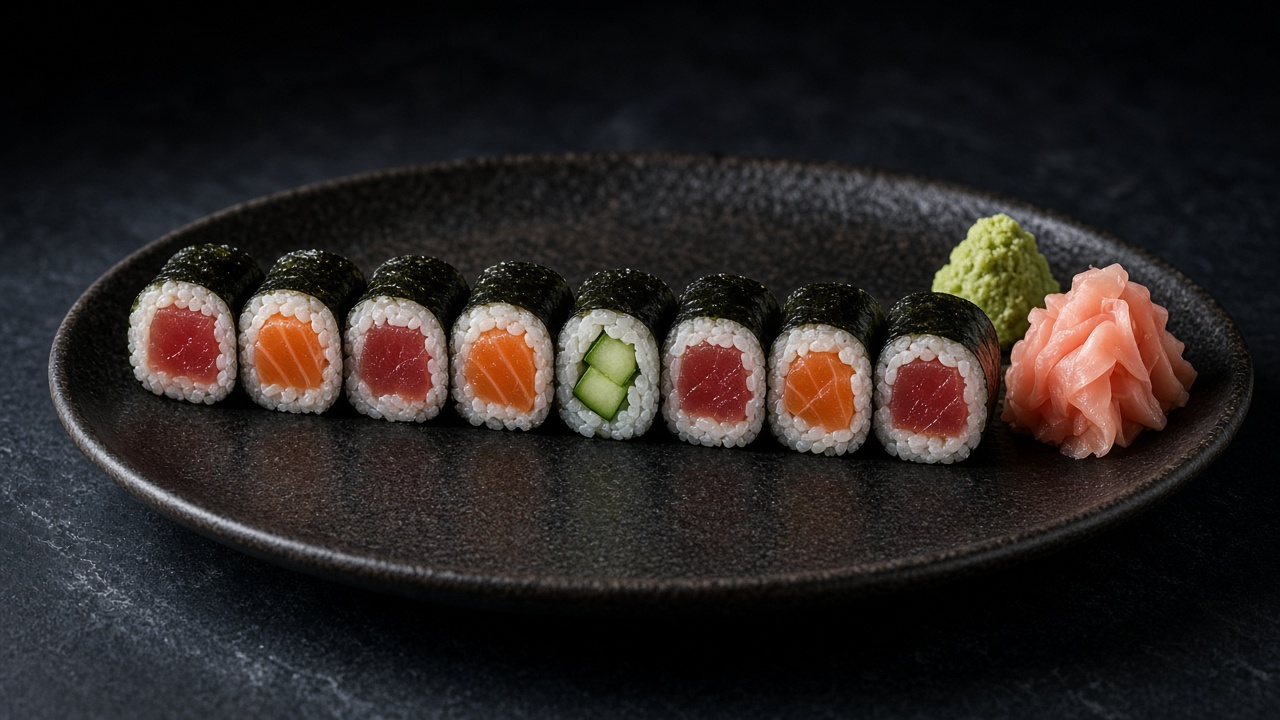
Maki Sushi: Tuna, Salmon and Cucumber Hosomaki Rolls
Inspired by techniques from Serious Eats.
Thin nori rolls of seasoned sushi rice with a single strip of tuna, salmon or cucumber, cut into neat pieces and served with soy sauce, wasabi and pickled ginger.
Always check the labels of the products you use.
Method
- 1
Rinse and drain. Wash the rice in several changes of cold water until it runs almost clear and drain it for 15 min. This clears away excess starch so the cooked rice is sticky enough to hold but not pasty.
- 2
Steam the rice. Boil the rice with 480 ml water in a heavy covered pan, then cook on the lowest heat for 12 min. Leave it covered off the heat for 10 min more so the grains finish softening in their own steam.
- 3
Dress the rice. Dissolve the sugar and salt in the vinegar over a low heat. Spread the hot rice in the wide bowl, sprinkle the seasoning over and fold it in with slicing strokes while fanning; this cools it quickly and makes it shine. Cover with a damp cloth once it reaches body temperature.
- 4
Crisp the nori. Pass each sheet a few times over a gas flame or under a hot grill (broiler) for a few seconds, until it smells toasty and turns brittle. Halve the sheets along the lines to make 8 strips.
- 5
Fill and roll. On the film-wrapped mat, lay a half sheet shiny side down and, with damp fingers, spread about 100 g rice thinly over it, leaving 1 cm uncovered at the top and bottom. Put one filling along the near third, lift the mat to tuck the edge over it and roll forward firmly, sealing the bare edge with a little water; make 3 tuna, 3 salmon and 2 cucumber rolls.
- 6
Cut and serve. Wipe the knife with a damp cloth, cut each roll in half and each half into three, wiping the blade between cuts so the rice does not drag. Serve at once with soy sauce, wasabi and pickled ginger.
Storage
Sushi rolls are best eaten within an hour of rolling; discard leftovers containing raw fish.
EU nutrition claims
- Source of protein: 4.2 g protein per 100 kcal, about 17% of energy (needs ≥ 12%)
- Low saturated fat: 0.7 g saturated fat per 100 g, 1.9% of energy (limits ≤ 1.5 g and ≤ 10%)
- Low sugars: 3.8 g sugars per 100 g (limit ≤ 5 g)
Per 100 g of the finished dish, worked out from the nutrition per serving and the lowest likely cooked weight (about 144 g a serving), so the true values are, if anything, lower. Thresholds from the Annex to EU Regulation (EC) No 1924/2006. How we decide
Free sugars
5 g per serving
10 % of the 50 g daily maximum · 20 % of the ideal 25 g
Free sugars under 50 g a day, ideally about 25 g, based on WHO free-sugar guidance (not endorsed by WHO). The share shown is the share of one serving. WHO
Equipment
- sieve
- heavy saucepan with tight lid
- wide bowl (wooden if possible)
- rice paddle or spatula
- fan or folded card
- damp tea towel
- bamboo rolling mat
- cling film
- small bowl of water
- very sharp knife
Nutrition per serving (estimated values)
| Per serving | Amount |
|---|---|
| Energy | 476 kcal |
| Protein | 19.8 g |
| Carbohydrate | 85.6 g |
| of which sugars | 5.5 g |
| of which free sugars | 5 g |
| Fat | 4.4 g |
| of which saturates | 1 g |
| Fibre | 0.2 g |
| Salt | 2.27 g |
Protein per 100 kcal
4.2 g High Protein needs ≥ 5 g (20% of energy)
Calculated from USDA FoodData Central ingredient values