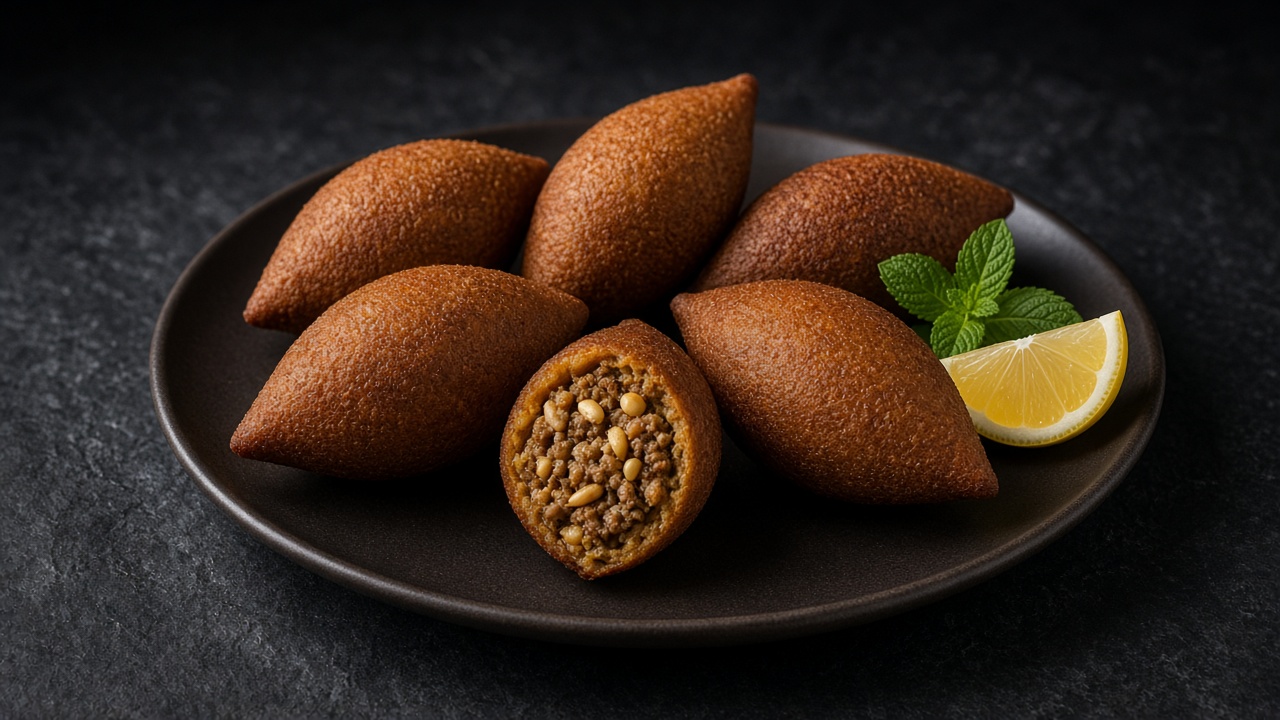
Fried Kibbeh with Spiced Lamb Filling
Inspired by techniques from America's Test Kitchen and NYT Cooking.
Crisp, deep-brown torpedoes of bulgur and lamb, filled with lamb, onion, warm spices and a touch of pomegranate molasses. Serve warm with lemon and mint.
Always check the labels of the products you use.
Method
- 1
Soak. Rinse the bulgur in a sieve, then cover with cold water and soak for 20 minutes. Drain and squeeze out as much water as you can with your hands; wet bulgur makes a sticky dough.
- 2
Filling. Heat the oil in a frying pan over medium heat and cook the onion for 6-8 minutes, until soft and golden. Add the lamb, cinnamon, allspice, salt and pepper and cook for 6-8 minutes, breaking it up, until browned and it reads 71 °C. Spoon off excess fat, stir in the pomegranate molasses and cool completely.
- 3
Paste. Process the shell lamb, onion, spices, salt and pepper for about 1 minute, to a smooth paste. Keeping the meat cold helps it bind.
- 4
Dough. Add the bulgur and 1 ice cube and process for 1-2 minutes more, adding the second ice cube if it warms, until it forms a smooth, pliable dough with no visible grains. Chill for 30 minutes so it firms up.
- 5
Hollow. With wet hands, roll the dough into 16 balls (about 35 g each). Hold one in your palm and push a finger into it, turning and pressing to make a shell with walls about 5 mm thick.
- 6
Fill. Spoon in a heaped tablespoon of cold filling, pinch the opening closed and roll into a torpedo with pointed ends. Patch any cracks with wet fingers, then chill on a lined tray for 30 minutes.
- 7
Fry. Heat 4 cm oil to 180 °C. Fry 4-5 at a time for 5-6 minutes, turning, until deep brown and the shell reads 71 °C in its thickest part. Drain on paper towels and serve warm with lemon and mint.
Storage
Fried kibbeh keep in the fridge for 3 days; reheat at 200 °C for 10 minutes, until piping hot (74 °C). Shaped, unfried kibbeh freeze for 3 months. Cool leftovers in a shallow container and refrigerate within 2 hours (within 1 hour on a day above 32°C).
EU nutrition claims
- Source of protein: 4 g protein per 100 kcal, about 16% of energy (needs ≥ 12%)
Per serving, from the nutrition table. Condition from the Annex to EU Regulation (EC) No 1924/2006. How we decide
Free sugars
1.4 g per serving
2.8 % of the 50 g daily maximum · 5.6 % of the ideal 25 g
Free sugars under 50 g a day, ideally about 25 g, based on WHO free-sugar guidance (not endorsed by WHO). The share shown is the share of one serving. WHO
Equipment
- fine sieve
- large bowl
- food processor
- frying pan
- instant-read thermometer
- baking tray
- baking paper
- deep frying pan or heavy pot
- slotted spoon
- paper towels
Nutrition per serving (estimated values)
| Per serving | Amount |
|---|---|
| Energy | 304 kcal |
| Protein | 12.3 g |
| Carbohydrate | 20.8 g |
| of which sugars | 2.7 g |
| of which free sugars | 1.4 g |
| Fat | 19.6 g |
| of which saturates | 6.4 g |
| Fibre | 3.4 g |
| Salt | 1.01 g |
Protein per 100 kcal
4 g High Protein needs ≥ 5 g (20% of energy)
Calculated from USDA FoodData Central ingredient values