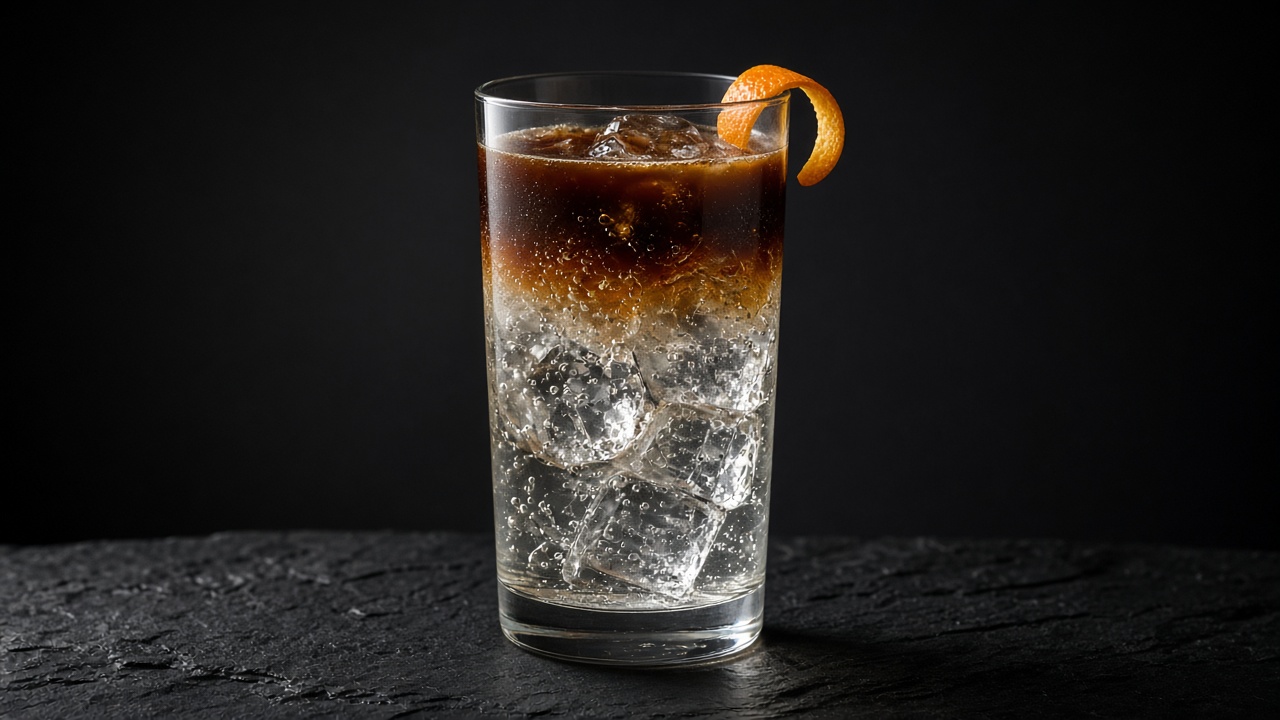
Layered Espresso Tonic with Orange
Inspired by techniques from Serious Eats and NYT Cooking.
Chilled tonic water is poured over ice, a double espresso is floated slowly on top to make a dark layer, and an orange peel twist adds fragrance.
Based on the listed ingredients, none of the 14 major EU allergens. Always check product labels.
Method
- 1
Fill the glass. Fill a tall glass with ice and pour in the cold tonic.
- 2
Brew. Pull a double espresso into a small jug.
- 3
Layer. Pour the espresso very slowly over the back of a spoon so it floats; it will foam up.
- 4
Garnish. Twist the orange peel over the glass and drop it in.
- 5
Serve. Drink right away, stirred or layered.
Storage
Make to order; it goes flat within minutes. Cool leftovers in a shallow container and refrigerate within 2 hours (within 1 hour on a day above 32°C).
EU nutrition claims
- Low fat: 0.1 g fat per 100 ml (limit ≤ 1.5 g)
- Low saturated fat: 0.1 g saturated fat per 100 ml, 1.6% of energy (limits ≤ 0.75 g and ≤ 10%)
- Low salt: 0.05 g salt per 100 ml (limit ≤ 0.3 g)
Per 100 ml of the finished dish, worked out from the nutrition per serving and the lowest likely cooked weight (about 146 ml a serving), so the true values are, if anything, lower. Thresholds from the Annex to EU Regulation (EC) No 1924/2006. How we decide
Caffeine · Free sugars
- Per serving: about 127 mg caffeine (serving: 1 glass (double espresso, 60 ml)). Source: 60 ml espresso × USDA FDC SR Legacy #171891 (espresso, 212 mg/100 g) (moka-pot coffee counted like espresso).
- Scaling: making more servings does not change the caffeine in each serving; what counts is how many servings you drink in a day. 1 serving: 127 mg · 2 servings: 254 mg (above EFSA 200 mg at once) · 3 servings: 381 mg (above EFSA 200 mg at once) · 4 servings: 508 mg (above EFSA 400 mg a day).
- General guideline: EFSA Scientific Opinion on the safety of caffeine (2015): for healthy adults, up to 200 mg in a single dose and up to 400 mg per day do not raise safety concerns. 1 serving = 32 % of 400 mg. EFSA
13.6 g per serving
27.2 % of the 50 g daily maximum · 54.4 % of the ideal 25 g
Free sugars under 50 g a day, ideally about 25 g, based on WHO free-sugar guidance (not endorsed by WHO). The share shown is the share of one serving. WHO
Equipment
- espresso machine or moka pot
- tall glass
- small jug
Nutrition per serving (estimated values)
| Per serving | Amount |
|---|---|
| Energy | 58 kcal |
| Protein | 0.1 g |
| Carbohydrate | 14.6 g |
| of which sugars | 13.6 g |
| of which free sugars | 13.6 g |
| Fat | 0.1 g |
| of which saturates | 0.1 g |
| Fibre | 0 g |
| Salt | 0.07 g |
Protein per 100 kcal
0.2 g High Protein needs ≥ 5 g (20% of energy)
Calculated from USDA FoodData Central ingredient values