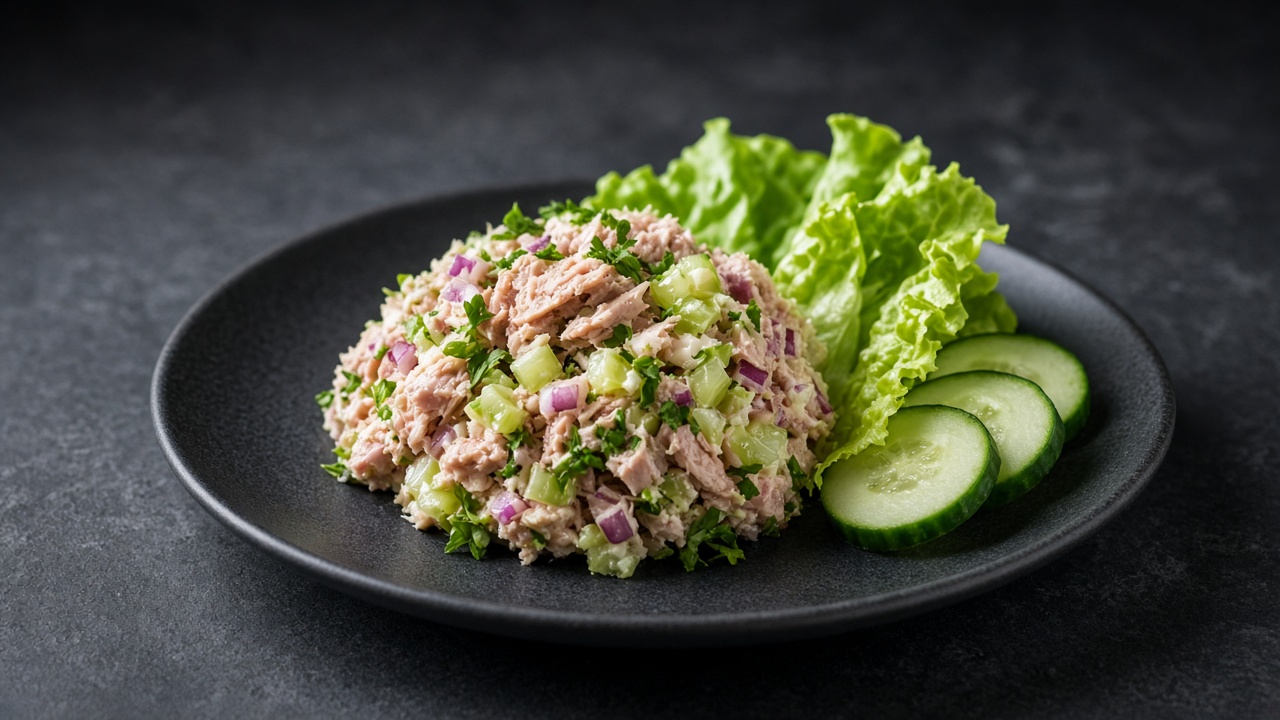
Lemony Tuna Salad with Celery and Capers
Inspired by techniques from America's Test Kitchen and NYT Cooking.
Flaked tuna is softened with a quick warm onion and lemon dressing before being folded with mayonnaise, celery and capers for a bright, zesty tuna salad.
Always check the labels of the products you use.
Method
- 1
Drain the Tuna Well. The tuna goes into the sieve first, pressed firmly with a fork to squeeze out as much liquid as possible, then flaked into the bowl. Getting it properly dry matters here, since tuna that's still wet will dilute the dressing and leave the finished salad watery rather than creamy.
- 2
Soften the Onion. Cook the chopped onion with the olive oil in the microwave for 1-2 minutes, or in the small frying pan over low heat for about 3 minutes, until it's just softened but not browned. This brief cooking takes the raw bite out of the onion without turning it mushy or coloured.
- 3
Season the Tuna. Once the onion is ready, stir it and its oil into the tuna along with the lemon juice and black pepper, then leave it for 10 minutes before going any further. Letting the warm, acidic mixture sit with the fish gives it time to actually absorb the flavour rather than just coating the surface.
- 4
Fold in the Rest. Add the mayonnaise, celery, red pepper, capers and parsley and fold everything together gently. Taste the salad before reaching for any extra salt, since both the tuna and the capers are already salty and it's easy to over-season by mistake.
- 5
Serve and Enjoy. A plate of crisp lettuce and sliced cucumber is the classic way to serve this, or pile it into sandwiches instead. It keeps well in the fridge for up to 1 day, covered.
Storage
Keep covered in the fridge for up to 1 day. It's not suitable for freezing, as the mayonnaise will separate once thawed. Cool leftovers in a shallow container and refrigerate within 2 hours (within 1 hour on a day above 32°C).
Why this label?
24.7 g protein for 348 kcal = 7.1 g per 100 kcal, so protein gives about 28% of the energy. High Protein needs at least 20% (5 g per 100 kcal), the condition in the Annex to EU Regulation (EC) No 1924/2006. How we decide
EU nutrition claims
- Low sugars: 3.3 g sugars per 100 g (limit ≤ 5 g)
Per 100 g of the finished dish, worked out from the nutrition per serving and the lowest likely cooked weight (about 69 g a serving), so the true values are, if anything, lower. Thresholds from the Annex to EU Regulation (EC) No 1924/2006. How we decide
Free sugars
0.3 g per serving
0.6 % of the 50 g daily maximum · 1.2 % of the ideal 25 g
Free sugars under 50 g a day, ideally about 25 g, based on WHO free-sugar guidance (not endorsed by WHO). The share shown is the share of one serving. WHO
Equipment
- sieve
- small microwave-safe bowl or small frying pan
- medium bowl
- fork
- chopping board and knife
Nutrition per serving (estimated values)
| Per serving | Amount |
|---|---|
| Energy | 348 kcal |
| Protein | 24.7 g |
| Carbohydrate | 5.4 g |
| of which sugars | 2.3 g |
| of which free sugars | 0.3 g |
| Fat | 25.1 g |
| of which saturates | 4.1 g |
| Fibre | 1.5 g |
| Salt | 1.34 g |
Protein per 100 kcal
7.1 g meets High Protein (≥ 5 g, 20% of energy)
Calculated from USDA FoodData Central ingredient values