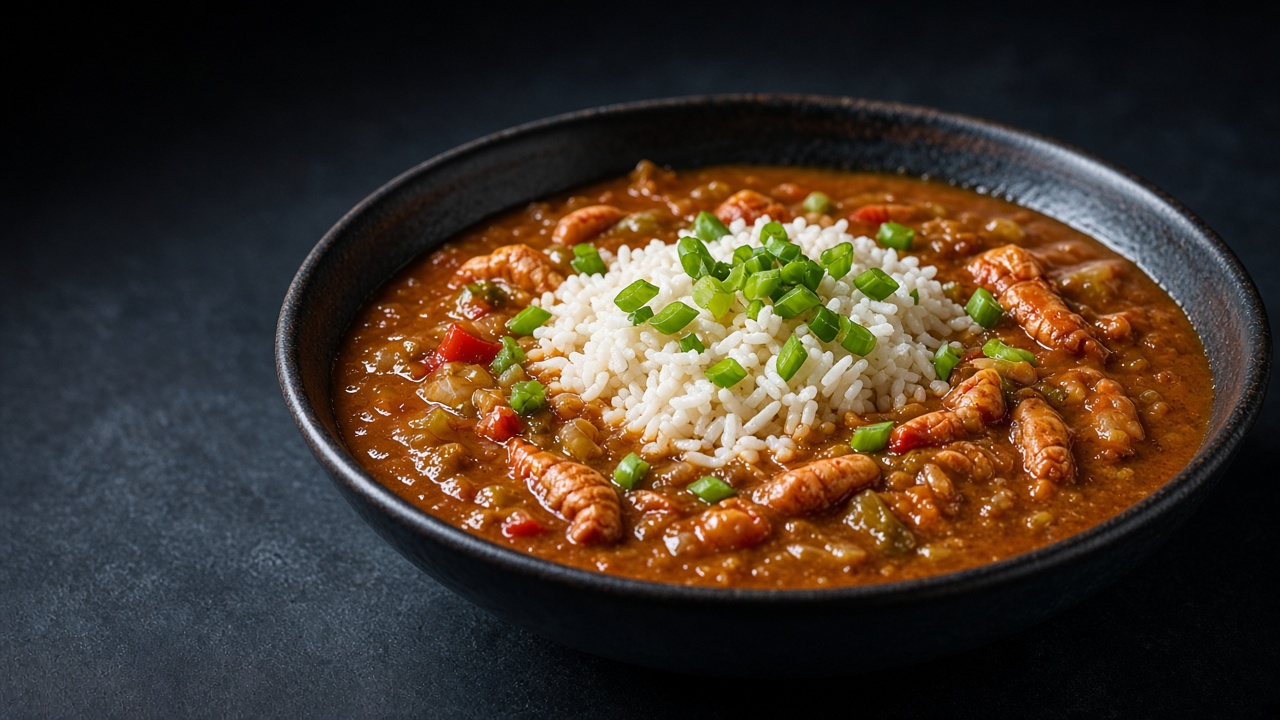
Louisiana-Style Crayfish Tail Stew with Rice
Inspired by techniques from NYT Cooking and America's Test Kitchen.
Sweet crayfish tails in a rich, gently spiced sauce built on a nutty butter roux with onion, green pepper and celery, served over fluffy rice. Finished with spring onions, parsley and a splash of hot sauce.
Always check the labels of the products you use.
Method
- 1
Cook the roux. Melt the butter in the casserole over medium-low heat, whisk in the flour and keep stirring for 8-10 minutes. It is ready when it reaches the colour of peanut butter and smells nutty. Turn the heat down if it darkens too quickly, because a burnt roux tastes bitter and has to be started again.
- 2
Soften the vegetables. Add the onion, green pepper and celery and cook for 8-10 minutes, stirring often, until soft. Stir in the garlic, tomato purée, paprika, cayenne, thyme, bay leaves and pepper for 1 minute. The hot roux toasts the spices briefly, which brings out their aroma.
- 3
Simmer the sauce. Whisk in the stock a little at a time so the sauce stays smooth, then add the salt. Simmer gently, uncovered, for 20 minutes, stirring now and then, until it coats the back of a spoon. Adding liquid gradually lets the roux absorb it evenly, which prevents lumps.
- 4
Cook the rice. Meanwhile, rinse the rice until the water runs clear and put it in the saucepan with the 450ml water. Bring to the boil, cover, cook on the lowest heat for 15 minutes, then rest off the heat for 10 minutes. Leaving the lid on throughout traps the steam that finishes the grains.
- 5
Add the crayfish. Stir in the crayfish tails with their juices and most of the spring onions, then simmer for 4-5 minutes until piping hot, at least 74°C, since the tails are already cooked. If using raw prawns, simmer for the same time until pink and opaque. Adding the shellfish last stops it turning rubbery; stir in the parsley and taste for seasoning.
- 6
Serve over rice. Spoon the stew over the rice and scatter with the remaining spring onions. Serve with lemon wedges and hot pepper sauce at the table.
Storage
Cool within 2 hours, refrigerate and eat within 2 days. Reheat gently on the hob, stirring, until piping hot (74°C); add a splash of water if the sauce has thickened.
Why this label?
31.2 g protein for 582 kcal = 5.4 g per 100 kcal, so protein gives about 21% of the energy. High Protein needs at least 20% (5 g per 100 kcal), the condition in the Annex to EU Regulation (EC) No 1924/2006. How we decide
EU nutrition claims
- Low sugars: 1.8 g sugars per 100 g (limit ≤ 5 g)
Per 100 g of the finished dish, worked out from the nutrition per serving and the lowest likely cooked weight (about 255 g a serving), so the true values are, if anything, lower. Thresholds from the Annex to EU Regulation (EC) No 1924/2006. How we decide
Free sugars
0.1 g per serving
0.2 % of the 50 g daily maximum · 0.4 % of the ideal 25 g
Free sugars under 50 g a day, ideally about 25 g, based on WHO free-sugar guidance (not endorsed by WHO). The share shown is the share of one serving. WHO
Equipment
- large heavy casserole (Dutch oven, 4-5 litres)
- wooden spoon or flat-edged spatula
- medium saucepan with tight lid
- instant-read probe thermometer
Nutrition per serving (estimated values)
| Per serving | Amount |
|---|---|
| Energy | 582 kcal |
| Protein | 31.2 g |
| Carbohydrate | 78.6 g |
| of which sugars | 4.6 g |
| of which free sugars | 0.1 g |
| Fat | 15.4 g |
| of which saturates | 8.4 g |
| Fibre | 4.3 g |
| Salt | 1.57 g |
Protein per 100 kcal
5.4 g meets High Protein (≥ 5 g, 20% of energy)
Calculated from USDA FoodData Central ingredient values