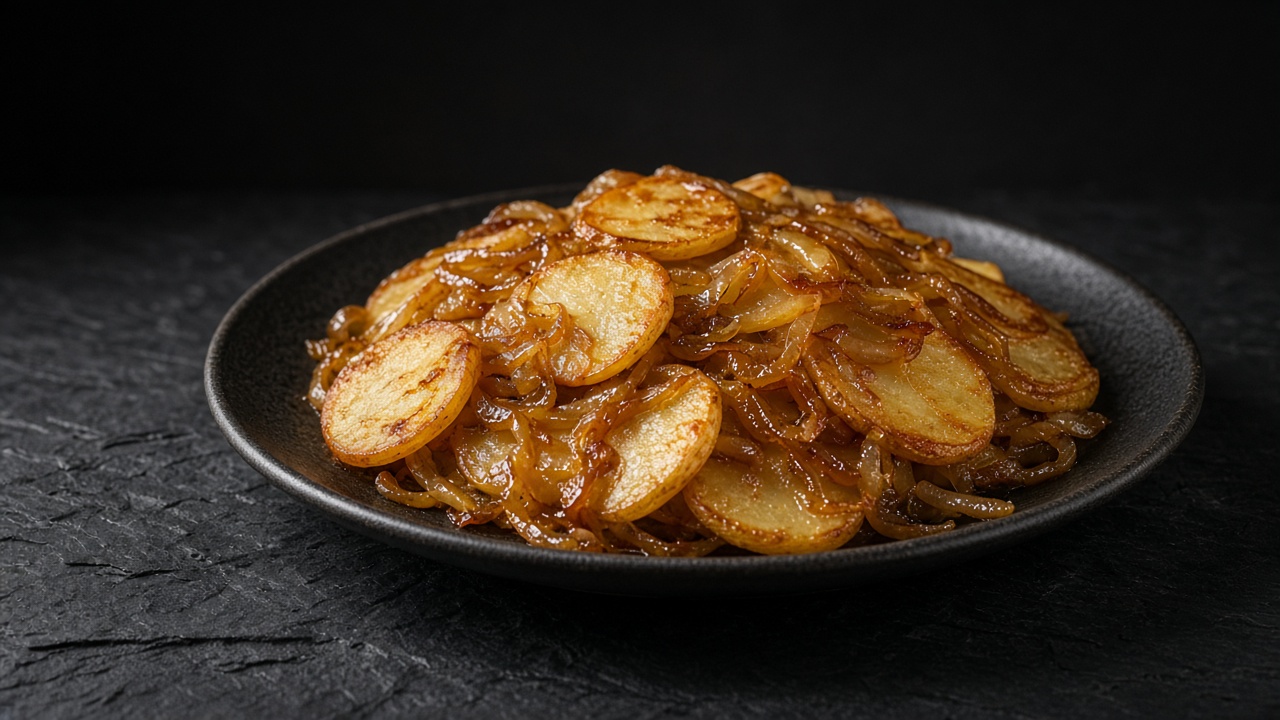
Lyonnaise Potatoes (Sautéed Potatoes and Caramelised Onions)
Inspired by techniques from Serious Eats and NYT Cooking.
Fried potato slices are tossed through deeply caramelised onions for a rich, bistro-style side from Lyon. The slow-cooked onions give the dish most of its flavour, so it's worth taking your time with them.
Always check the labels of the products you use.
Method
- 1
Par-cook the potatoes. Cover the potato rounds with cold water, add the salt and vinegar, bring to the boil and simmer for about 4 minutes until just barely tender. The vinegar firms the pectin in the potato slightly, which keeps the rounds whole rather than falling apart when they're fried.
- 2
Drain and dry. Drain well and spread the rounds out on a towel to dry thoroughly. Any surface moisture left on the potato will stop it browning properly in the pan.
- 3
Caramelise the onions. Heat 1 tbsp of ghee in the pan over medium heat and cook the onion with a pinch of salt for 12-15 minutes, stirring occasionally, until soft and deep golden. Add a splash of water to lift the browned bits from the base of the pan, then tip the onions into a bowl.
- 4
Fry the potatoes. Heat 2 tbsp of ghee in the same pan over medium-high heat and fry half the potato rounds in a single layer for 4-5 minutes per side until golden; repeat with the remaining ghee and potatoes. Ghee can take this higher heat without burning the way whole butter would, so the potatoes get properly crisp.
- 5
Combine and serve. Return all the potatoes and onions to the pan, toss together for 1-2 minutes to heat through, then season with the pepper, scatter over the parsley and serve.
Storage
Leftovers keep in the fridge for up to 2 days. Reheat in a hot frying pan over medium heat until piping hot and recrisped, as a microwave will leave them soft. Cool leftovers in a shallow container and refrigerate within 2 hours (within 1 hour on a day above 32°C).
EU nutrition claims
- Low sugars: 2.4 g sugars per 100 g (limit ≤ 5 g)
- Source of fibre: 1.7 g fibre per 100 kcal (needs ≥ 1.5 g)
Per 100 g of the finished dish, worked out from the nutrition per serving and the lowest likely cooked weight (about 178 g a serving), so the true values are, if anything, lower. Thresholds from the Annex to EU Regulation (EC) No 1924/2006. How we decide
Free sugars
0 g per serving
0 % of the 50 g daily maximum · 0 % of the ideal 25 g
Free sugars under 50 g a day, ideally about 25 g, based on WHO free-sugar guidance (not endorsed by WHO). The share shown is the share of one serving. WHO
Equipment
- large pan for simmering
- colander
- large heavy frying pan (30 cm)
- thin metal spatula
- bowl
Nutrition per serving (estimated values)
| Per serving | Amount |
|---|---|
| Energy | 312 kcal |
| Protein | 4.9 g |
| Carbohydrate | 41.1 g |
| of which sugars | 4.3 g |
| of which free sugars | 0 g |
| Fat | 15.2 g |
| of which saturates | 9.4 g |
| Fibre | 5.4 g |
| Salt | 1.25 g |
Protein per 100 kcal
1.6 g High Protein needs ≥ 5 g (20% of energy)
Calculated from USDA FoodData Central ingredient values