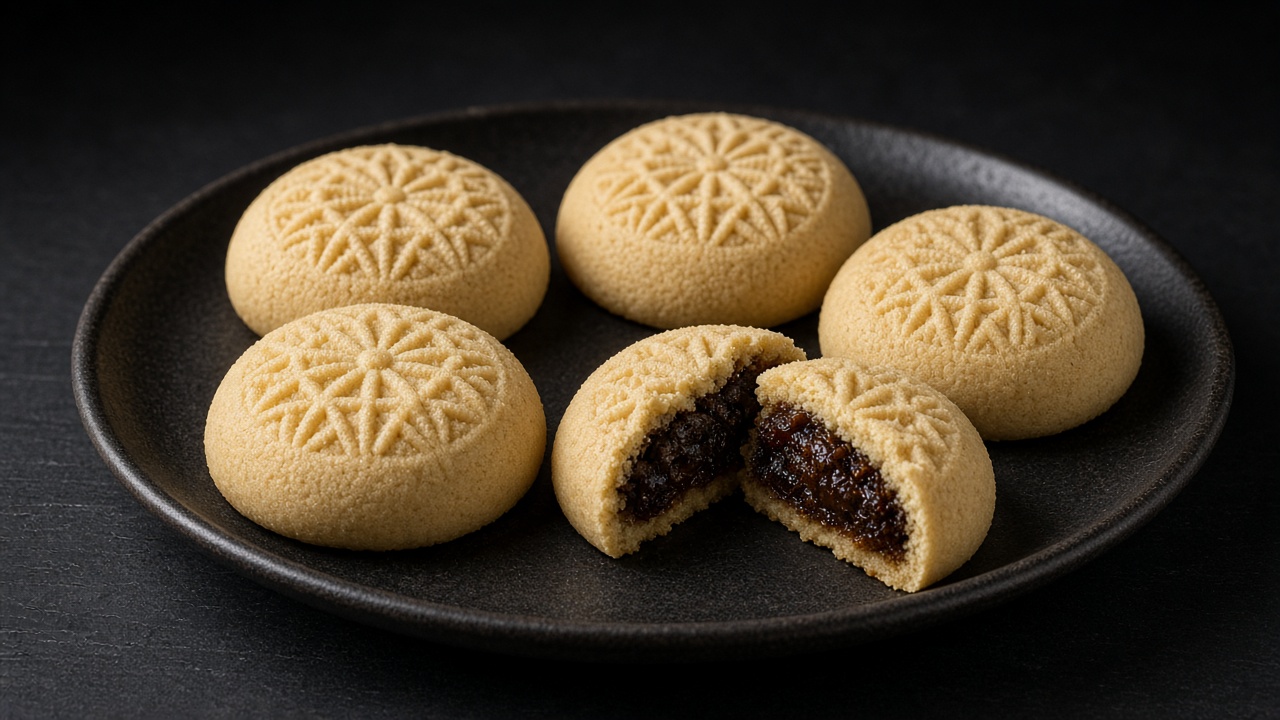
Maamoul: Moulded Semolina Cookies with Date Filling
Inspired by techniques from NYT Cooking.
Tender semolina cookies wrapped around a spiced date and walnut filling, patterned in a mould and baked until just golden underneath.
Always check the labels of the products you use.
Method
- 1
Cook the filling. Warm the dates and butter in the small saucepan over low heat for 5-8 min, mashing with the spoon until they form a thick, smooth paste. Stir in the cinnamon and walnuts and leave to cool. Roll into 20 small balls of about 14 g so the filling is ready when the dough is.
- 2
Rub in the butter. Mix the semolina, flour, sugar, salt and mahlab if using in the large bowl. Pour in the melted butter and rub it through with your fingertips for 2-3 min until every grain looks coated. The fat coats the semolina and is what gives maamoul their short, crumbly bite.
- 3
Rest the dough. Cover and leave at room temperature for 1 h. During this time the semolina softens and absorbs the butter, so the dough will hold together without kneading.
- 4
Bind gently. Add the rose water if using, then enough milk to make a dough that clumps when squeezed; add the last 10 ml only if needed. Mix with a light hand, as working it too much makes the cookies hard.
- 5
Fill the cookies. Heat the oven to 175 °C (155 °C fan) and line the trays with baking paper. Flatten a 35 g piece of dough (one twentieth) in your palm, put a date ball in the centre and ease the dough up and around it into a smooth ball.
- 6
Mould the tops. Press each ball into the mould, level the back with your fingers and tap it out onto a tray. With no mould, flatten into a 5 cm disc and pattern the top with a fork.
- 7
Bake pale. Bake for 18-20 min, until the bases are golden while the tops are still pale. Leave on the trays for 10 min, as they are fragile while hot, then cool on the rack.
Storage
Store in an airtight tin at room temperature for up to 1 week, or freeze for up to 2 months and thaw at room temperature.
EU nutrition claims
- Low salt: 0.19 g salt per 100 g (limit ≤ 0.3 g)
Per 100 g of the finished dish, worked out from the nutrition per serving and the lowest likely cooked weight (about 42 g a serving), so the true values are, if anything, lower. Thresholds from the Annex to EU Regulation (EC) No 1924/2006. How we decide
Free sugars
1.5 g per serving
3 % of the 50 g daily maximum · 6 % of the ideal 25 g
Free sugars under 50 g a day, ideally about 25 g, based on WHO free-sugar guidance (not endorsed by WHO). The share shown is the share of one serving. WHO
Equipment
- small saucepan
- wooden spoon
- large mixing bowl
- cling film
- maamoul mould (or a fork for patterning)
- 2 baking trays
- baking paper
- wire rack
Nutrition per serving (estimated values)
| Per serving | Amount |
|---|---|
| Energy | 202 kcal |
| Protein | 3 g |
| Carbohydrate | 26.1 g |
| of which sugars | 10 g |
| of which free sugars | 1.5 g |
| Fat | 10 g |
| of which saturates | 5.7 g |
| Fibre | 1.7 g |
| Salt | 0.08 g |
Protein per 100 kcal
1.5 g High Protein needs ≥ 5 g (20% of energy)
Calculated from USDA FoodData Central ingredient values