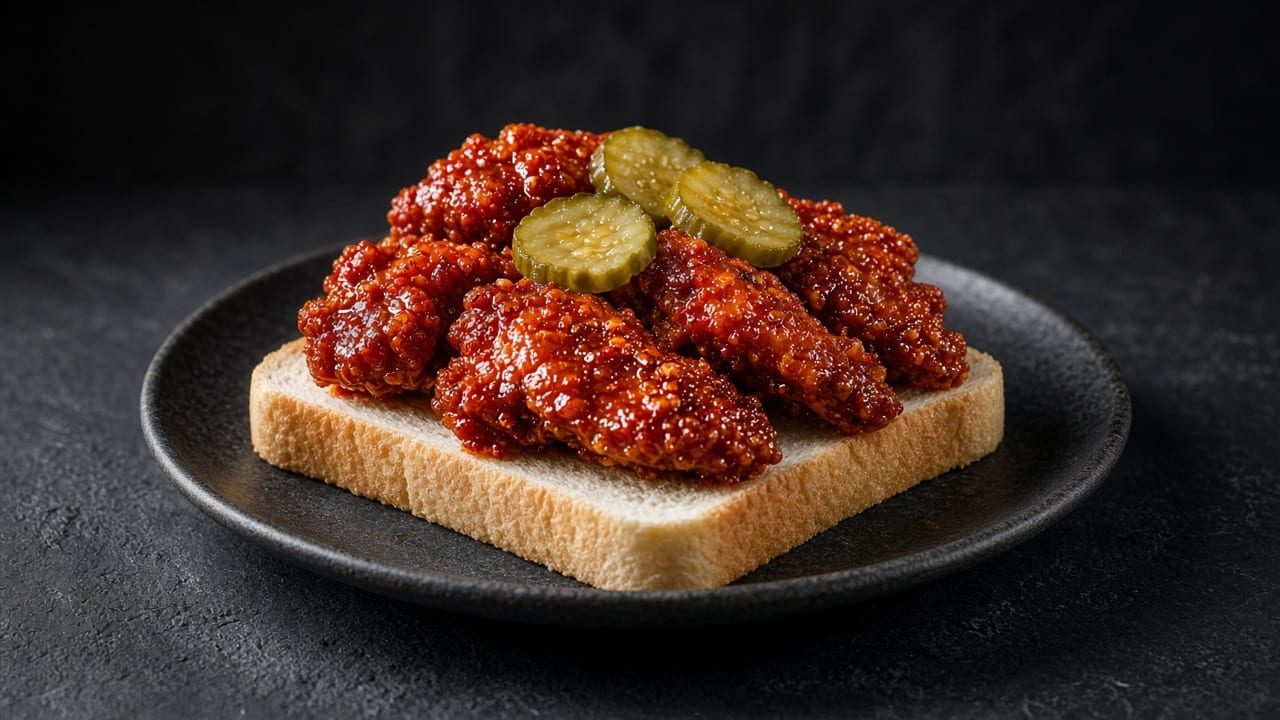
Nashville Hot Chicken
Inspired by techniques from Serious Eats and America's Test Kitchen.
Buttermilk-brined chicken is coated, deep-fried until crisp, then brushed with a blazing cayenne and brown sugar oil and served on white bread with pickles.
Always check the labels of the products you use.
Method
- 1
Brine the chicken. Mix the buttermilk, hot sauce and salt, then add the chicken and refrigerate for 1-12 hours. The salty brine seasons the meat right through and helps it stay juicy in the hot oil, and the buttermilk left on the surface helps the dredge stick.
- 2
Mix the dredge. Whisk together the flour, cornflour, baking powder, cayenne, paprika, salt and pepper. Drizzle in 2 tbsp of the brine and rub it through the flour with your fingers to form small clumps, which is what gives the finished crust its craggy texture.
- 3
Coat and rest. Lift the chicken from the brine, let it drip briefly, then press firmly into the dredge to coat. Rest the coated pieces on the rack for 15 minutes before frying, so the flour has time to hydrate and grip the chicken rather than falling off in the oil.
- 4
Fry the chicken. Heat 4-5 cm of oil to 175°C in the heavy pot. Fry 3 pieces at a time for 6-8 minutes, turning occasionally and keeping the oil between 150-165°C, until deep golden and the chicken reaches 80°C inside, then drain on the rack.
- 5
Make the hot oil. Put the cayenne, sugar, paprika, garlic powder, salt and butter into a heatproof bowl, then carefully ladle in 120 ml of the still-hot frying oil and whisk together. Pouring the hot oil straight over the spices blooms the cayenne, waking up its flavour far more than stirring it in cold would.
- 6
Glaze and serve. While both are still hot, brush or spoon the spiced oil over the chicken so it clings evenly to the crust. Serve each piece on a slice of white bread with pickles underneath - the bread soaks up the fiery oil and the pickles cool the heat down.
Storage
Best eaten fresh, as the hot oil glaze softens the crust over time. If needed, keep for up to 2 days in the fridge and reheat in a hot oven until piping hot (74°C), understanding the crust won't be quite as crisp as when first made. Cool leftovers in a shallow container and refrigerate within 2 hours (within 1 hour on a day above 32°C).
Why this label?
44.8 g protein for 717 kcal = 6.2 g per 100 kcal, so protein gives about 25% of the energy. High Protein needs at least 20% (5 g per 100 kcal), the condition in the Annex to EU Regulation (EC) No 1924/2006. How we decide
EU nutrition claims
- Low sugars: 2.9 g sugars per 100 g (limit ≤ 5 g)
Per 100 g of the finished dish, worked out from the nutrition per serving and the lowest likely cooked weight (about 257 g a serving), so the true values are, if anything, lower. Thresholds from the Annex to EU Regulation (EC) No 1924/2006. How we decide
Free sugars
5.8 g per serving
11.6 % of the 50 g daily maximum · 23.2 % of the ideal 25 g
Free sugars under 50 g a day, ideally about 25 g, based on WHO free-sugar guidance (not endorsed by WHO). The share shown is the share of one serving. WHO
Equipment
- heavy pot (at least 4 litres)
- frying thermometer
- wire rack over a tray
- heatproof bowl
- ladle
- pastry brush
Nutrition per serving (estimated values)
| Per serving | Amount |
|---|---|
| Energy | 717 kcal |
| Protein | 44.8 g |
| Carbohydrate | 37.3 g |
| of which sugars | 7.5 g |
| of which free sugars | 5.8 g |
| Fat | 42.9 g |
| of which saturates | 7.3 g |
| Fibre | 2.5 g |
| Salt | 2.81 g |
Protein per 100 kcal
6.2 g meets High Protein (≥ 5 g, 20% of energy)
Calculated from USDA FoodData Central ingredient values