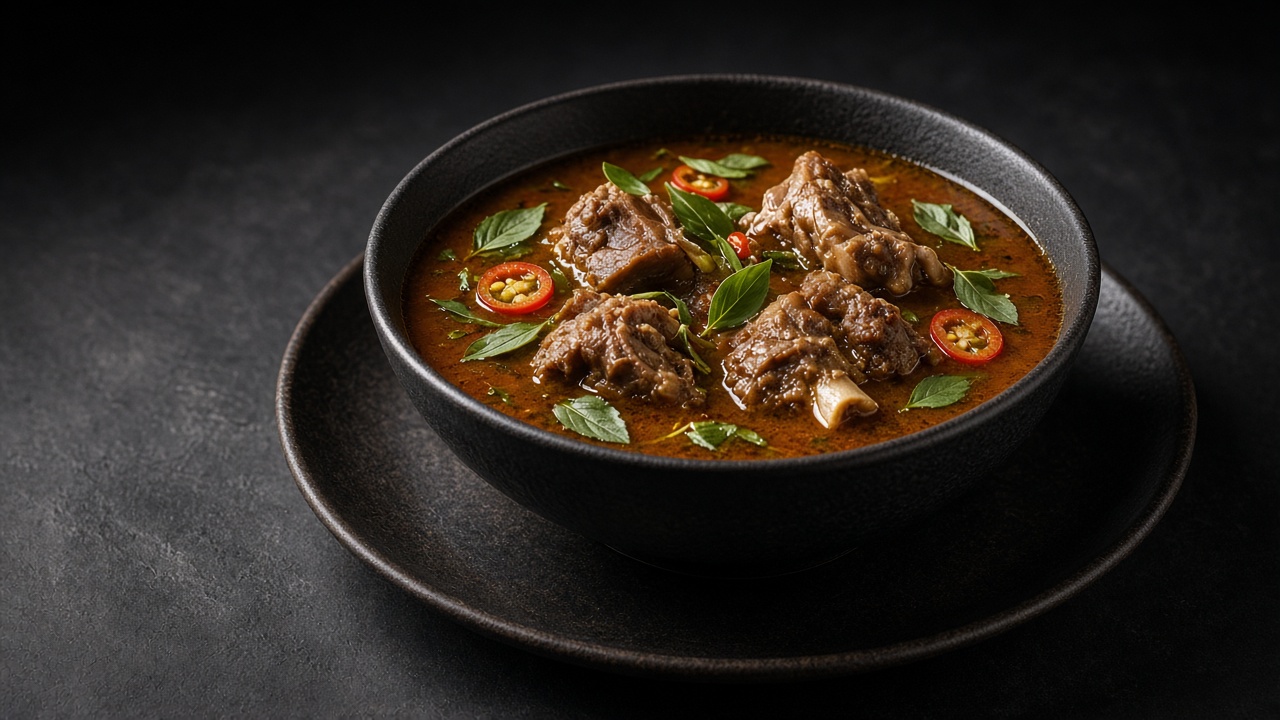
Nigerian Goat Pepper Soup with Scent Leaf
Inspired by techniques from NYT Cooking.
A fiery, aromatic Nigerian broth of bone-in goat simmered with a home-toasted pepper-soup spice, ginger and Scotch bonnet, finished with scent leaf and sliced red chilli.
Based on the listed ingredients, none of the 14 major EU allergens. Always check product labels.
Method
- 1
Grind the spice. Toast the coriander, cumin, fennel, peppercorns and cloves in the dry pan over medium heat for 1-2 min until fragrant. Cool, grind to a powder and stir in the nutmeg.
- 2
Season the goat. Rinse the goat, drain and put it in the pot with the onion, ginger, garlic, Scotch bonnet, chilli flakes, half the salt and half the spice mix. Stir well and leave 15 min.
- 3
Steam in its juices. Set the pot over medium heat, cover and cook 10 min, stirring once or twice, so the meat releases its juices and absorbs the spice.
- 4
Simmer. Pour in the water, bring to the boil, skim, then cover and simmer gently for 1½-2 h until the goat is tender and pulls from the bone.
- 5
Spice the broth. Stir in the rest of the spice and salt and simmer 10 min more, uncovered, so the broth darkens and tastes peppery. Taste and add a little hot water if it is too strong.
- 6
Finish. Turn off the heat, stir in the torn scent leaf and fish out the Scotch bonnet if you prefer it milder.
- 7
Serve. Ladle into bowls with plenty of broth and scatter over the sliced red chilli. Serve as it is, or with boiled yam or white rice.
Storage
Keep in the fridge for up to 3 days or freeze for up to 3 months. Reheat until boiling and add fresh leaves to serve. Cool leftovers in a shallow container and refrigerate within 2 hours (within 1 hour on a day above 32°C).
Why this label?
45.2 g protein for 270 kcal = 16.7 g per 100 kcal, so protein gives about 67% of the energy. High Protein needs at least 20% (5 g per 100 kcal), the condition in the Annex to EU Regulation (EC) No 1924/2006. How we decide
EU nutrition claims
- Low saturated fat: 0.7 g saturated fat per 100 ml, 5.3% of energy (limits ≤ 0.75 g and ≤ 10%)
- Low sugars: 0.9 g sugars per 100 ml (limit ≤ 2.5 g)
Per 100 ml of the finished dish, worked out from the nutrition per serving and the lowest likely cooked weight (about 236 ml a serving), so the true values are, if anything, lower. Thresholds from the Annex to EU Regulation (EC) No 1924/2006. How we decide
Free sugars
0 g per serving
0 % of the 50 g daily maximum · 0 % of the ideal 25 g
Free sugars under 50 g a day, ideally about 25 g, based on WHO free-sugar guidance (not endorsed by WHO). The share shown is the share of one serving. WHO
Equipment
- small dry frying pan
- spice grinder or pestle and mortar
- large heavy pot with lid
- ladle
- skimmer
Nutrition per serving (estimated values)
| Per serving | Amount |
|---|---|
| Energy | 270 kcal |
| Protein | 45.2 g |
| Carbohydrate | 7.9 g |
| of which sugars | 2.2 g |
| of which free sugars | 0 g |
| Fat | 5.5 g |
| of which saturates | 1.6 g |
| Fibre | 1.9 g |
| Salt | 2.27 g |
Protein per 100 kcal
16.7 g meets High Protein (≥ 5 g, 20% of energy)
Calculated from USDA FoodData Central ingredient values