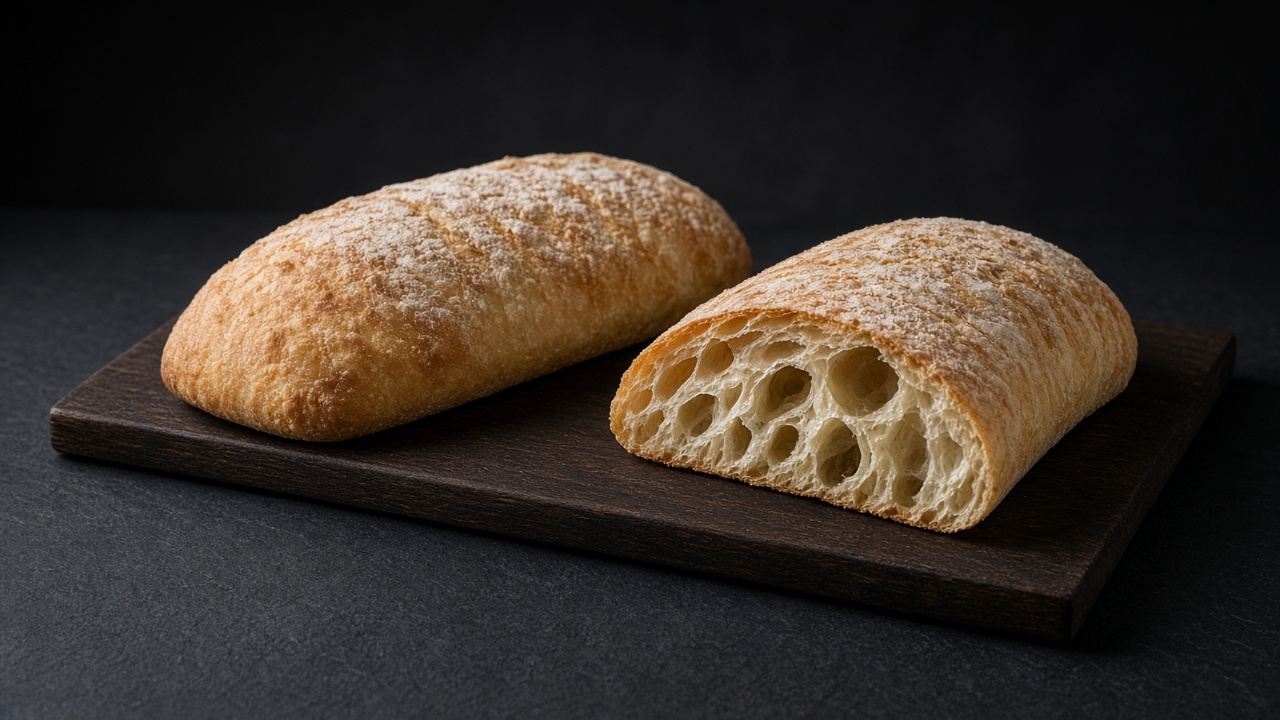
Open-Crumb Rustic Italian Ciabatta
Inspired by techniques from America's Test Kitchen and NYT Cooking.
A very wet dough built on an overnight starter, with a splash of milk for a softer crumb, is strengthened by folding, shaped gently into two flat slipper loaves and baked on a hot stone.
Always check the labels of the products you use.
Method
- 1
Starter. Mix the starter and leave it 8-24 hours.
- 2
Mix. Put the starter and all the dough ingredients in the stand mixer with the paddle. Mix on low until shaggy, then on medium-low for 4-6 minutes until the wet dough collects on the paddle and pulls away in ribbons. Switch to the dough hook and knead on medium for about 10 minutes until smooth and shiny.
- 3
Fold. Fold in the container every 30 minutes during the first hour of a 2-hour rise.
- 4
Shape. Turn out, halve and press gently into slipper shapes, then rest.
- 5
Bake. At least 30 minutes ahead, put the stone in the oven and heat to 230 °C (210 °C fan). Dimple the loaves all over with floured fingertips, mist with water and slide onto the stone on their paper. Mist twice more in the first 5 minutes and bake for 22-27 minutes, until deep golden and 96 °C in the centre.
- 6
Cool. Cool for an hour so the crumb sets.
Storage
Keep in a paper bag for up to 2 days and crisp in a hot oven, or freeze for up to 1 month. Cool leftovers in a shallow container and refrigerate within 2 hours (within 1 hour on a day above 32°C).
EU nutrition claims
- Source of protein: 3.4 g protein per 100 kcal, about 14% of energy (needs ≥ 12%)
- Low fat: 2.6 g fat per 100 g (limit ≤ 3 g)
- Low saturated fat: 0.6 g saturated fat per 100 g, 1.1% of energy (limits ≤ 1.5 g and ≤ 10%)
- Low sugars: 0.9 g sugars per 100 g (limit ≤ 5 g)
Per 100 g of the finished dish, worked out from the nutrition per serving and the lowest likely cooked weight (about 34 g a serving), so the true values are, if anything, lower. Thresholds from the Annex to EU Regulation (EC) No 1924/2006. How we decide
Free sugars
0 g per serving
0 % of the 50 g daily maximum · 0 % of the ideal 25 g
Free sugars under 50 g a day, ideally about 25 g, based on WHO free-sugar guidance (not endorsed by WHO). The share shown is the share of one serving. WHO
Equipment
- stand mixer with paddle and dough hook
- large square container or bowl, oiled
- cling film
- baking stone or heavy upturned baking tray
- baking paper
- spray bottle of water
- wire rack
Nutrition per serving (estimated values)
| Per serving | Amount |
|---|---|
| Energy | 167 kcal |
| Protein | 5.7 g |
| Carbohydrate | 33.3 g |
| of which sugars | 0.3 g |
| of which free sugars | 0 g |
| Fat | 0.9 g |
| of which saturates | 0.2 g |
| Fibre | 1.2 g |
| Salt | 0.88 g |
Protein per 100 kcal
3.4 g High Protein needs ≥ 5 g (20% of energy)
Calculated from USDA FoodData Central ingredient values