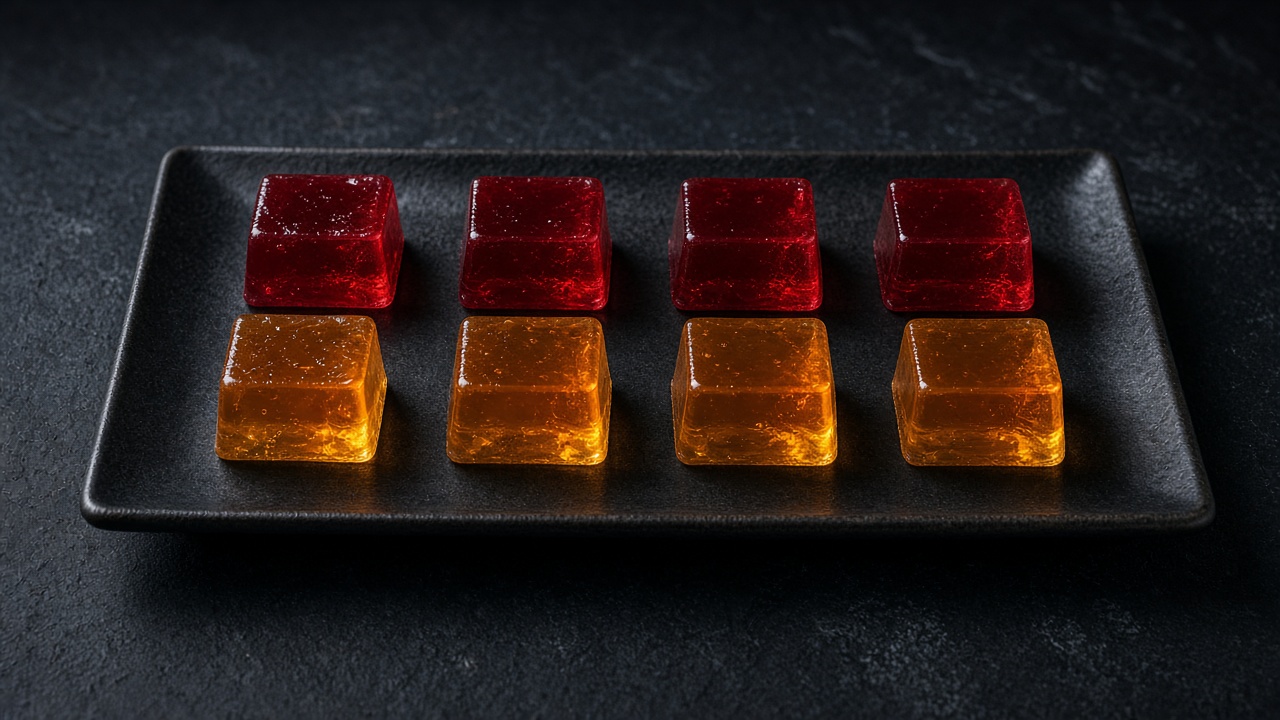
Orange and Cranberry Agar Jelly Cubes
Inspired by techniques from Serious Eats and America's Test Kitchen.
Firm, vegan jelly cubes in two colours, made by boiling orange and cranberry juice with agar powder and cutting the set slabs into cubes.
Based on the listed ingredients, none of the 14 major EU allergens. Always check product labels.
Method
- 1
Oil the containers. Wipe the inside of both containers very lightly with oil and blot off any excess with kitchen paper.
- 2
Make the orange jelly. Whisk the agar and sugar into the cold orange juice in one saucepan. Bring it to the boil and boil gently for 2 min, whisking, until there are no specks of agar left.
- 3
Pour. Pour the orange jelly into the first container and skim off any foam with a spoon.
- 4
Make the cranberry jelly. Repeat with the cranberry juice, sugar and agar in the second pan, boil for 2 min and pour into the second container.
- 5
Let them set. Leave both at room temperature for 30 min, then chill for 1 h, until firm enough to slice cleanly.
- 6
Cut into cubes. Run a knife around the edges, turn each slab out onto a board and cut into 2.5 cm cubes.
Storage
Keep in an airtight container in the fridge for up to 5 days.
EU nutrition claims
- Low fat: 0.4 g fat per 100 g (limit ≤ 3 g)
- Low saturated fat: 0 g saturated fat per 100 g, 0% of energy (limits ≤ 1.5 g and ≤ 10%)
- Low salt: 0.01 g salt per 100 g (limit ≤ 0.3 g)
Per 100 g of the finished dish, worked out from the nutrition per serving and the lowest likely cooked weight (about 103 g a serving), so the true values are, if anything, lower. Thresholds from the Annex to EU Regulation (EC) No 1924/2006. How we decide
Free sugars
20.2 g per serving
40.4 % of the 50 g daily maximum · 80.8 % of the ideal 25 g
Free sugars under 50 g a day, ideally about 25 g, based on WHO free-sugar guidance (not endorsed by WHO). The share shown is the share of one serving. WHO
Equipment
- 2 square containers or tins, about 15 cm
- 2 small saucepans
- whisk
- sharp knife
Nutrition per serving (estimated values)
| Per serving | Amount |
|---|---|
| Energy | 96 kcal |
| Protein | 0.5 g |
| Carbohydrate | 23.3 g |
| of which sugars | 20.2 g |
| of which free sugars | 20.2 g |
| Fat | 0.4 g |
| of which saturates | 0 g |
| Fibre | 0.2 g |
| Salt | 0.01 g |
Protein per 100 kcal
0.5 g High Protein needs ≥ 5 g (20% of energy)
Calculated from USDA FoodData Central ingredient values