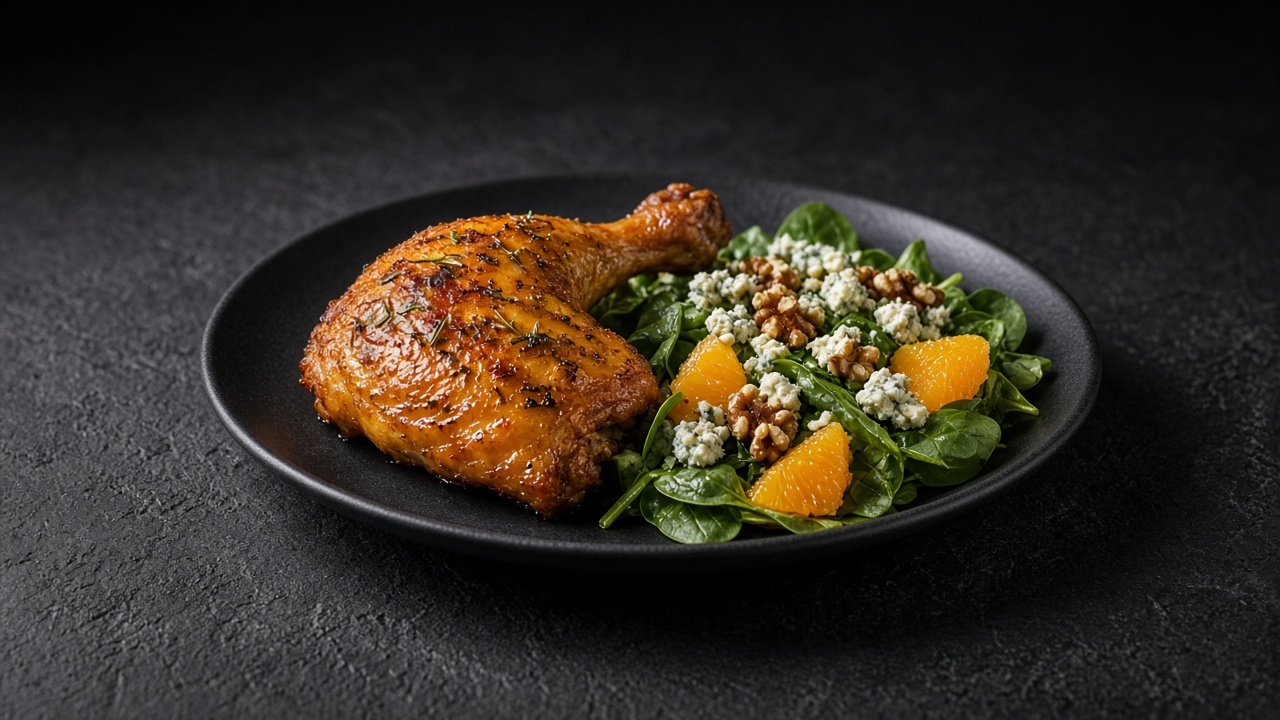
Orange-Glazed Chicken Legs with Spinach Salad
Inspired by techniques from Serious Eats.
Bone-in chicken legs are marinated in orange zest and rosemary, roasted skin side up, then brushed with a syrupy reduced orange and apricot glaze and finished under the grill. A simple spinach, walnut and blue cheese salad dressed with balsamic vinaigrette rounds out the plate.
Always check the labels of the products you use.
Method
- 1
Marinate the chicken. Whisk the orange zest, 2 tablespoons of the rosemary, olive oil, fine salt and pepper together in a small bowl. Rub the mixture all over the chicken legs, then seal in a bag or shallow dish and refrigerate for 2 hours, turning occasionally.
- 2
Roast the chicken. Set a rack in the upper-middle of the oven and heat to 230 °C (210 °C fan). Arrange the chicken skin side up on a rimmed baking tray. Roast until the skin is deep golden and the thickest part of the thigh reaches 79 °C, about 20 minutes.
- 3
Reduce the glaze. While the chicken roasts, bring the orange juice to a simmer in a small saucepan over medium heat and cook until reduced to about 120 ml, around 10 minutes. Stir in the remaining rosemary, the apricot jam and the fine salt, then keep cooking until syrupy and reduced to about 80 ml.
- 4
Glaze and grill. Brush the glaze generously over the chicken. Switch the oven to its grill setting and cook just until the glaze bubbles and browns, 1-2 minutes, watching closely so it doesn't scorch. Transfer to a plate and rest for 15 minutes.
- 5
Dress the salad and serve. Whisk the balsamic vinegar, Dijon mustard and fine salt together in a medium bowl, then slowly whisk in the olive oil until combined. Toss the spinach with the dressing, blue cheese, walnuts and orange segments. Season to taste with salt and pepper, and serve alongside the chicken.
Storage
Refrigerate leftover chicken and dressed salad separately in airtight containers; the chicken keeps for up to 3 days, but the salad is best eaten the same day as it wilts once dressed. Cool leftovers in a shallow container and refrigerate within 2 hours (within 1 hour on a day above 32°C).
EU nutrition claims
- Source of protein: 4 g protein per 100 kcal, about 16% of energy (needs ≥ 12%)
Per serving, from the nutrition table. Condition from the Annex to EU Regulation (EC) No 1924/2006. How we decide
Free sugars
17.7 g per serving
35.4 % of the 50 g daily maximum · 70.8 % of the ideal 25 g
Free sugars under 50 g a day, ideally about 25 g, based on WHO free-sugar guidance (not endorsed by WHO). The share shown is the share of one serving. WHO
Equipment
- fine grater or zester
- small bowl
- freezer bag or shallow dish
- rimmed baking tray
- small saucepan
- pastry brush
- whisk
- medium bowl
- instant-read thermometer
- chef's knife
- chopping board
Nutrition per serving (estimated values)
| Per serving | Amount |
|---|---|
| Energy | 933 kcal |
| Protein | 37.1 g |
| Carbohydrate | 33.2 g |
| of which sugars | 20.9 g |
| of which free sugars | 17.7 g |
| Fat | 73.9 g |
| of which saturates | 17.2 g |
| Fibre | 4.4 g |
| Salt | 2.76 g |
Protein per 100 kcal
4 g High Protein needs ≥ 5 g (20% of energy)
Calculated from USDA FoodData Central ingredient values