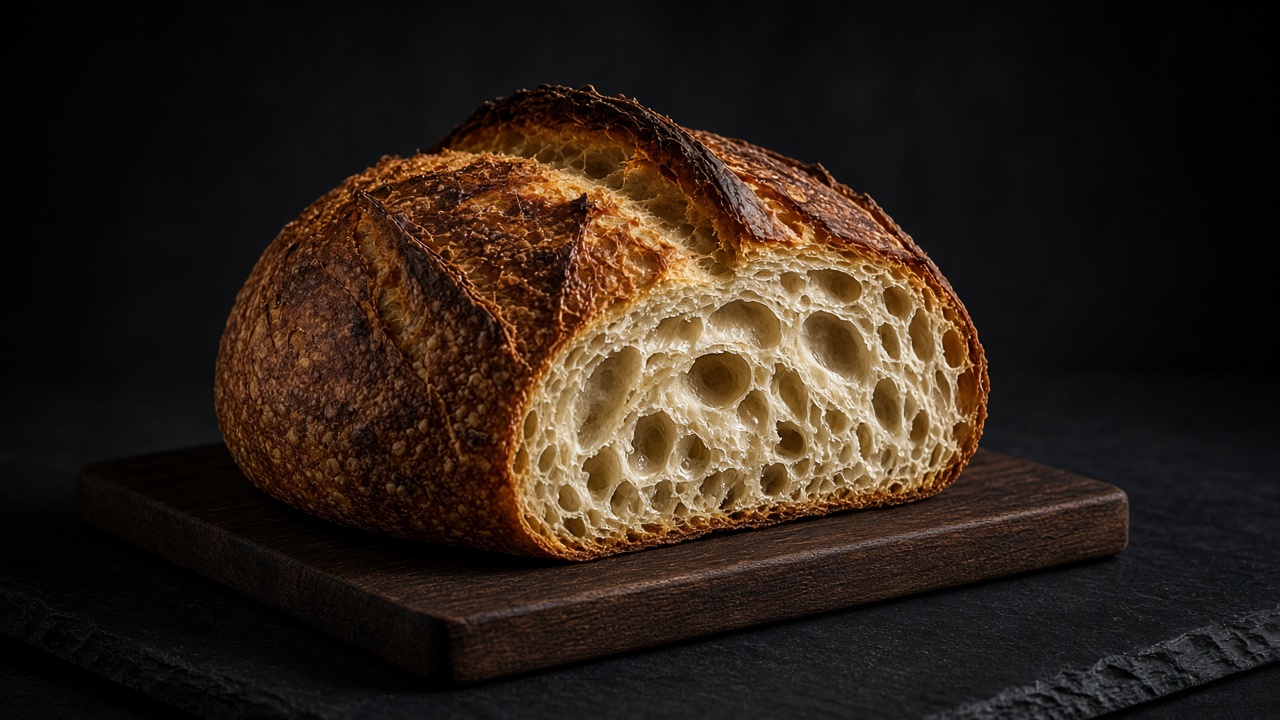
Pain de Campagne (Rustic Sourdough Boule)
Inspired by techniques from King Arthur Baking and America's Test Kitchen.
A slow-risen country sourdough boule with a touch of wholemeal, baked in a hot covered pot for a dark, crackling crust and an open, glossy crumb.
Always check the labels of the products you use.
Method
- 1
Build the levain. The evening before, stir the active starter with the 40 g bread flour, 10 g wholemeal flour and 50 ml water at about 26 °C until smooth. Cover and leave 8-12 hours at room temperature, until doubled and bubbly on top. A ripe levain gives the dough plenty of lift and a rounded, mild sourness.
- 2
Mix and rest. Stir the 450 g bread flour and 100 g wholemeal flour with the 370 ml water into a rough, shaggy dough. Cover and leave 30 minutes. This rest lets the flour drink up the water and start forming gluten on its own, so less work is needed later.
- 3
Add salt and levain. Scatter the salt over the dough, add the levain and the held-back water, then squeeze and fold everything together by hand until no dry streaks or pockets of levain remain. Adding the salt after the rest keeps it from tightening the dough too early.
- 4
Bulk rise with folds. Cover and leave for 4-5 hours at about 24-26 °C, giving 4 sets of stretch-and-folds during the first 2 hours, 30 minutes apart. The dough is ready when it has grown by about half, looks domed and shows bubbles at the edges. Folding builds strength gently, which is what supports an open, irregular crumb.
- 5
Shape the boule. Tip the dough out, pre-shape it into a loose round and rest it 20 minutes. Then shape firmly into a tight boule, building tension across the surface, and place it seam-up in the banneton dusted with rice flour. Rice flour has no gluten, so it does not stick to the damp dough.
- 6
Cold retard. Cover and refrigerate for 12-16 hours. The long chill deepens the flavour and firms the dough, making it far easier to score cleanly.
- 7
Preheat the pot. Put the lidded cast-iron pot in the oven and heat to 250 °C (230 °C fan) for 45 minutes. A thoroughly hot pot delivers a burst of heat to the base and traps the loaf's own steam for a big rise.
- 8
Score and bake. Turn the cold loaf onto baking paper, slash the top about 1 cm deep and lower it into the pot with the paper. Bake covered for 20 minutes, then uncover, lower the oven to 230 °C (210 °C fan) and bake 20-25 minutes more, until very dark brown all over and the centre reads about 96 °C. The loaf should sound hollow when tapped underneath.
- 9
Cool fully. Lift the loaf onto a wire rack and cool for at least 2 hours before cutting. The crumb is still setting as it cools, so slicing early leaves it gummy.
Storage
Keep the cooled loaf wrapped in a cloth or paper bag at room temperature for up to 3 days, cut side down on the board. Slice and freeze for up to 1 month, toasting from frozen.
EU nutrition claims
- Source of protein: 3.4 g protein per 100 kcal, about 14% of energy (needs ≥ 12%)
- Low fat: 2.5 g fat per 100 g (limit ≤ 3 g)
- Low saturated fat: 0.3 g saturated fat per 100 g, 0.5% of energy (limits ≤ 1.5 g and ≤ 10%)
- Low sugars: 0.6 g sugars per 100 g (limit ≤ 5 g)
Per 100 g of the finished dish, worked out from the nutrition per serving and the lowest likely cooked weight (about 36 g a serving), so the true values are, if anything, lower. Thresholds from the Annex to EU Regulation (EC) No 1924/2006. How we decide
Free sugars
0 g per serving
0 % of the 50 g daily maximum · 0 % of the ideal 25 g
Free sugars under 50 g a day, ideally about 25 g, based on WHO free-sugar guidance (not endorsed by WHO). The share shown is the share of one serving. WHO
Equipment
- large bowl
- dough scraper
- 23 cm round banneton or bowl lined with a floured cloth
- 4-5 litres cast-iron casserole with lid
- razor blade or very sharp knife
- baking paper
- instant-read thermometer
- wire rack
Nutrition per serving (estimated values)
| Per serving | Amount |
|---|---|
| Energy | 182 kcal |
| Protein | 6.2 g |
| Carbohydrate | 36.9 g |
| of which sugars | 0.2 g |
| of which free sugars | 0 g |
| Fat | 0.9 g |
| of which saturates | 0.1 g |
| Fibre | 2 g |
| Salt | 0.98 g |
Protein per 100 kcal
3.4 g High Protein needs ≥ 5 g (20% of energy)
Calculated from USDA FoodData Central ingredient values