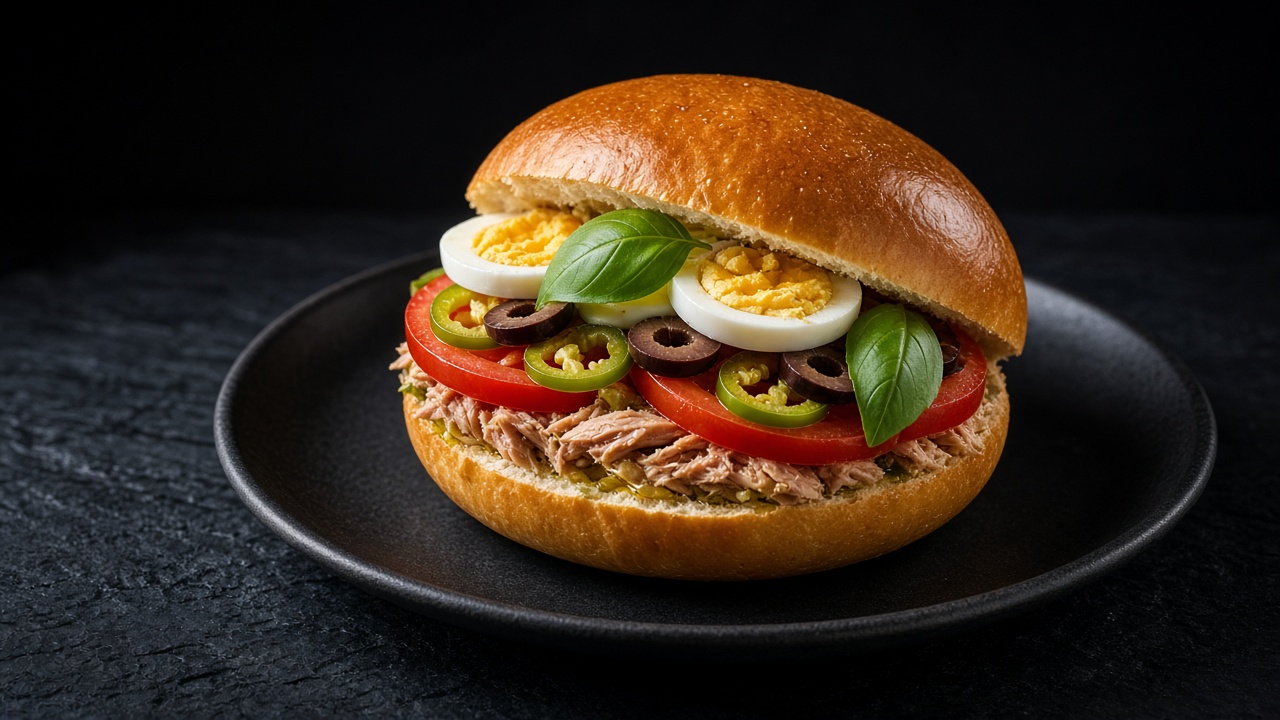
Pan Bagnat with Tuna, Egg and Olives
Inspired by techniques from America's Test Kitchen and NYT Cooking.
A crusty loaf is spread with an olive, caper and anchovy relish, filled with tuna, tomato, hard-cooked egg, rocket and basil, wrapped tightly and pressed for an hour.
Always check the labels of the products you use.
Method
- 1
Cook the eggs. Simmer 11 minutes, chill, peel and slice.
- 2
Soften the onion. Toss the red onion with vinegar, garlic and a pinch of salt.
- 3
Make the relish. Pulse the olives, parsley, capers, anchovies and mustard powder until coarsely chopped, then stir into the onion mixture with 4 tbsp of the oil and the pepper.
- 4
Prepare the bread. Heat the oven to 180 °C (160 °C fan). Split the loaf, hollow the bottom half slightly and toast cut side up for 5 minutes. Brush the insides with the remaining 2 tbsp oil.
- 5
Fill. Spread two-thirds of the relish in the bottom, then layer the tuna, tomato, egg, rocket and basil and top with the rest of the relish.
- 6
Press. Wrap tightly and weigh down for 1 hour before slicing.
Storage
Keep wrapped in the fridge and eat within 24 hours. Cool leftovers in a shallow container and refrigerate within 2 hours (within 1 hour on a day above 32°C).
Why this label?
21.1 g protein for 407 kcal = 5.2 g per 100 kcal, so protein gives about 21% of the energy. High Protein needs at least 20% (5 g per 100 kcal), the condition in the Annex to EU Regulation (EC) No 1924/2006. How we decide
EU nutrition claims
- Low sugars: 3.1 g sugars per 100 g (limit ≤ 5 g)
Per 100 g of the finished dish, worked out from the nutrition per serving and the lowest likely cooked weight (about 142 g a serving), so the true values are, if anything, lower. Thresholds from the Annex to EU Regulation (EC) No 1924/2006. How we decide
Free sugars
2.5 g per serving
5 % of the 50 g daily maximum · 10 % of the ideal 25 g
Free sugars under 50 g a day, ideally about 25 g, based on WHO free-sugar guidance (not endorsed by WHO). The share shown is the share of one serving. WHO
Equipment
- small saucepan
- bowl of iced water
- oven
- food processor or sharp knife
- 2 bowls
- bread knife
- cling film
- baking tray and a heavy pan or tins to weigh
Nutrition per serving (estimated values)
| Per serving | Amount |
|---|---|
| Energy | 407 kcal |
| Protein | 21.1 g |
| Carbohydrate | 32.1 g |
| of which sugars | 4.4 g |
| of which free sugars | 2.5 g |
| Fat | 21.7 g |
| of which saturates | 3.8 g |
| Fibre | 2.3 g |
| Salt | 1.82 g |
Protein per 100 kcal
5.2 g meets High Protein (≥ 5 g, 20% of energy)
Calculated from USDA FoodData Central ingredient values