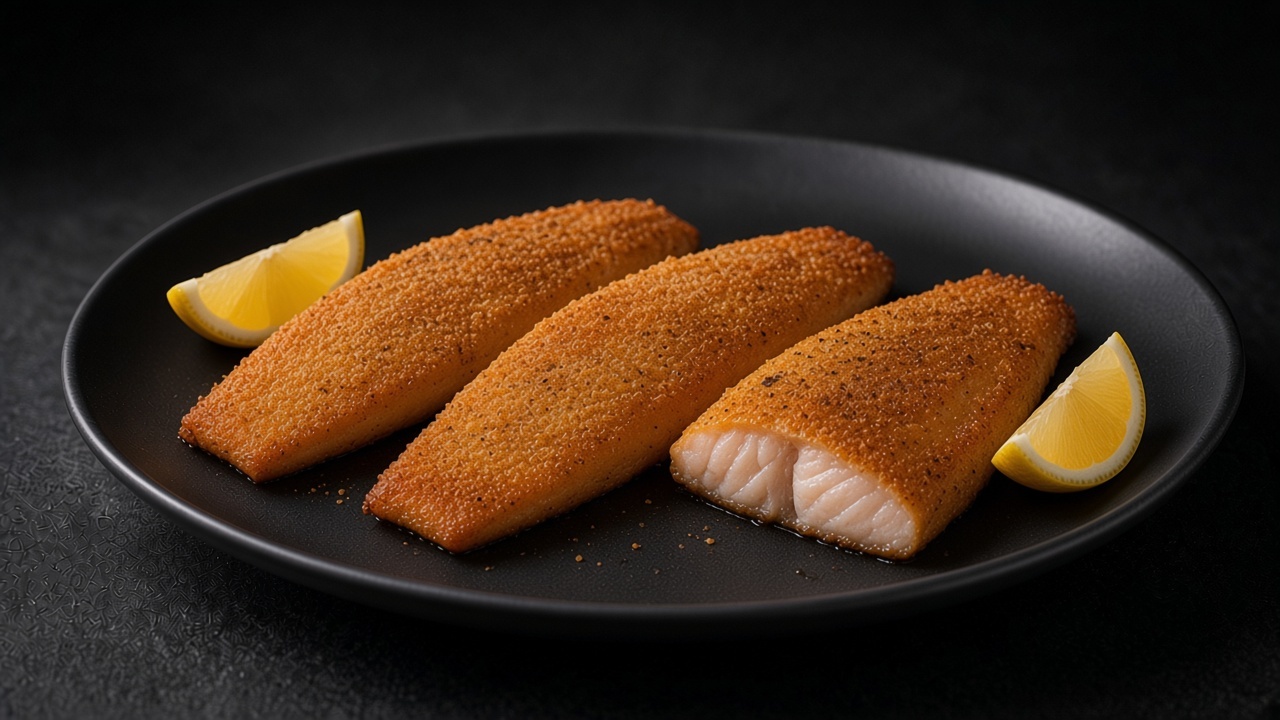
Pan-Fried Trout
Inspired by techniques from America's Test Kitchen.
Whole trout fillets are dredged in flour, dipped in egg and coated in a cornmeal-and-cayenne crust, then fried in batches until deep golden and crisp. Breading and frying in stages keeps the oil hot and the crust shatteringly crisp while the trout underneath stays moist.
Always check the labels of the products you use.
Method
- 1
Set up the stations. Set a wire rack over a rimmed baking tray, slide it onto the middle oven rack and heat the oven to 95 °C (80 °C fan) to hold the fried fish warm. Put the plain flour in one wide, shallow dish. In a second dish, mix the remaining flour with the cornmeal, salt, pepper and cayenne. In a third dish, whisk the eggs with the tablespoon of oil until smooth.
- 2
Bread the fillets. Pat the trout fillets dry with kitchen paper and season both sides with the salt and pepper for the fish. Drop each fillet into the plain flour and shake off the excess. Using tongs, dip into the egg mixture, letting the excess drip off, then coat in the cornmeal mixture, pressing gently so it sticks and shaking off anything loose. Lay the breaded fillets on a second wire rack.
- 3
Fry in two batches. Pour the frying oil into a heavy-bottomed pot to a depth of about 1.3 cm and heat over high heat to 204 °C. Lay two fillets in the oil and fry, turning once, until deep golden brown, about 4 minutes total, adjusting the heat to keep the oil between 196-199 °C. Lift out with a slotted spoon onto kitchen paper to blot, then transfer to the rack in the warm oven.
- 4
Finish and serve. Bring the oil back up to 204 °C and fry the remaining two fillets the same way. Serve the fried trout straight away with lemon wedges.
Storage
Best eaten hot and crisp, within the day it is fried, as the coating softens on standing. Cool leftovers in a shallow container and refrigerate within 2 hours (within 1 hour on a day above 32°C); reheat in a hot oven to re-crisp rather than in a microwave.
Why this label?
40.5 g protein for 604 kcal = 6.7 g per 100 kcal, so protein gives about 27% of the energy. High Protein needs at least 20% (5 g per 100 kcal), the condition in the Annex to EU Regulation (EC) No 1924/2006. How we decide
EU nutrition claims
- Low sugars: 0.5 g sugars per 100 g (limit ≤ 5 g)
Per 100 g of the finished dish, worked out from the nutrition per serving and the lowest likely cooked weight (about 118 g a serving), so the true values are, if anything, lower. Thresholds from the Annex to EU Regulation (EC) No 1924/2006. How we decide
Free sugars
0 g per serving
0 % of the 50 g daily maximum · 0 % of the ideal 25 g
Free sugars under 50 g a day, ideally about 25 g, based on WHO free-sugar guidance (not endorsed by WHO). The share shown is the share of one serving. WHO
Equipment
- wire racks
- rimmed baking tray
- 3 wide shallow dishes
- whisk
- tongs
- heavy-bottomed pot or Dutch oven
- deep-fry or instant-read thermometer
- slotted spoon
- kitchen paper
Nutrition per serving (estimated values)
| Per serving | Amount |
|---|---|
| Energy | 604 kcal |
| Protein | 40.5 g |
| Carbohydrate | 33.9 g |
| of which sugars | 0.6 g |
| of which free sugars | 0 g |
| Fat | 33 g |
| of which saturates | 6.1 g |
| Fibre | 1.6 g |
| Salt | 2.47 g |
Protein per 100 kcal
6.7 g meets High Protein (≥ 5 g, 20% of energy)
Calculated from USDA FoodData Central ingredient values