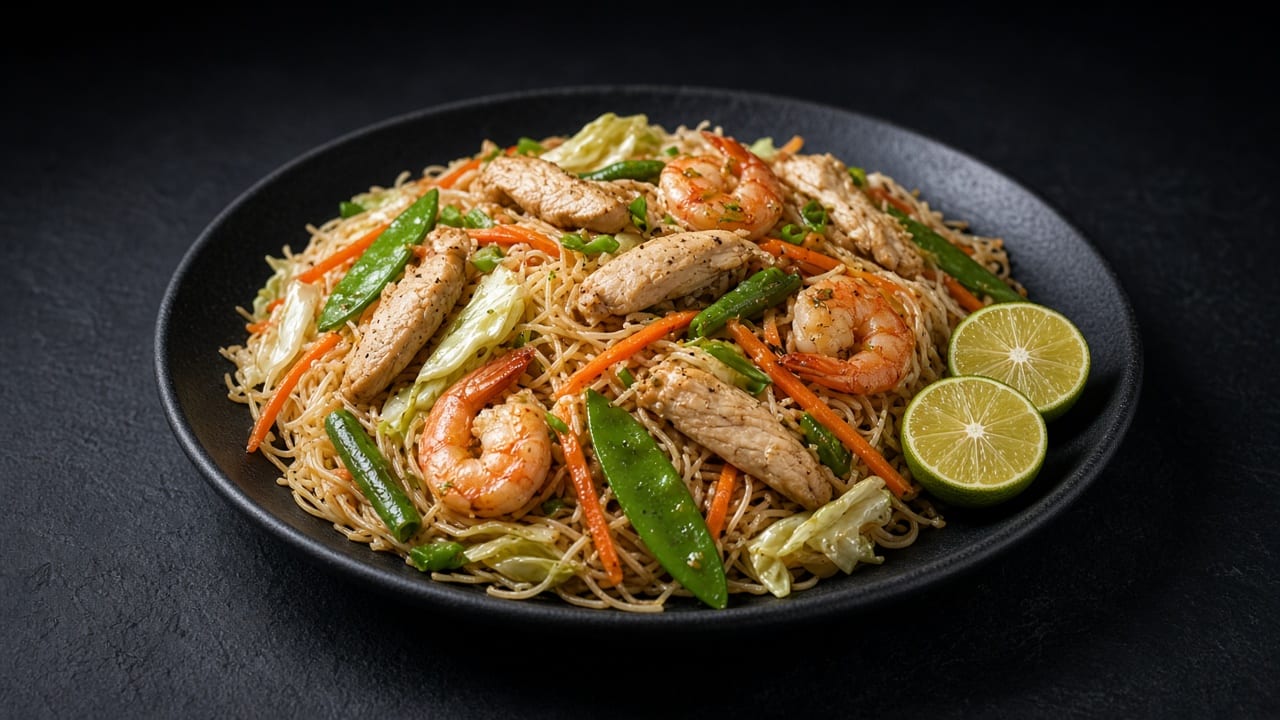
Pancit Bihon (Filipino Rice Vermicelli with Chicken and Vegetables)
Inspired by techniques from Serious Eats and NYT Cooking.
Fine rice vermicelli stir-fried with chicken, prawns and crunchy vegetables in a light soy and oyster sauce broth, a classic Filipino noodle dish for sharing.
Always check the labels of the products you use.
Method
- 1
Soak the vermicelli. Soak the rice vermicelli in warm water for 8-10 minutes, just until the strands turn pliable but not fully soft, then drain and snip into shorter lengths with scissors. Stopping the soak early matters, since over-softened bihon turns mushy as soon as it hits the hot wok.
- 2
Cook chicken and prawns. Heat 1 tbsp of oil in the wok over medium-high heat and stir-fry the chicken for 4-5 minutes until no pink remains and it reaches 74°C at the thickest point, then add the prawns and cook for a further 1-2 minutes until opaque. Lift everything out onto a plate so it doesn't overcook while you move on to the vegetables.
- 3
Soften garlic and onion. Add the remaining oil, garlic and onion to the wok and stir-fry for 1-2 minutes until lightly golden. Cooking these first builds a fragrant base that the vegetables and noodles will cook into.
- 4
Stir-fry the vegetables. Add the carrots, mangetout and cabbage and stir-fry for 2 minutes until bright and just tender, then scoop them out and set aside with the chicken and prawns. Keeping everything crisp at this stage means it won't turn soft and grey once it goes back in with the noodles.
- 5
Simmer the noodles. Pour the stock, water, oyster sauce and soy sauce into the wok and bring to the boil, then add the drained noodles and toss for 3-4 minutes until they turn translucent and have absorbed the liquid. Letting the vermicelli cook directly in the seasoned liquid is what gives pancit bihon its savoury depth right through the noodle rather than just on the surface.
- 6
Combine and finish. Return the chicken, prawns and vegetables to the wok and toss for 1 minute until everything is heated through and evenly mixed. Scatter over the spring onions and serve with calamansi or lime wedges on the side.
Storage
Keep in an airtight container in the fridge for up to 3 days. Reheat gently in a pan with a splash of water, or in the microwave, until piping hot (74°C) throughout; freezing isn't recommended as the fine noodles turn soft and clumpy once thawed. Cool leftovers in a shallow container and refrigerate within 2 hours (within 1 hour on a day above 32°C).
Why this label?
33.8 g protein for 482 kcal = 7 g per 100 kcal, so protein gives about 28% of the energy. High Protein needs at least 20% (5 g per 100 kcal), the condition in the Annex to EU Regulation (EC) No 1924/2006. How we decide
EU nutrition claims
- Low saturated fat: 0.6 g saturated fat per 100 g, 3.4% of energy (limits ≤ 1.5 g and ≤ 10%)
- Low sugars: 1.8 g sugars per 100 g (limit ≤ 5 g)
Per 100 g of the finished dish, worked out from the nutrition per serving and the lowest likely cooked weight (about 312 g a serving), so the true values are, if anything, lower. Thresholds from the Annex to EU Regulation (EC) No 1924/2006. How we decide
Free sugars
0.1 g per serving
0.2 % of the 50 g daily maximum · 0.4 % of the ideal 25 g
Free sugars under 50 g a day, ideally about 25 g, based on WHO free-sugar guidance (not endorsed by WHO). The share shown is the share of one serving. WHO
Equipment
- large heatproof bowl
- wok (35 cm) or large non-stick frying pan (30 cm)
- wok spatula or tongs
- small bowls for the prepared ingredients
Nutrition per serving (estimated values)
| Per serving | Amount |
|---|---|
| Energy | 482 kcal |
| Protein | 33.8 g |
| Carbohydrate | 58.6 g |
| of which sugars | 5.6 g |
| of which free sugars | 0.1 g |
| Fat | 11.8 g |
| of which saturates | 1.8 g |
| Fibre | 4.4 g |
| Salt | 2.68 g |
Protein per 100 kcal
7 g meets High Protein (≥ 5 g, 20% of energy)
Calculated from USDA FoodData Central ingredient values